

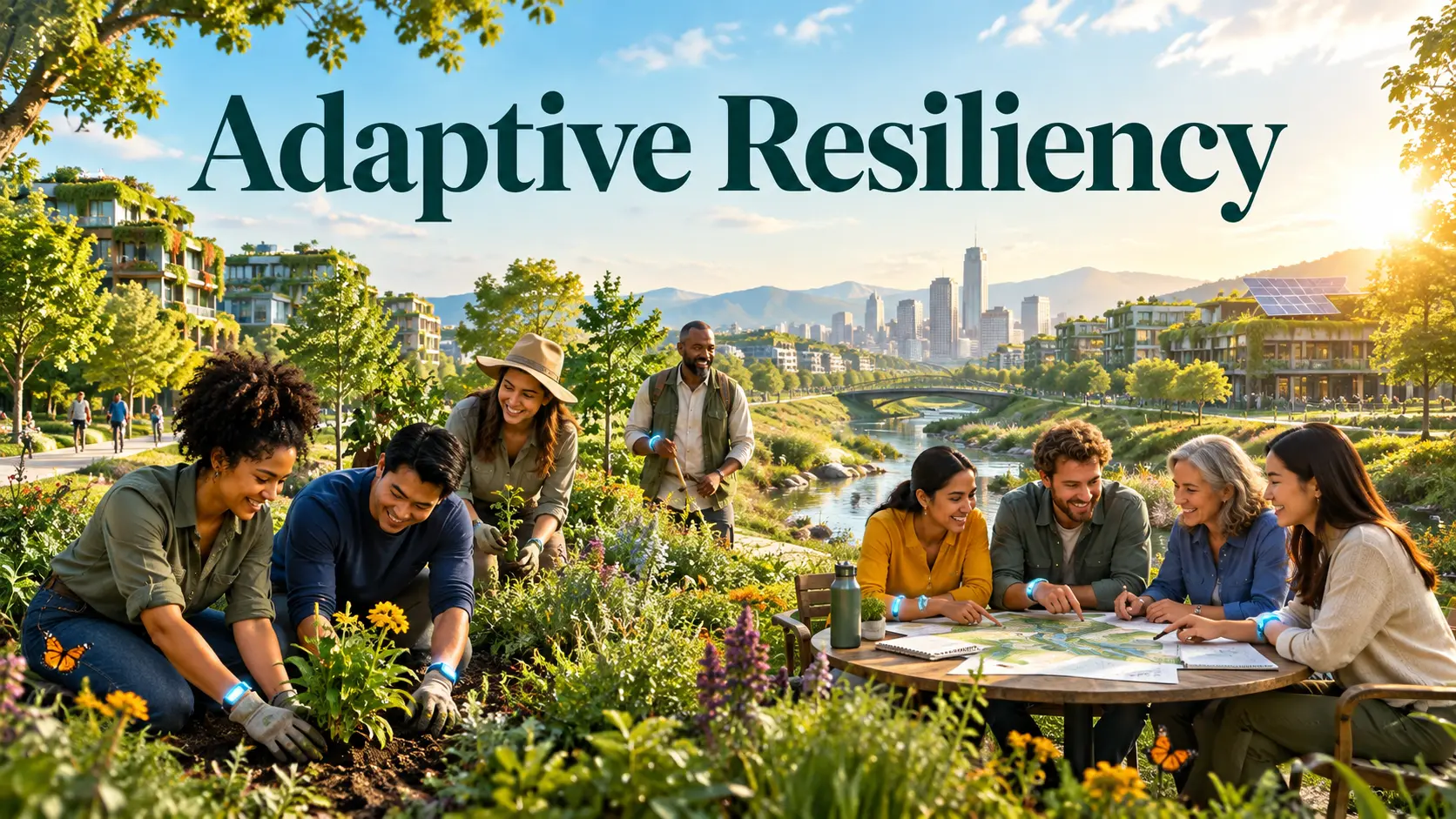
Adaptation and Resiliency: The Climate Response Our Times Now Demand
 Preparing, adjusting, recovering, and transforming must now become everyday climate practice
For decades, climate conversations focused mainly on prevention: cut emissions, protect ecosystems, shift energy systems. That work remains essential, and mitigation is still non-negotiable. But the climate and ecological emergency is no longer a future threat. It is here, and we must also become far better at living through disruption while reducing the harm it causes.
That is where adaptation and resiliency meet.
Adaptation Is the Adjustment. Resiliency Is the Capacity.
Adaptation asks: What is changing, who is at risk, and what must we do differently? It means redesigning stormwater systems, opening cooling centers, restoring wetlands, updating building standards, strengthening emergency communication, and helping residents understand local climate risks.
Resiliency asks: When disruption comes, can we absorb the shock, protect the most vulnerable, keep essential services running, recover fairly, and improve? It is not about bouncing back to the way things were, because the old normal is often what made communities vulnerable in the first place. True resiliency means bouncing forward into safer, fairer, more flexible systems.
Adaptation without resiliency becomes a checklist of short-term fixes. Resiliency without adaptation becomes vague optimism. Together, they form a living strategy for self-preservation and collective preservation in an unstable world.
Why the Times Demand It Now
Climate impacts rarely arrive alone. A heat wave stresses the power grid, endangers health, damages crops, and deepens inequality. A flood reaches roads, schools, housing, insurance, mental health, and trust in institutions. The climate crisis is not one problem. It is a pressure system acting on every system we depend on.
The global response is not keeping pace. The United Nations Environment Programme’s Adaptation Gap Report 2025: Running on Empty found that developing countries will need an estimated $310–365 billion per year for adaptation by 2035. International public adaptation finance actually fell, to about $26 billion in 2023. Needs now exceed funding by roughly 12 to 14 times.
Delay is costly. Every year of waiting is paid for in damaged homes, displaced families, overwhelmed emergency services, and lost trust. And some places and ecosystems can be pushed beyond what gradual adjustment can protect. The earlier we act, the more options remain.
The Cycle of Adaptive Resiliency
Adaptive resiliency works in cycles:
- Observe: Track local risks, climate data, lived experience, and early warning signs.
- Prepare: Build plans, skills, supplies, relationships, and policies before crisis arrives.
- Absorb: Keep people safe and essential functions running during disruption.
- Recover: Restore stability in ways that are fair and inclusive.
- Learn: Review honestly what worked, what failed, and who was left behind.
- Transform: Change the conditions that created vulnerability in the first place.
The future will not repeat the past. Old assumptions about seasons, water, food, insurance, and public health are becoming unreliable. This cycle lets communities keep updating their response as conditions change.
Four Levels, One Strategy
- Personal: Climate literacy, preparedness habits, health awareness, and trusted information.
- Neighborhood: Mutual aid, communication networks, shared resources, and safe gathering places.
- Institutional: Continuity plans and climate-informed decisions in schools, businesses, hospitals, utilities, nonprofits, and local government.
- Ecological: Healthy trees, wetlands, soils, waterways, and biodiversity, because nature itself is a frontline defense.
When these levels connect, the result is not fear-based survivalism. It is community intelligence: cooperation under pressure, and the ability to face hard truths without freezing.
What It Looks Like in Practice
- Make climate education accessible, local, and continuous.
- Map who is most exposed to heat, flooding, poor air, food insecurity, or isolation.
- Build communication networks before emergencies, not during them.
- Plan infrastructure for future climate conditions, not historical averages.
- Treat nature-based solutions as essential protection, not beautification.
- Build redundancy into food, water, energy, healthcare, and information systems, with backup options and support for those with the fewest resources.
- Use digital tools, including AI, to analyze risk, organize information, and coordinate, always guided by human judgment, local knowledge, transparency, and justice.
Above all, preparedness is rooted in relationships. A prepared community is not just a place with supplies. It is a place where people know how to reach one another, share trusted information, protect vulnerable neighbors, and cooperate when systems are strained.
The Future Belongs to Prepared Communities
Adaptation is the method. Resiliency is the muscle. Together, they form the practice of adaptive resiliency.
Focusing on them is not surrender to climate change. It is a refusal to be passive. We reduce emissions to limit future harm. We adapt to reduce present harm. We build resiliency to protect life, dignity, continuity, and hope through the disruptions already unfolding.
No one can climate-proof a community alone. But we can learn together, organize together, prepare together, and demand better decisions together. The work is serious, but it is not hopeless.