This is Version #2 – Version #1 can be found at my personal site…
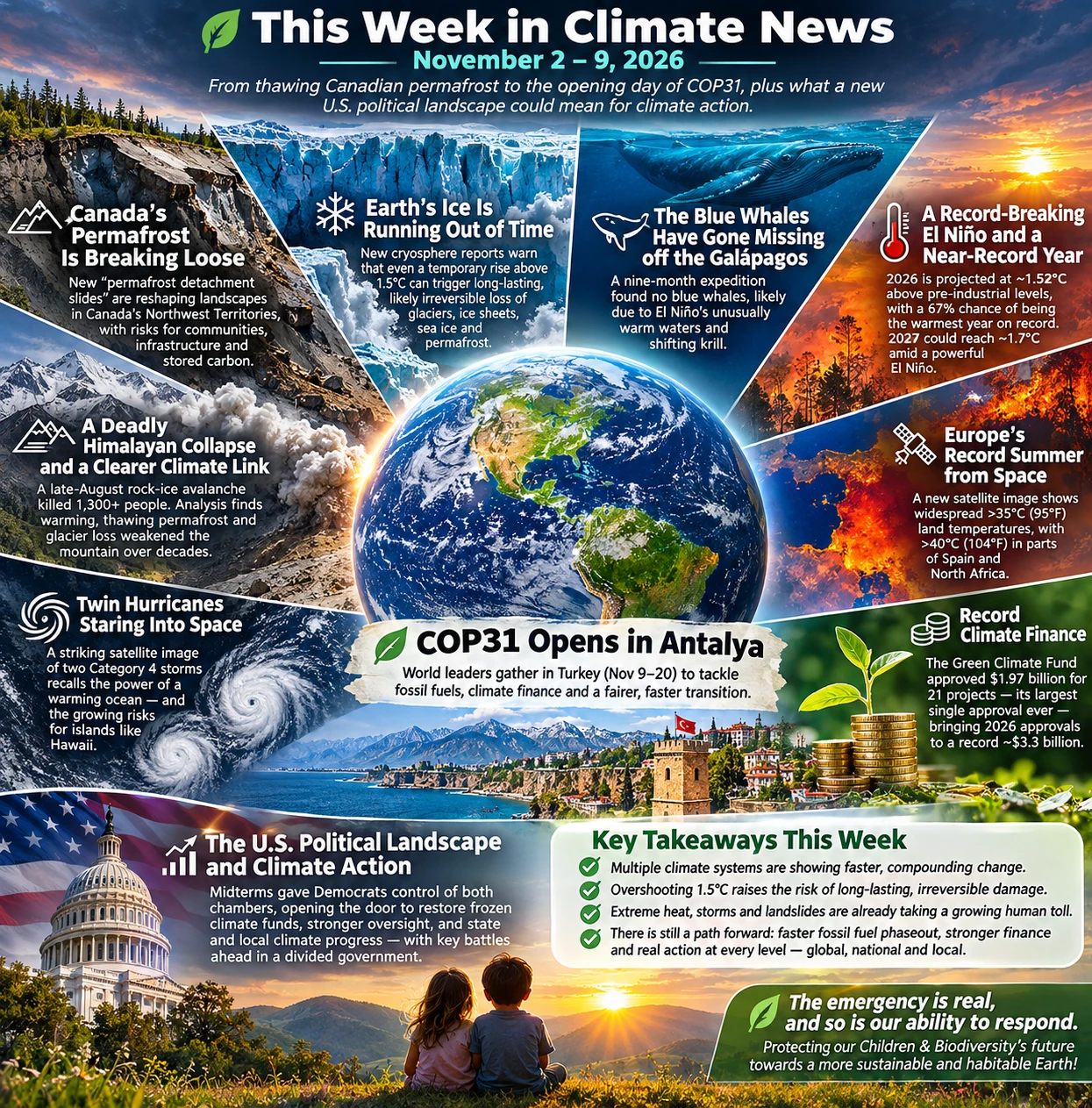
From thawing Canadian permafrost to the opening day of COP31, plus Climate Change Community’s take on what a new U.S. political landscape could mean for climate action.
Opening Thoughts
This was one of those weeks where the headlines piled up faster than any of us could keep up with. The planet sent us warnings from the Arctic, the Pacific, the Himalayas and the Mediterranean. World leaders gathered in Antalya, Turkey for COP31. And here at home in the United States, voters reshaped the political map in ways that could change the direction of climate policy. Let’s walk through it together, one story at a time.
Canada’s Permafrost Is Breaking Loose
In Canada’s Northwest Territories, researchers have identified what they are calling a new type of landslide: “permafrost detachment slides.” In the Johnson River and Redstone River valleys, ground that had been frozen and stable for a very long time gave way, carrying blocks of frozen earth some 10 meters tall, roughly the size of a house. The 2017 Johnson River slide moved about 18 million cubic meters of soil and rock, and the 2018 Redstone River slide moved about 4.5 million. Both dammed rivers, created new lakes and sent sediment downstream. The research, led by Joseph Young through the University of Alberta and published in Geophysical Research Letters, points to a chain reaction. Permafrost in the area has warmed about 0.3°C per decade since 1980. A severe wildfire in 1995 opened the door, and over roughly 20 years, thaw worked its way about 20 meters down until meltwater reached the base of the frozen layer. More than 150 similar slides have been found in the region. Young described the change as stable ground that suddenly “flipped a switch.”
Why It Matters
This is the compounding effect we talk about so often: heat plus wildfire plus time. The researchers warn that deep permafrost in other parts of Canada and Alaska may be vulnerable too, especially as northern wildfires intensify. Thawing permafrost doesn’t just reshape landscapes; it threatens roads, homes and the stored carbon that, once released, feeds even more warming.
Earth’s Ice Is Running Out of Time: The Cryosphere Reports
Speaking of frozen ground, on November 2 the International Cryosphere Climate Initiative (ICCI) and the UN Environment Programme released two reports: “Overshoot and the Cryosphere: Averting Global Meltdown” and “State of the Cryosphere 2026: The Cost of Overshoot.” Their central warning is sobering. Even a temporary rise above the Paris Agreement’s 1.5°C target can trigger long-lasting and, in most cases, irreversible changes to glaciers, ice sheets, sea ice and permafrost on any timescale that matters to human beings. The reports note that the Greenland and Antarctic ice sheets are now melting about six times faster than in the 1990s. The reports also leave a door open. Limiting how high warming peaks, keeping any overshoot as short as possible, and getting back below 1.5°C by speeding the transition away from fossil fuels can still reduce the damage. For coastal communities, including those of us here on the U.S. East Coast watching sea level rise, this is not abstract science. It is our future shoreline.
The Blue Whales Have Gone Missing off the Galápagos
A nine-month expedition from October 2025 through July 2026, led by Daniela Alarcón of the Universidad San Francisco de Quito’s Galápagos campus, searched waters where blue whales have long been recorded. The team found none and tagged none. Sea surface temperatures reached 28°C (82°F), and at 100 meters deep the water ran up to 5°C warmer than normal for the season. Scientists suspect this year’s powerful El Niño pushed the krill that blue whales depend on away from the islands. A single blue whale can eat up to 5,500 kilograms of krill a day, so when food moves, whales move too, possibly south toward Peru’s colder, richer waters. To be fair to the science, krill wasn’t measured directly, and the article does not attribute this event directly to climate change. There is hopeful history here, though: whales shifted south during the 1982–83 El Niño and came back after the 2015 and 2023 events. Researchers expect more warm water in early 2027 and a possible return around 2028.
Why It Matters
When one of the largest animals that has ever lived simply disappears from its feeding grounds, it reminds us how tightly every part of the ocean food web is connected. Biodiversity doesn’t only suffer from slow trends; it also suffers from sudden shocks. And a warming world loads the dice for stronger shocks.
A Record-Breaking El Niño and a Near-Record Year
That El Niño is now a story of its own. Carbon Brief’s latest quarterly update (November 3) projects that 2026 will finish around 1.52°C above pre-industrial levels, with a 67% chance of edging out 2024 as the warmest year on record. Model forecasts suggest this El Niño could peak around 4°C in December, more than 1°C above the previous record. Its biggest effect on global temperatures will land in 2027, which Carbon Brief projects at around 1.7°C, with a 96% chance of becoming the warmest year ever measured. Not every agency reads the numbers the same way. The EU’s Copernicus Climate Change Service said this week that 2026 is most likely to be the second-hottest year, with about a 20% chance of tying or beating 2024. Either way, the direction is the same, and Copernicus says the 2023–2026 average is expected to top 1.5°C.
WMO: Planetary Extremes Are “Off the Charts”
On November 9, as COP31 opened, the World Meteorological Organization released a new report covering January 2025 to September 2026. Its key findings:
- Twelve years, twelve records: The past 12 years are the 12 warmest on record, and January–September 2026 ran about 1.47°C above pre-industrial levels.
- Greenhouse gases: Carbon dioxide, methane and nitrous oxide hit record levels in 2025 and kept rising in 2026.
- Seas and ice: Sea level reached a record high in 2026, and in 2025 glaciers lost enough ice to fill five Olympic-sized pools every second for a full year.
- Human toll: Summer 2026 European heat waves are estimated to have killed more than 50,000 people, likely an undercount. Flooding in Vietnam and a weak monsoon in India hurt food production and livelihoods.
- Looking ahead: The WMO expects this year’s extremes to carry into 2027 as El Niño continues.
The report also points to the late-August rock-ice avalanche on the Nepal-China border, which killed more than 1,300 people. A World Weather Attribution analysis in September found that warming had weakened the mountain over decades by thawing permafrost and shrinking the glacier, alongside the lasting damage from the 2015 earthquake. The flood reached the border in about seven minutes, far faster than the warning system could respond. Notice the thread connecting this to Canada: in both places, thawing permafrost is turning once-solid mountains and valleys into hazards.
Looking Back: Europe’s Record Summer from Space
Live Science recently shared (October 20) a striking Sentinel-3B satellite image of Southern Europe and North Africa taken on June 23, 2026, at the height of a record-breaking heat wave. Land temperatures topped 35°C (95°F) across most of Spain and parts of France and Italy, with patches in Spain and North Africa above 40°C (104°F), while Mediterranean sea surface temperatures spiked. According to the WMO, June 2026 was Western Europe’s hottest June on record, averaging 20.7°C (69°F). What stayed with us was the reaction of Simonetta Cheli, ESA’s director of Earth observation programs. Rather than despair, she said the image makes her feel “that we can do a lot about it.” That is exactly the spirit of Adaptive Resiliency: see the data clearly, then act on it.
Bonus: Twin Hurricanes Staring Into Space
Not every story this week was new. Live Science republished a remarkable 2016 Suomi NPP satellite image of Hurricanes Madeline and Lester, each having reached Category 4 strength, lined up and heading toward Hawaii’s Big Island. Both storms ended up largely sparing the islands. The piece notes that human-caused climate change is shifting regional weather patterns, which may change how lucky Hawaii stays in future hurricane seasons. Mostly, it’s simply a beautiful reminder of how much our satellites let us see, and why keeping Earth observation funded matters.
COP31 Opens in Antalya
The UN’s COP31 climate conference runs November 9–20 in Antalya, Turkey, with Turkey hosting and Australia’s climate minister, Chris Bowen, presiding over the negotiations. The big questions are familiar ones: how fast to move away from fossil fuels, and who pays to help vulnerable countries adapt and recover. Last year’s COP30 final agreement in Belém didn’t even mention fossil fuels, so the bar for progress is low and the pressure is high. Pacific island nations and others are pushing for a clearer global roadmap away from coal, oil and gas.
Brazil Delivers Its Roadmaps
Ahead of the talks, Brazil’s outgoing COP30 presidency published two voluntary roadmaps this week: one for transitioning away from fossil fuels and one for halting and reversing deforestation by 2030. They sit outside the formal UN negotiations, but they give countries a menu of actions they can start now, such as reforming fossil fuel subsidies and stopping methane leaks. Some European governments have signaled support for using them in the next global assessment of climate progress, which concludes in 2028. Brazil also released guidelines for its own national fossil fuel transition plan.
Record Climate Finance
The Green Climate Fund approved $1.97 billion for 21 projects at its latest board meeting, its largest single approval ever, bringing 2026 approvals to a record of about $3.3 billion. This is money directed to developing countries that are least responsible for the crisis and most exposed to it.
Climate Change Community’s Take: What a New U.S. Political Landscape Could Mean for Climate
The votes have been counted, or very nearly. Last week’s midterm elections gave Democrats majorities in both the House and the Senate, and full control of state government in Wisconsin, Arizona and Pennsylvania, according to election analysts. But we want to look past the scoreboard of who won and who lost. What matters to us is what happens next for our climate, our communities and our everyday lives. Here is what stood out to us: climate shaped this election even when nobody called it climate. Rising electricity bills, fuel prices and the rapid growth of power-hungry data centers were among the most talked-about issues in many races. In dozens of towns, voters passed pauses or bans on data centers. In Georgia, Democrats won majority control of the Public Service Commission, which regulates Georgia Power, for the first time in about 30 years. In Colorado, a measure to enshrine a “right” to natural gas in the state constitution failed, while voters in several regions approved new funding for public transit and passenger rail. In North Carolina’s mountain district hit hard by Hurricane Helene, a candidate won by campaigning on the slow pace of recovery. Energy affordability, utility power and disaster recovery are climate issues, and voters treated them as such.
What Could Change
- Restored funding: The new Congress could use spending bills to push back against frozen climate funds, such as the $7 billion EPA community solar program and halted Department of Energy clean hydrogen and low-carbon cement projects.
- Oversight: With control of both chambers, the new majority can hold hearings, issue subpoenas and examine federal rollbacks of climate and environmental protections.
- Clean energy tax credits: Some lawmakers may try to bring back clean energy tax credits that were repealed last year.
- State and local action: This may be where the biggest changes happen. States with new unified leadership could pass meaningful climate and clean energy laws, in some cases for the first time.
A Dose of Realism
We want to be honest with our community. The White House has not changed hands, and any new federal climate law still needs the President’s signature. Analysts expect two years of divided government, more oversight and budget battles than sweeping new legislation. Many newly elected leaders also support an “all-of-the-above” energy approach that keeps oil and gas in the mix, and they are talking about clean energy mainly in terms of affordability rather than climate. A single election does not change the fact that the physics of a warming planet keeps moving, regardless of who holds office.
Where We Stand
Climate Change Community’s hope is simple: that the direction of U.S. climate policy not only turns around but speeds up, because, as this week’s science shows, faster action is no longer optional. It is a necessity. We will be watching closely: what the new Congress funds, what state legislatures pass, what utility commissions decide about our electric bills, and whether the data center boom is powered by clean energy or by more fossil fuels. Elected leaders respond to engaged, informed people. That’s us. Over the coming months, we will keep covering U.S. climate news more closely here and in the Climate News Space in The Commons on Climate Tribe Social. Learning together and holding leaders of every party accountable is how climate concern becomes climate competence.
Closing Thoughts
Permafrost slides in Canada. Missing whales in the Galápagos. A record El Niño. A deadly Himalayan collapse. Irreversible ice loss if we overshoot. And yet, record climate finance, a fossil fuel roadmap on the table at COP31, and voters at home who made energy costs and community wellbeing a deciding issue. The emergency is real, and so is our ability to respond. As Simonetta Cheli reminded us, we can still do a lot about it. Read posts at climatechangecommunity.com
Sources
- Live Science: Permafrost landslides in Canada — https://www.livescience.com/planet-earth/climate-change/a-potential-glimpse-into-the-future-climate-change-has-triggered-permafrost-landslides-with-house-size-blocks-of-ice-in-canada
- Live Science: Twin hurricanes toward Hawaii — https://www.livescience.com/planet-earth/weather/twin-hurricanes-stare-out-to-space-as-they-barrel-toward-hawaii-earth-from-space
- Live Science: Blue whales missing off the Galápagos — https://www.livescience.com/animals/whales/blue-whales-have-gone-missing-off-the-galapagos-scientists-think-el-nino-could-be-why
- Live Science: Europe’s summer heat from space — https://www.livescience.com/planet-earth/weather/it-makes-me-feel-that-we-can-do-a-lot-about-it-esa-official-shares-striking-satellite-snap-of-europes-record-breaking-summer-heat-waves-earth-from-space
- Carbon Brief: State of the climate — https://www.carbonbrief.org/state-of-the-climate-2026-likely-to-tie-with-2024-as-the-warmest-year-on-record
- CNN via ABC17: WMO report as COP31 opens — https://abc17news.com/cnn-other/2026/11/09/planetary-extremes-are-off-the-charts-as-worlds-biggest-climate-talks-kick-off/
- Korea Times: Copernicus 2026 outlook — https://www.koreatimes.co.kr/world/20261106/2026-most-likely-to-be-second-hottest-year-on-record-eu-monitor
- IFLScience: Cryosphere overshoot reports — https://www.iflscience.com/overshooting-15c-of-global-warming-could-lock-in-centuries-of-damage-to-earths-icy-regions-85088
- Dhaka Tribune: Nepal mountain collapse attribution — https://www.dhakatribune.com/world/asia/420107/how-climate-change-worsened-nepal-s-deadly
- Climate Home News: Brazil’s fossil fuel roadmap — https://climatechangenews.com/2026/11/03/brazils-fossil-fuel-roadmap-sketches-out-first-global-timetable
- Green Climate Fund: Record approvals — https://www.greenclimate.fund/about/news-and-updates/gcf-financing-tops-usd-3-billion-consecutive-record-year-reforms-continue-deliver
- Grist: What a blue wave midterm means for climate — https://grist.org/elections/midterms-2026-blue-wave-climate-races-data-centers/
- MIT Technology Review: U.S. energy policy after the midterms — https://www.technologyreview.com/2026/11/04/1148022/us-energy-midterm/
- TIME: What experts think the blue wave means for climate — https://time.com/article/2026/11/04/democrats-midterms-win-climate-action/
Protecting our Children & Biodiversity’s future towards a more sustainable and habitable Earth! Compiled & Mr. Alvarez’s Thoughts | AI Enhanced. A note on AI: Artificial intelligence was used to enhance my creativity and thinking in researching and drafting this post. The perspectives, choices and responsibility for what is shared here remain my own.