Why a nationwide aviation failure is a warning about how we are handling the Climate, Ecological, and Displacement Emergencies
On Friday afternoon, November 13, 2026, the skies over the United States went quiet.
At 3:54 p.m. Eastern, the Federal Aviation Administration ordered every departing flight in the country to stay on the ground, citing “extraordinary circumstances and for reasons of safety.” The order lasted until 8:15 p.m. For more than four hours, one of the busiest airspace systems in the world could not send a single departure into the sky. By Friday evening, flight-tracking data showed thousands of cancellations and roughly 10,000 delays, with hundreds more flights already cancelled for Saturday. More than 800 flights in the air were diverted, most of them turning back to the airports they had just left.
Officials said there was no cyberattack. The problem, they said, was inside the system itself: the telecommunications backbone that lets air traffic controllers talk to each other and track aircraft across the country.
Then the explanations began to multiply.
As someone who talks constantly about the fusion of adaptation and resiliency, the thing I call Adaptive Resiliency, I watched Friday night unfold as a case study. Not only in how a critical system fails, but in how a society communicates when it does. And I came away convinced that Friday night was a small-scale rehearsal of how we are failing to handle the Climate, Ecological, and Displacement Emergencies.
Why So Many Different Causes?
Within a few hours, the public heard at least four versions of what went wrong, as of Saturday reporting:
-
Transportation Secretary Sean Duffy said air traffic control routers became overloaded with data and began giving inconsistent readings, and that the system was shut down because of it. He blamed outdated technology, pointing to 1980s-era copper lines, switches, and routers.
-
Homeland Security Secretary Markwayne Mullin pointed to FAA updates to the air traffic control system.
-
Unnamed sources speaking to CBS News said an update to the network connecting the air traffic control system caused a reboot, a crash, and an outage.
-
The FAA reportedly told airlines that a network router problem, believed to have started at Chicago Midway, caused the outage, according to CNN.
Meanwhile, the AI company behind the FAA’s new SMART air traffic system publicly insisted its technology was not responsible, and CNN reported that some air traffic controllers did not accept Secretary Duffy’s explanation at all.
So what is going on? Here I want to be careful, because fairness is part of credibility. These accounts may not actually contradict one another. It is entirely possible that they describe different links in a single chain: a system update, or new technology added to an old network, pushes aging routers past their limits; one router fails; the failure cascades; the network reboots and crashes. Some reporting summarized it in exactly that way, describing new technology overloading older components and causing intermittent communication and radar gaps. The investigation is ongoing, and the final answer may tie these pieces together.
But that is precisely the point. If the explanations fit together, nobody put them together for the public. Instead, people received fragments, from different officials, at different moments, with different emphases. A router. An update. Overloaded data. Old copper. Not the AI. Not a cyberattack.
And there was a deeper mixed message. The FAA grounded the nation “for reasons of safety.” Secretary Mullin later said the public was never in danger. Both statements can be true: a precautionary stop exists precisely so that danger never arrives. But without someone explaining that, the two statements sound like they are coming from two different emergencies.
One stranded passenger, Nicholas Erdodi, captured it in a sentence that every emergency manager should hang on the wall. He told reporters that the lack of information was what bothered him most.
Not the delay. The silence, and the noise, where clear information should have been.
A Lesson I Learned in 1995
I started training as an IT technician in 1995, and later spent nearly fourteen years as a Tech Support Specialist in the court system. If that work taught me one principle above all others, it is this: redundancy is not a luxury. It is the design.
In a well-built network, one failing router should not be able to bring down a nation. Critical systems are supposed to have backups that take over automatically, ideally before anyone notices. When I read that an aviation law professor publicly questioned why backup systems did not take over immediately on Friday, I recognized the question. It is the first one any network technician would ask.
To be fair, something did work. Officials said roughly 3,000 flights already in the air landed safely after the order. Controllers, pilots, and crews adapted under pressure, and that deserves real recognition. Stopping departures when a safety system is unstable can be the responsible decision.
But reacting well in the moment is not the same as being prepared. According to one former aviation safety executive quoted by Al Jazeera, a Government Accountability Office report in September had already warned about aging copper cables and poorly scheduled system changes. He questioned why the outage was not anticipated. Secretary Duffy, for his part, is now calling for $50 billion in air traffic control upgrades.
That sequence should sound familiar: the warning comes, the warning waits, the failure arrives, and then the funding request follows.
Adaptive Resiliency: Reactive and Proactive at the Same Time
I coined Adaptive Resiliency because I believe adaptation and resiliency are too often treated as separate skills, when they are really two halves of one survival strategy. Adaptation is the capacity to adjust to new realities. Resiliency is the capacity to absorb a shock and keep functioning. Fused together, they describe a community, an institution, or a society that can be correctly reactive and proactive at the same time.
Being reactive means responding wisely when the unexpected happens. Friday showed us that kind of reaction in the cockpits and control towers.
Being proactive means planning in advance, before the alarm sounds. It means funding the upgrade before the router fails. It means writing the communication plan before the cameras arrive. It means testing whether the backup actually works, not assuming it will.
Proactiveness cannot be improvised. It takes planning, money, discipline, and political courage, all spent during calm times when nobody is demanding it. That is exactly why it so often gets skipped.
This Is How We Don’t Handle the Climate, Ecological, and Displacement Emergencies
Hold onto the image from Friday night: crowded terminals, stranded families, staff without answers, officials offering fragments. Now scale it up, stretch it out from four hours to decades, and remove the option to simply reopen the system the next morning.
The Climate Emergency
Our climate is critical infrastructure. Like the air traffic system, it is carrying loads it was never designed to carry. The warnings have not been hidden in obscure reports. They have arrived for decades through assessment after assessment, and now through disasters we can watch live: heat waves, floods, wildfires, and storms. Yet our response remains mostly reactive. We scramble after the disaster, rebuild in the same place, promise a review, and return to business as usual. And unlike aviation, the climate has no ground-stop button. We cannot pause the warming of the oceans while we finish the investigation.
The Ecological Emergency
Ecosystems are the original redundant network. Wetlands buffer floods. Forests regulate water and temperature. Biodiversity gives living systems their capacity to recover. Every time we drain a wetland or fragment a forest, we are removing a backup system, often without noticing until the moment we need it. Friday’s question about the aviation backups applies here too: when the shock comes, will the natural backups still be there to take over?
The Displacement Emergency
On Friday, a huge number of travelers were displaced for an evening. They were stuck far from home, unsure where to sleep, and searching for reliable information. Many had credit cards, phones, and airlines responsible for rebooking them. Now imagine families displaced by floods, fires, or rising seas, with fewer resources and no rebooking desk. If we cannot communicate clearly with travelers during a four-hour outage, we should be deeply concerned about how we will communicate with entire communities that must relocate. People are not cargo to be rerouted. They deserve dignity, honesty, and a plan made before the emergency, not after it.
Communication Is Infrastructure
Friday proved something I have believed for a long time: communication is not public relations. It is part of the emergency system itself. A router can fail, and the system recovers. When trust fails, recovery becomes far harder.
Honest emergency communication does not require having every answer immediately. It requires a single, coordinated voice that tells people:
-
What happened, based on what is currently known.
-
What is still uncertain, said plainly.
-
What is being done right now.
-
What people should do next.
-
When and where the next reliable update will come.
Five questions. On Friday, the public mostly received partial answers to the first one, from several different voices. In the Climate, Ecological, and Displacement Emergencies, garbled communication will not just mean a missed connection. It can mean missed evacuations, lost trust in science, and openings for misinformation to fill the vacuum. That is where these three emergencies meet the Democracy Emergency and the Humanity Emergency: people cannot participate in their own protection without reliable information, and they cannot be treated with dignity if they are left in the dark.
What a Robust Five Emergencies Approach Looks Like
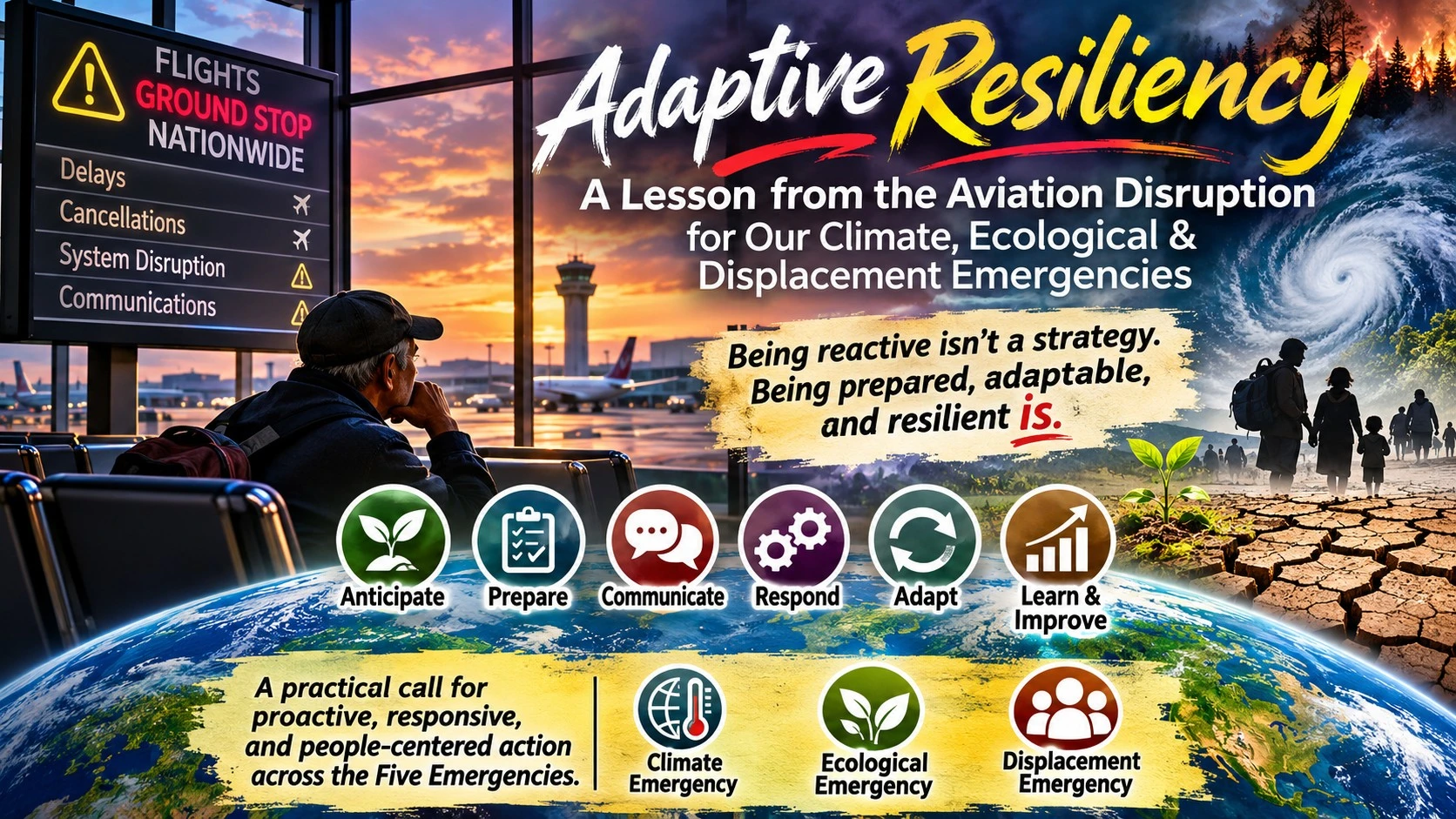
If Friday showed us what not to do, here is what Adaptive Resiliency asks of us instead:
-
Anticipate. Treat warnings as work orders, not suggestions. When a report flags aging infrastructure, whether copper lines or coastal levees, the clock has already started.
-
Build redundancy by design, not by luck. Distributed energy, local food systems, protected wetlands, community networks, and backup communication channels that exist on purpose.
-
Speak with one honest voice. Coordinate the message before the crisis. Say what is known, what is not, and when the next update will come.
-
Respond and adapt. Act on evidence, adjust as new information arrives, and be willing to stop an activity to prevent greater harm.
-
Learn without forgetting. After-action reviews must lead to funded, completed improvements, not another report on a shelf.
-
Center people. Those most vulnerable to an emergency should never carry the greatest burden of our failure to prepare.
This is what I mean when I talk about the Green Way Forward: not a slogan, but a commitment to the well-being of our children and the health of the biodiversity that sustains us, built through preparation, cooperation, and honest dialogue rather than through one emergency response after another.
A Rehearsal We Cannot Afford to Ignore
The investigation into Friday’s ground stop may eventually produce one clean explanation. The routers may be replaced. The funding may arrive. Planes are already flying again.
But the Climate, Ecological, and Displacement Emergencies will not be a four-hour disruption, and there will be no announcement that normal operations have resumed. We were given a warning on Friday night, with stranded passengers instead of lost homes, and with a national timeout instead of a tipping point.
We can treat it as yesterday’s inconvenience. Or we can treat it as the rehearsal it truly is.
Let’s choose to adapt. Let’s choose to be resilient. Let’s choose both, together, before the next alert arrives.
Sources
-
Al Jazeera, “FAA ground stop lifted: Why were US flights grounded, and what’s next?” (Nov. 14, 2026)
-
CNN, live updates on the FAA ground stop (Nov. 13, 2026)
-
CBS News, “FAA lifts nationwide ground stop that disrupted thousands of flights” (Nov. 13, 2026)
-
NBC News, “Ground stop lifted hours after stranding thousands of flights across the U.S.” (Nov. 13, 2026)
-
AVweb, “FAA Rules Out SMART AI System as Cause of Nationwide Ground Stop” (Nov. 13, 2026)
Details reflect reporting as of Saturday, November 14, 2026. The cause of the outage remains under investigation.
A note on how this was made: I use AI to enhance my creativity and thinking. The perspective, the concept of Adaptive Resiliency, and the final editorial judgment are my own.
Read posts at climatechangecommunity.com
Protecting our Children & Biodiversity’s future towards a more sustainable and habitable Earth!
Compiled & Mr. Alvarez’s Thoughts | AI Enhanced.