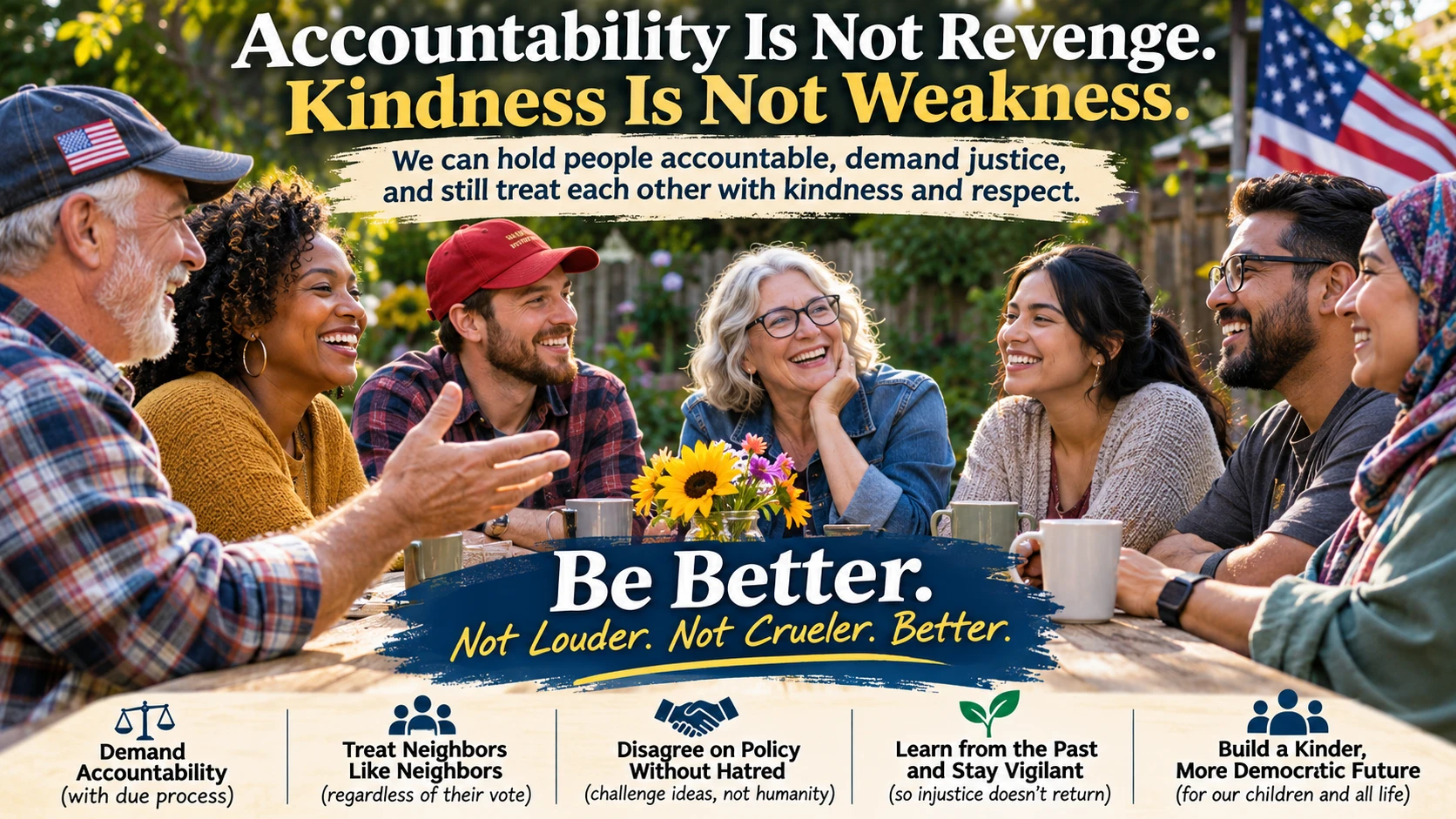
We must never become the very thing we once stood against.
After the Blue Wave, I spent some time watching YouTube reactions and scrolling through comment sections. I expected celebration. What I did not expect was how often one word kept appearing:
REVENGE.
For some people, the political tide has turned, and now it is time to get even. Time to humiliate, punish, financially ruin, and openly cheer the misfortune of those who held power or supported policies we opposed.
My answer is simple. No. Absolutely not.
History teaches that revenge rarely produces justice. More often, it keeps alive the very cycle of hostility, cruelty, and division that brought us here in the first place. We cannot spend years demanding decency, fairness, and accountability from our leaders and fellow citizens, then abandon those principles the moment the political winds shift in our favor.
We do not get to become the very thing we claimed to oppose.
So let’s talk about the difference between accountability and revenge, because that difference matters enormously, not only for America, but for humanity.
1. Accountability Is Not Revenge
Accountability and revenge are not interchangeable words, and they should never be treated as if they were.
Accountability means people answer for their actions. When someone abuses public office, breaks the law, commits fraud, undermines democratic institutions, or causes demonstrable harm, there must be appropriate consequences. Nobody is above the law: not a president, a governor, a senator, a billionaire, a corporate executive, or anyone with millions of supporters behind them.
Accountability looks like this:
-
Investigations based on credible evidence
-
Independent courts and impartial judges
-
Due process and the right to a defense
-
Criminal prosecution when the evidence supports it
-
Sentences that fit convictions
-
Lawful asset freezes, restitution, and penalties where justified
-
Removal from office when legally and constitutionally warranted
-
Stronger institutions, so the same abuses cannot simply be repeated
I spent nearly 14 years working in the court system as a Tech Support Specialist, in daily conversation with judges, court officers, and law and bench clerks. That experience left me with a deep respect for how much justice depends on process: evidence, procedure, and fairness applied the same way to everyone who walks through the door.
Revenge is something else entirely. It is personal. It is emotional score-settling. It seeks to make someone hurt because we believe they deserve to feel the pain we felt. And that is where we must draw a firm line.
If we celebrate the financial destruction of ordinary families because they voted differently, we have abandoned justice. If we cheer harassment, humiliation, or intimidation because someone belongs to the other political camp, we have abandoned decency. If we decide cruelty is acceptable as long as it targets people we dislike, we have surrendered the very principles we claim to defend.
Justice must be impartial, or it isn’t justice.
2. Remember the Past Without Repeating It
Forgiving and forgetting are not the same thing.
Some people will forgive those who hurt them. Others never will, and forgiveness should never be demanded as the price of moving forward. But remembering is essential. We must preserve the record, recognize the warning signs, and stay vigilant so injustice does not quietly return wearing a different political label.
Forgiveness does not mean letting harmful behavior repeat without consequences. Moving forward does not mean pretending nothing happened. We can acknowledge the harm, pursue legitimate accountability, protect those affected, and work to prevent future abuses, all at the same time.
What we cannot do is let our memory of injustice become an excuse to create new injustice. Imagine spending years fighting corruption, discrimination, authoritarianism, and abuse of power, only to applaud those same tactics once they are aimed at the other side. What would we have accomplished?
We would have changed the people holding the instruments of injustice. The instruments themselves would remain.
3. “Never Again” Must Mean Never Again for Everyone
History warns us, again and again, about what happens when people come to believe that their suffering gives them permission to inflict suffering on others. People who once demanded dignity can grow indifferent to the dignity of others. People who once cried out for justice can become advocates of collective punishment. It is one of humanity’s most dangerous contradictions.
The Holocaust stands as one of history’s most horrific examples of what happens when an ideology dehumanizes an entire people and turns prejudice into organized persecution and mass murder. Its lesson must be universal: no population should ever be dehumanized, persecuted, collectively punished, or targeted for destruction. That principle cannot depend on nationality, religion, ethnicity, political affiliation, or which government is responsible.
The suffering of Jewish people throughout history deserves remembrance and respect. The safety and dignity of Israeli civilians matter. Palestinian civilians have exactly the same right to life, safety, dignity, and self-determination. We must be able to condemn attacks on civilians, hostage-taking, collective punishment, and forced displacement wherever they occur, and by whoever commits them.
International humanitarian law exists because humanity learned, through unimaginable suffering, that there must be limits on how power and force are used. Those limits apply to every government, including those whose people have endured terrible historical injustice.
Never again must mean never again for anyone. That is not weakness. It is moral consistency.
4. A Vote Does Not Erase a Person’s Humanity
Let’s bring this back home.
America is not just a collection of parties, districts, and ideologies. It is millions of ordinary people who get up in the morning, go to work, raise children, care for aging parents, pay bills, worry about the future, and hope for something better. Some vote Democrat. Some vote Republican. Some vote independent. Some don’t vote at all. Many are simply trying to make ends meet.
A person’s vote does not erase their humanity.
We can strongly disagree with someone’s choices without deciding they are worthless, evil, or undeserving of respect. We can challenge their arguments, question their assumptions, present evidence, and explain why we believe their choices cause harm, without turning them into enemies.
Think about the people around you. Your neighbor may have voted differently. Your coworker may hold opposite beliefs. Members of your own family may disagree with you on issues that feel fundamental. Should we refuse to help someone in an emergency because of their ballot? Should a struggling family be treated with contempt because of their politics? Should kindness depend on tribal membership?
I certainly hope not. Political disagreement is inevitable. Treating one another as disposable never should be.
5. Our Kindness Should Not Change With Election Results
If you remember only one thing from this post, let it be this: our kindness, our manners, and our willingness to help others should not depend on who occupies the White House, the statehouse, or the local school board.
Be friendly to your neighbors regardless of how they voted. Be respectful in your workplaces, schools, and public spaces. Offer help when someone needs it. Listen before judging, ask before assuming, and remember that most people are far more complicated than the political labels we attach to them.
This does not mean agreeing with everyone. It does not mean tolerating harassment, discrimination, or intimidation. And it certainly does not mean staying silent when someone spreads dangerous misinformation or pushes policies that threaten the rights and well-being of others.
It means we can stand our ground without abandoning our humanity. We can be firm without being cruel, passionate without being hateful, and challenging without being humiliating. We can demand better from elected officials without wishing suffering on the ordinary people who voted for them.
Imagine conversations where people actually listened instead of waiting to attack. Imagine social media where disagreement didn’t automatically turn into insults and threats. Imagine sharing a meal with someone across the political divide, having an honest conversation, and walking away with mutual respect intact. That is not an impossible dream. It starts with individual choices.
6. Kindness Is Not Weakness
Kindness is often mistaken for weakness. Nothing could be further from the truth.
It takes strength to stay decent when someone has treated you badly. It takes maturity to resist the urge to retaliate. It takes courage to defend the rights of someone whose beliefs you oppose. And it takes integrity to hold your own allies to the same standards you demand of your opponents.
Kindness does not mean surrendering your values, accepting injustice, or letting people walk all over you. It means refusing to let someone else’s behavior decide who you become. We should be able to say:
I disagree with you. I believe what you did was wrong. I will challenge your actions, and I will support investigations and lawful consequences where they are warranted. But I will not wish suffering on you or your family. I will not celebrate cruelty. And I will not abandon my principles simply because you abandoned yours.
That is strength. And frankly, it is the kind of strength our society desperately needs.
7. Our Leaders Are Temporary. Our Values Should Not Be.
Presidents, governors, senators, mayors, and school board members come and go. Parties gain power, lose it, and reorganize. But the people remain. Our communities remain. Our children remain. And our responsibility to one another remains.
Our character should never be a reflection of whoever happens to be governing. If compassion matters, it matters under every administration. If fairness matters, it matters no matter which party benefits. If democracy matters, we defend it even when results don’t go our way. And if accountability matters, we demand it from our own side as readily as from the opposition.
Otherwise, we aren’t defending principles. We’re defending teams. There is a tremendous difference.
No elected official deserves unconditional loyalty. They are temporary stewards of public trust, and keeping our institutions healthy and our communities connected is a responsibility that doesn’t end on Election Day.
8. The Five Emergencies Demand That We Rise Above Tribalism
There is another reason this matters so much. We are facing interconnected crises that demand cooperation, creativity, and a willingness to work together:
-
The Climate Emergency: rising temperatures, extreme weather, and the urgent need for a sustainable transition across political, economic, and national boundaries.
-
The Ecological Emergency: biodiversity loss, habitat destruction, and pollution degrading the living systems all of us depend on.
-
The Humanity Emergency: hatred, discrimination, poverty, inequality, and the erosion of human dignity.
-
The Democracy Emergency: corruption, disinformation, extremism, declining trust, and attacks on democratic institutions.
-
The Displacement Emergency: conflict, disasters, economic instability, and persecution forcing millions from their homes.
How can we build resilient communities while celebrating our neighbors’ suffering? How can we protect children and biodiversity while teaching the next generation that revenge is an acceptable answer to disagreement? How can we strengthen democracy if politics becomes an excuse to deny one another’s humanity?
We can’t. These emergencies are bigger than any party, election cycle, or politician. They require people who can disagree and still cooperate, who can challenge injustice without creating more of it, and who understand that kindness and mutual respect are not decorations. They are load-bearing walls of a functioning society.
9. Our Children Are Watching
The most important audience for our behavior may not be the people we’re arguing with today. It’s our children.
What do they learn when adults celebrate the humiliation of others? When political opponents are called enemies who deserve to suffer? When compassion is reserved for people who agree with us? Children learn from what we do far more than from what we say. If we tell them to be kind but behave cruelly whenever politics comes up, our words lose their meaning.
We have the chance to show them something better: that standing up for justice doesn’t require hatred, that strength doesn’t require cruelty, and that a person’s dignity is not determined by their political affiliation. When someone does wrong, the right response is to seek the truth, establish responsibility, and pursue fair consequences.
Not revenge. That is a lesson worth passing on.
10. Where Do We Go From Here?
My position is straightforward.
We demand accountability. We support independent investigations, evidence-based prosecutions, due process, and appropriate legal consequences. We protect democratic institutions and work to keep abuses of power from happening again. We remember the past, honor those who suffered, and refuse to minimize injustice.
But we do not celebrate cruelty. We do not encourage political persecution. We do not target ordinary families for how they voted. We do not treat our neighbors as enemies. And we do not let revenge become our guiding principle.
We can organize, protest, vote, campaign, advocate, and challenge those in power. We can insist that people answer for their actions regardless of wealth or connections. Through all of it, we can remain decent human beings.
The next time you meet someone who voted differently, remember you are talking to a human being, not a political symbol. The next time you see someone celebrating another person’s suffering, ask whether it brings us any closer to the society we say we want. And the next time you feel the urge to get even, pause and ask whether revenge will actually make anything better.
Sometimes the greatest victory is refusing to become what you fought against.
Be Better. Not Louder. Not Crueler. Better.
We have enough anger, division, and hostility in this world, and enough voices telling us that those who disagree with us deserve less respect. What we need is more understanding, more compassion, more honest dialogue, and more people willing to stand for what is right without abandoning their humanity.
Accountability must prevail. Justice must prevail. Democracy must be protected. And kindness must remain part of who we are, no matter who leads us.
Whether your candidate won or lost, whether your party holds power or sits in opposition, whether you agree with your neighbor on almost nothing, remember this:
You do not have to hate someone to hold them accountable.
You do not have to humiliate someone to prove they were wrong.
You do not have to seek revenge to show that injustice matters.
And you certainly do not have to surrender your kindness to prove your strength.
Let’s hold the powerful accountable, protect the vulnerable, defend our democratic principles, and treat one another with the dignity we all deserve. Our children deserve better. Our communities deserve better. Humanity deserves better.
Be the example you want others to follow.
Read posts at climatechangecommunity.com
Protecting our Children & Biodiversity’s future towards a more sustainable and habitable Earth!
Compiled & Mr. Alvarez’s Thoughts | AI Enhanced.
A note on how this post was made: I use AI as a tool to enhance my creativity and thinking. The ideas, convictions, and final judgment are my own.