Or: The Law Is Catching Up — Will We?
Climate Tribe Social Editorial
Where We Left Off
In Part 2, we named the Fifth Emergency: the Climate Refugee Crisis. We documented the numbers — roughly 250 million weather-related internal displacements over the past decade, two human beings every three seconds — and we exposed the legal vacuum that leaves climate-displaced families invisible to international law. We ended with a promise: to bring you the front lines, the policy pathways, the names of those who profit, and the actions our Tribe can take. Here they are.
From the Front Lines: Three Case Studies
The Pacific Islands. Tuvalu — a nation of roughly 11,000 souls on low-lying atolls — has become the proving ground for what dignified climate mobility can look like. Under the Falepili Union treaty with Australia, up to 280 Tuvaluans a year can now live, work, and study in Australia permanently. When the first ballot opened in mid-2025, over 5,000 citizens — nearly half the country — applied. The first families landed in Brisbane before the year was out. And embedded in that treaty is something revolutionary: Australia legally recognizes that Tuvalu’s statehood and sovereignty continue even if the sea takes the land. A drowned island is not an erased nation. NASA scientists project most of Tuvalu’s land and critical infrastructure will sit below current high-tide levels by 2050. The clock is not ticking. It is ringing.
Bangladesh. The World Bank projects that by 2050, over 13 million Bangladeshis could become internal climate migrants — driven by riverbank erosion, salt water poisoning farmland and drinking wells, and cyclones striking one of the most densely populated deltas on Earth. Every day, families arrive in Dhaka’s informal settlements carrying what remains of their lives. These are farmers and fishers whose carbon footprints are a rounding error compared to ours, paying the highest price for emissions they did not create.
The Sahel. Lake Chad — once a lifeline for tens of millions across Nigeria, Niger, Chad, and Cameroon — has lost roughly ninety percent of its surface area since the 1960s. The region is warming faster than the global average, and where water vanishes, conflict follows: herders and farmers pressed into competition, armed groups recruiting from despair, and displacement stacked upon displacement. The Sahel shows us how the Fifth Emergency feeds the other four in real time — climate collapse breeding poverty, poverty breeding instability, instability breeding the strongmen who thrive on it.
Policy Pathways: Making the Law Catch Up
The 1951 Refugee Convention was written for a different world. So the pathway forward runs on several tracks at once. First, expand the cracks already opened: the Teitiota principle, the ITLOS opinion, and the ICJ’s unanimous 2025 advisory opinion together establish that returning people into life-threatening climate conditions violates the right to life. Advocates and national courts must now turn those principles into binding domestic protections.
Second, replicate the Falepili model. Bilateral and regional mobility agreements — negotiated with dignity, not desperation — can protect people now while the slower work of treaty reform grinds forward. Africa’s Kampala Convention, the world’s only binding treaty on internal displacement, deserves full funding and enforcement, and it deserves siblings on every continent.
Third, fix the money. Fragile countries hosting the displaced receive only a fraction of the climate finance they need. The Loss and Damage Fund must be filled — not with pledges, but with deposits — and climate finance must actually reach displaced communities instead of evaporating in the pipeline.
Follow the Money: Naming Who Profits
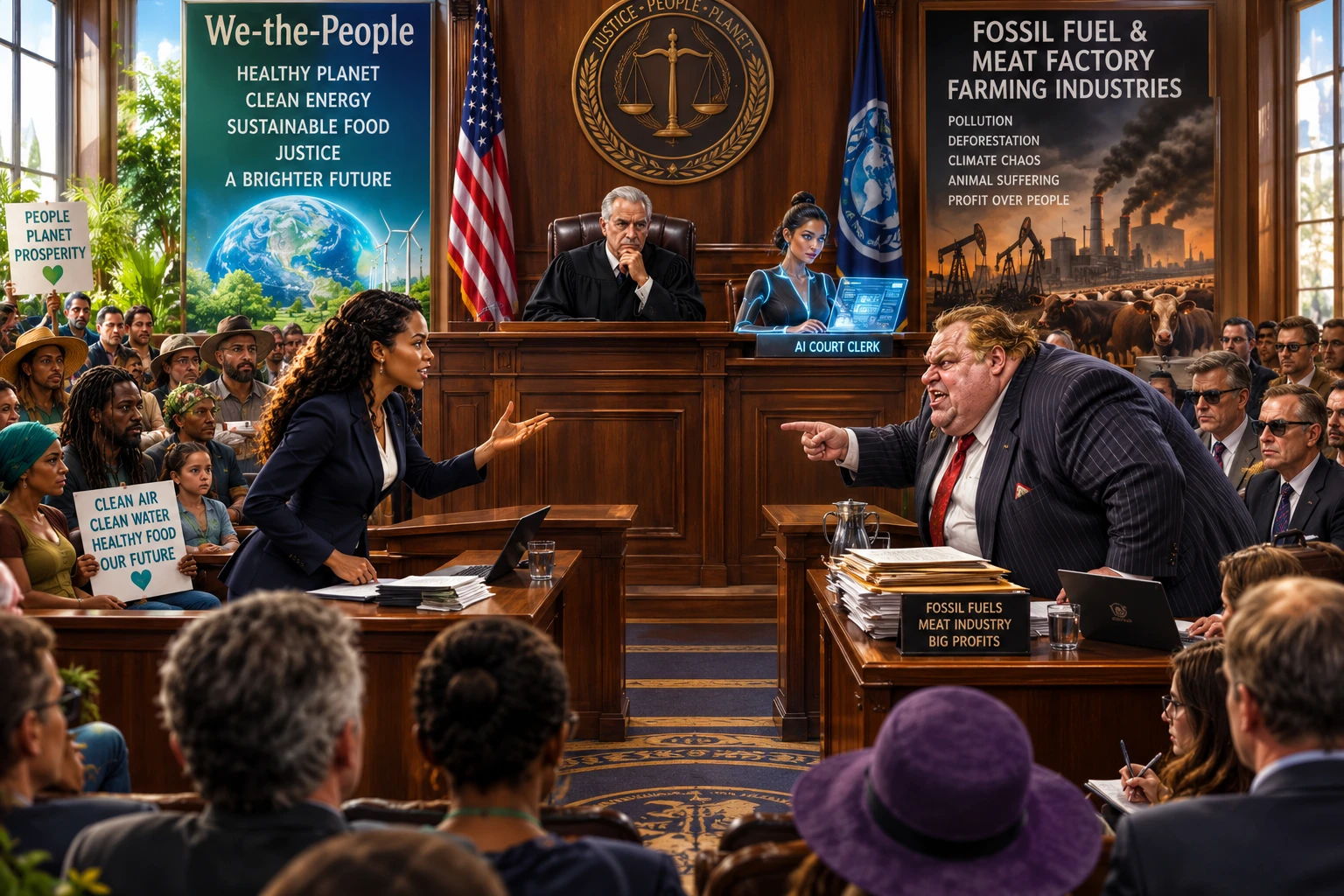
None of this displacement is an act of God. The scientific record is unambiguous: a small number of fossil fuel and cement producers are responsible for the majority of industrial carbon emissions in the modern era — and internal documents show major oil companies’ own scientists projected today’s warming with remarkable accuracy decades ago, even as their executives funded doubt. They knew. They drilled anyway. They are drilling still.
Accountability means climate litigation, windfall and polluter-pays taxation directed toward loss and damage, an end to the trillions in annual fossil fuel subsidies, and public naming — relentless, factual, unafraid. The same machine that manufactures the emissions manufactures the refugees, then profits a third time from militarized borders and “crisis management.” Our job is to jam that machine with truth.
What Our Tribe Can Do
Awareness without action is just spectatorship. So here is our part:
-
Advocate: Press representatives at every level to support climate-displacement protections, Loss and Damage funding, and humane migration policy.
-
Welcome: Support refugee-led organizations and resettlement groups in your own community. The Fifth Emergency arrives locally.
-
Divest and redirect: Move your money — banks, pensions, purchases — away from the machine and toward resilience.
-
Prepare together: Build Adaptive Resiliency where you live — because displacement prevention begins with communities that can absorb the blow.
Announcing: The Climate Emergency Control Center
Which brings me to news I have been waiting to share. Climate Change Community LLC is building the Climate Emergency Control Center — opening on or before August 24th, 2026, at $29.99 a year. It is for homeowners, building owners, apartment tenants, businesses small and large, and anyone else ready to prepare, connect, and act.
Picture it: a firefighter from New Jersey, California, or Wisconsin talking directly with firefighters in Canada, France, Germany, Korea, or Turkey — comparing wildfire tactics, flood response, evacuation lessons — practitioner to practitioner, human to human. That is what this Control Center is for.
And hear me now: this is not political, and we must stop pretending it is, once and for all. Some things are simply humanity-based — we come together to protect each other and the animal species we share this Earth with. Those who deny the science, or who align themselves with fossil fuel interests and the unethical wealthy whose agenda is to keep burning — this space is not built for your agenda. It is built for the rest of us.
The time for wars and division must subside if we are going to face what is coming. Dammit — our children’s lives are on the line here, and so is our biodiversity. Pull away from the madness of those who want to wait, deny, or are paid to disregard reality. Feel me!
The Closing of the Trilogy
We named the Fifth Emergency. We measured it. We traced it to its source. And now we answer it — with law, with money moved, with communities built, with a Control Center where humanity talks to humanity across every border the sea does not respect.
It is a critical time, and we must respond likewise.
Compiled & Mr. Alvarez’s Thoughts | AI Enhanced
Sources for fact-checking (Draft 3): Australia–Tuvalu Falepili Union Treaty (2023, in force Aug 2024) and Falepili Mobility Pathway ballot data (2025); NASA Sea Level Change Team projections for Tuvalu; World Bank Groundswell reports on internal climate migration (Bangladesh); UNEP/FAO assessments of Lake Chad Basin; ICJ Advisory Opinion, Obligations of States in Respect of Climate Change (23 July 2025); UN Human Rights Committee, Teitiota v. New Zealand (2020); ITLOS Advisory Opinion (May 2024); African Union Kampala Convention (2009); Carbon Majors Database; Supran, Rahmstorf & Oreskes, “Assessing ExxonMobil’s global warming projections,” Science (2023).