Adaptive Resiliency, Self- and Collective-Self Preservation, and Why We Are Building What We Are Building
In December 2024, in Windhoek, Namibia, representatives of 147 governments approved a scientific report that said in careful institutional language what we have been saying in plainer words for years.
The IPBES Nexus Assessment did something the world’s major scientific bodies had never formally done at that scale. It refused to examine biodiversity, water, food, health and climate change separately. It examined them as one interlocking system. And its central finding was not a number. It was a diagnosis: decisions about these five things are still being made in isolation from one another, and that isolation is itself a driver of failure. Solve for one element while ignoring the rest and you manufacture trade-offs you did not plan for, cannot see coming, and will not control.
That is the argument of everything below, arriving from a direction I did not expect.
We do not organize our work around the Five Emergencies because five is a satisfying number. We organize it that way because these emergencies are not separable in reality, and because any response that treats them as separable will fail in ways that are predictable in advance.
What Adaptive Resiliency Actually Means
Resilience has been worn smooth by overuse. In most sentences it now means endurance — the capacity to absorb a blow and remain standing. Adaptation has suffered a similar fate, shrinking to mean adjusting to whatever happens to us.
Neither is sufficient, and both are too passive to describe what this century will require.
Adaptive Resiliency is the developed capacity — individual and collective — to anticipate, prepare, absorb, respond, recover, learn, reorganize, improve, and when necessary transform. It is not a mood or a mindset. It is a set of practiced capabilities. And it carries obligations attached: to human dignity, to democratic participation, to ecological foundations, to fairness, and to the generations who will inherit whatever we leave behind.
Follow that far enough and you arrive at something more fundamental than climate policy.
Self-Preservation and Collective-Self Preservation.
Because the real question in front of us was never how humanity manages climate change. It is this: how do we learn to protect one another, protect the living systems that make civilization possible, and become capable of navigating an unstable century together?
Everything else in our work is downstream of that question.
The Five Emergencies
We name five: the Climate Emergency, the Ecological Emergency, the Democracy-Based Emergency, the Humanity-Centered Emergency, and the Climate Refugee Emergency.
They demand different knowledge and different expertise. They are not different predicaments.
The Climate Emergency
The Climate Emergency is not a temperature reading. It is what a destabilized climate system does to everything built on the assumption of stability: extreme heat, flooding, drought, wildfire, intensifying hazards, infrastructure under stress, food and water insecurity, health impacts, economic disruption, and adaptation choices that grow harder and more expensive the longer they are deferred.
Every increment of warming matters, and every increment forecloses options that were available at the increment before.
Adaptive Resiliency therefore refuses the false choice between mitigation and adaptation. We work on mitigation, adaptation, preparedness, recovery and transformation simultaneously — reducing what is worsening the emergency while preparing seriously for impacts that can no longer be avoided.
The Ecological Emergency
A civilization cannot run indefinitely on collapsing ecological foundations.
Forests, soils, oceans, wetlands, pollinators, insects, plants, wildlife and microorganisms are not scenery arranged around human affairs. They are load-bearing. The IPBES Nexus Assessment put a figure on the exposure that should end the argument about whether this is an economic issue: more than half of global GDP — over fifty trillion dollars of annual economic activity — is moderately to highly dependent on nature.
This changes what preservation can mean.
Collective-Self Preservation cannot mean preserving humanity while dismantling the systems humanity runs on. Protecting biodiversity is an act of human self-preservation. Protecting humanity requires protecting biodiversity. These are one sentence, not two.
The Democracy-Based Emergency
Adaptive Resiliency requires societies that can still make hard decisions together.
That means institutions that function. Access to reliable information. Accountability. Participation. Disagreement without dehumanization. The ability to correct a bad policy instead of being trapped inside it. And enough retained trust that people can still cooperate when conditions get difficult — which is precisely when cooperation gets hardest and matters most.
The evidence gives us reason for concern. International IDEA’s Global State of Democracy 2025 found that 94 countries — 54 per cent of those assessed — had declined in at least one factor of democratic performance compared with five years earlier, while only 55 countries advanced. It marked the ninth consecutive year in which more countries declined than improved, the longest such run since the organization’s records began in 1975. Representation fell to its lowest level since 2001.
Climate resilience without social resilience is brittle. Ecological policy without public legitimacy stalls. Emergency response without accountability becomes dangerous. And a society that has lost the ability to talk across its own divisions has lost the ability to respond collectively to anything.
The Humanity-Based Emergency
Beneath the others sits an emergency about how human beings treat each other: polarization, dehumanization, misinformation, poverty, isolation, exploitation, fear, the erosion of real community, and the ancient temptation to sort humanity into those whose suffering counts and those whose suffering does not.
No technology repairs that. No policy repairs that. AI certainly will not repair it for us.
What Adaptive Resiliency requires here is unfashionable and entirely human: kindness, humility, cooperation, collaboration, dialogue, curiosity, responsibility, and a willingness to say I may not know — but I would like to understand.
Those are not soft virtues to be indulged once the serious work is done. In an emergency, they are infrastructure.
The Climate Refugee Emergency
Here I want to do something in the middle of this post rather than only argue for it later.
The Internal Displacement Monitoring Centre’s Global Report on Internal Displacement 2026 records 29.9 million internal displacements associated with disasters during 2025. A year ago I would have reported that number and moved on.
It would have been misleading.
That figure represents a 35 per cent decline from 2024’s extraordinary levels. State the raw number without the trend and you have shaded the truth in your own favor — which is exactly the habit this organization exists to break.
The decline is also not the whole story. Even after falling, disaster displacements ran 13 per cent above the average of the past decade. And for the first time in IDMC’s records, conflict and violence overtook disasters as the leading driver of internal displacement, producing a record 32.3 million movements, a nearly 60 per cent increase over the previous year. By the end of 2025, 82.2 million people were living in internal displacement worldwide.
The honest version is harder to summarize and more useful to act on. Disaster displacement fluctuates with the weather. Conflict displacement is compounding. And the two increasingly happen to the same people, in the same places, in sequence.
This is why displacement belongs in our framework rather than as a footnote to the climate one. Homes are lost. Communities become temporarily or permanently uninhabitable. Families are displaced repeatedly. Receiving communities absorb pressures of their own. And migration gets weaponized politically instead of planned for as the human reality it is.
Adaptive Resiliency has to think about receiving communities as seriously as displaced ones — housing, infrastructure, employment, education, culture, healthcare, ecological capacity, social cohesion. All of it, before the arrival rather than during it.
The Test We Apply to Every Decision
There is a simple question that cuts through most of our internal debates:
What does this decision mean for children who will live with its consequences far longer than we will?
UNICEF’s Children’s Climate Risk Report 2026, released this past June, found that 1.1 billion children — nearly half the world’s children — are now exposed to at least three overlapping climate hazards. Almost every child on earth, some 2.4 billion, faces at least one. More than four million face as many as six simultaneously. For scale on how fast the picture is sharpening: UNICEF’s 2021 index counted 820 million children exposed to heatwaves. The current figure is 1.5 billion.
Children did not design these energy systems. They did not build these political institutions. They did not choose these consumption patterns. They did not cause the biodiversity crisis.
They will live longest with all of it.
Adaptive Resiliency is therefore intergenerational or it is nothing. We are not trying to preserve the present arrangement. We are trying to leave the people who come after us enough ecological stability, accumulated knowledge, democratic capacity, technical competence, community strength and plain human decency to build something better than what we handed them.
Working Well With AI Is Not the Same as Using AI
Artificial intelligence is becoming embedded in education, research, communication, government, science, emergency management and ordinary daily decisions. Pretending otherwise accomplishes nothing.
Our response is not to teach people to use AI. It is to help people learn to work well with AI. The gap between those two things is where most of the damage will happen over the next decade.
Working well with AI means asking better questions. Checking sources. Separating evidence from speculation. Comparing perspectives. Recognizing uncertainty. Protecting privacy. Understanding what a system cannot do. Pressure-testing conclusions instead of collecting them. Knowing when a machine helps and when human expertise is not optional.
And above all, it means being willing to discover that you were wrong.
That applies to AI. It applies to me. It applies to this organization, to experts, to institutions, and to communities.
Being wrong is not the danger. Refusing to correct yourself once the evidence has arrived is the danger. One is a condition of learning anything. The other is how failures become permanent.
So when an AI system gives us bad information, we correct it. When research undermines one of our assumptions, we change the conclusion — as I did in this very post. When a member of our community identifies a real mistake, we investigate it. When the error is ours, we say so, in public, without burying it.
Accountability does not cost credibility. Handled properly, accountability is credibility.
The NIST AI Risk Management Framework arrives at compatible ground from an engineering direction, naming the characteristics of trustworthy AI as valid and reliable; safe, secure and resilient; accountable and transparent; explainable and interpretable; privacy-enhanced; and fair with harmful bias managed. That framework is itself under revision. Good. A standard for a fast-moving technology that never changes is not a standard. It is a monument.
The Part Most AI Advocates Skip
If we are going to advocate for AI inside a climate and ecological emergency, we are obligated to account for what AI costs the planet.
Training and running these systems consumes electricity. Data centers consume water for cooling. They occupy land, draw on grids that are frequently still carbon-intensive, and are being built at a pace that is outrunning the planning around them. A climate organization that promotes AI enthusiastically while treating its footprint as somebody else’s department is not being serious.
So our commitments are specific. We run models locally wherever a local model is genuinely sufficient for the task, rather than sending every trivial query to a distant data center. We treat the siting, energy sourcing and cooling of AI infrastructure as a legitimate part of the climate conversation rather than a technical detail below our pay grade. And we intend to be transparent about our own usage rather than quietly enjoying the benefits.
We do not have this fully solved. Nobody does. But an organization that will not name its own contradictions has no standing to ask anyone else to face theirs.
Accountability You Can Check
Statements about accountability are cheap. Structures are not.
Climate Change Community LLC operates under a hard salary cap. We maintain a Financial Support Program that redistributes excess revenue back to members and to communities. Those are constraints we placed on ourselves, in advance, precisely because good intentions decay under financial pressure and the only reliable protection against that decay is a rule you cannot quietly revise later.
We would rather be judged on structures that can be inspected than on values that can only be asserted.
ClimateTribe.Social: The Path From Knowing to Doing
ClimateTribe.Social exists because knowledge that never finds a pathway into action curdles into despair.
It is not meant to become another place to consume frightening information about everything going wrong. Knowledge matters enormously — and knowledge alone, at sufficient volume, without any route to participation, produces paralyzed people who are extremely well informed about their own helplessness.
So the structure is built as a progression: learn, understand, discuss, prepare, connect, collaborate, act, evaluate, correct, adapt, continue.
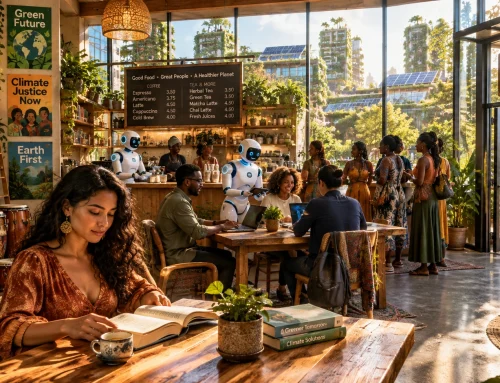
The Climate Emergency Control Center anchors it, holding two distinct spaces — cCc Nudge, a lighter daily support space, and the Response Hub, the working core for organizing, collaboration and disaster financial support. The Response Hub is where we publish The World’s Climate Policy Playbook, updated on a standing cycle rather than written once and abandoned. Around that sits our Basic Action Plan Collection — the Book Club Lab, the Green Tech Cafe, the Resilient Generations Space — with new spaces opening on a regular cadence.
We are also developing the Civic Hearth model, which allows municipalities to join as institutional members rather than leaving participation to individuals alone. Cities and towns are where adaptation actually happens or fails to. And we are preparing our first 11-Person Face-to-Face Dialogue Sessions, because there are forms of trust that no platform generates and no amount of posting substitutes for.
We do not expect every member to become a climate scientist, policy analyst, ecologist or AI specialist. We want people to become more capable participants in their own future.
Adaptive Resiliency Centers: Where This Touches Ground
Platforms alone cannot carry this.
Adaptive Resiliency Centers are the physical expression of the same idea — community-powered hubs that combine disaster preparedness, trauma-informed support and AI-assisted planning in a specific place, for specific neighbors, at the scale where a heatwave or a flood is not a statistic but a street.
An online community can teach ten thousand people what to do. A center down the road is what makes it possible for two hundred of them to actually do it when the power fails. The digital work and the ground-level work are not two projects. They are the same project, operating at two different radii.
SDL5: Civic Infrastructure, Not Another Feed
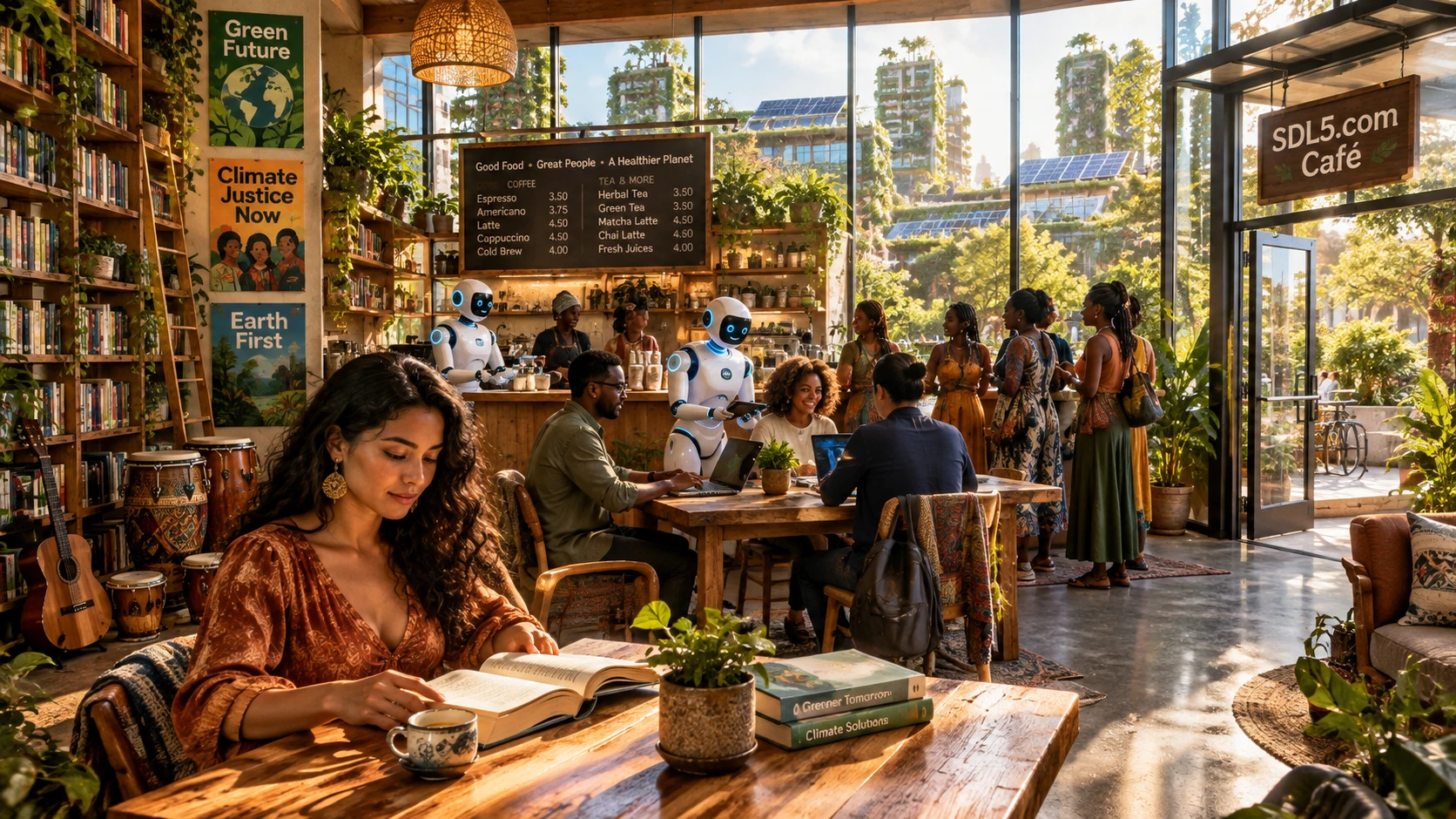
SDL5 is at an entirely different stage, and I want to be plain about that. It is in its infancy. What exists today is a small site with basic membership infrastructure we are still refining. It is not the vision. It is the foundation of the vision, and we are still pouring it.
The intention is to develop SDL5 into a full-scale collaborative and cooperative platform built specifically around the Five Emergencies.
That means thinking well past the idea of a website.
Here is the honest version of the ambition, and it is bigger than it may first sound. The dominant social platforms are not neutral spaces where human nature happens to express itself. They are architectures, and their architecture optimizes for engagement. Engagement, in practice, means arousal. And arousal reliably favors conflict over cooperation, certainty over inquiry, and speed over accuracy. The result is not a moral failure of the people using them. It is a design outcome, working as specified.
Which raises a question almost nobody has seriously attempted to answer: what would social technology look like if it were engineered to produce collective capability instead of individual reaction?
Could people organize real projects across borders? Could communities form working teams? Could scientists, educators, students, organizers, policy specialists, local leaders, technologists and ordinary citizens find each other by what they can contribute rather than by what enrages them? Could communities trade practical resilience knowledge that actually transfers? Could someone who knows almost nothing walk in, learn, participate, and gradually become a contributor? Could AI help people cross language, education and technical barriers without pretending to replace expertise?
Could we build a digital environment designed not to capture attention, but to focus it?
When I say we want SDL5 to eventually rival the capabilities of the world’s leading platforms, I am not talking about scale for its own sake, and I am certainly not talking about building another engine of endless scrolling, outrage and surveillance. I mean something narrower and more serious: the engineering that went into capturing human attention was extraordinary, and it was aimed at a trivial purpose. We want to find out what that caliber of engineering can do when it is aimed at civilization-scale cooperation instead.
That is a long road from where SDL5 stands today. Saying so is not a disclaimer. It is the first requirement of building it honestly.
One Ecosystem, One Question
These pieces are not competing. They are complementary.
ClimateTribe.Social develops concentrated climate learning, preparedness and action infrastructure. SDL5 grows into the broader cooperative environment organized explicitly around the Five Emergencies. The Adaptive Resiliency Centers carry it into physical places. adaptive-resiliency.info/ remains the stable doorway that explains the organization and how the pieces connect. Our public writing is the entrance. Our learning structures take people deeper. Our community spaces connect them. Our action structures help them organize.
This is not a collection of unrelated websites. It is an attempt to build an ecosystem around a single question:
How can ordinary human beings become better informed, better connected, better prepared and better organized to protect one another and the living world during a period of extraordinary change?
Organization Is Itself a Form of Adaptive Resiliency
We have had to learn this one on ourselves, repeatedly.
Urgency without organization becomes exhaustion. Attempting everything at once means doing almost nothing well. So Adaptive Resiliency applies to us too: prioritize, build realistically, respect human limits, correct course, sometimes close a project, sometimes consolidate, decide what deserves attention now and what has to wait, and design systems that actual human beings can actually sustain.
That is not retreating from the emergency. That is practicing what we teach.
An organization that cannot change when circumstances change has no business advising anyone else on resilience.
We Will Be Wrong About Things
We are building something ambitious, which guarantees error.
Technology will shift. Science will improve. AI will change faster than our ability to write about it. Some of our assumptions will prove incomplete. Some ideas will work and some will not. We will publish things and later find the evidence pointing elsewhere — as happened inside this post, in the section on displacement.
When that happens, our obligation is not to defend yesterday’s position because it was ours. It is to learn, correct it, explain the correction, improve, and continue.
That is not a departure from Adaptive Resiliency. That is Adaptive Resiliency.
A civilization capable of surviving this century will need the same capacity at scale. People willing to cooperate without always agreeing. People willing to learn without pretending they already know. Communities able to absorb a correction without turning it into humiliation. Institutions willing to accept accountability. Technology that strengthens human capacity without absorbing human responsibility. And millions of people who understand that preserving ourselves ultimately requires preserving one another.
What We Are Trying to Protect Is Alive
In the end this work is not about websites, or AI, or subscriptions, or platforms, or software. Those are tools, and tools are replaceable.
The purpose is the child growing up now who deserves a viable future, and the child not yet born who has no voice in any of this. The purpose is the community bracing for the next flood, heatwave, economic shock or displacement. The purpose is the person trying to understand a complicated world and wondering whether anything they do could matter.
The purpose is the forest. The wetland. The pollinator. The coral reef. The species that will disappear before most of humanity ever learns it existed.
The purpose is protecting enough of the living world — and enough of what is decent in us — that the people who come next still have choices.
That is Self-Preservation. That is Collective-Self Preservation. That is why Adaptive Resiliency matters.
We are early. ClimateTribe.Social is still developing. SDL5 is still in its infancy. Our learning systems will evolve, our use of AI will evolve, and our community will teach us things we cannot know yet.
But the direction is clear. Five Emergencies understood as one predicament. Adaptive Resiliency as the capacity to meet it. Self- and Collective-Self Preservation as the reason. AI used thoughtfully and accountably. Children protected. Biodiversity defended. People educated. Communities connected. Human beings learning to cooperate at a scale worthy of what is actually in front of us.
That is a future worth working toward.
And perhaps the most necessary form of resilience begins with still believing we are capable of building it — together.
A Note on Method
I use both local and internet-based artificial intelligence to enhance my creativity and thinking — as a research partner, a drafting aid, and a way to pressure-test my own reasoning. The judgment, the values, the corrections and the final word remain mine.
Many of my posts are working examples of that process. Sometimes the premise I start with turns out to be partly or entirely wrong, and careful checking produces something more accurate, more honest and more useful than where I began. This post is one of them: the displacement figures I intended to publish told a story the fuller data did not support, and the correction improved the piece.
That willingness to question ourselves, acknowledge mistakes and improve our thinking is not merely how I use AI.
I believe it is part of the Adaptive Resiliency we will all need to face what is coming — together.
Sources
-
IPBES, Thematic Assessment Report on the Interlinkages among Biodiversity, Water, Food and Health (Nexus Assessment), approved at IPBES-11, Windhoek, Namibia, December 2024.
-
IPCC, Sixth Assessment Synthesis Report and Working Group II findings on impacts, adaptation and climate-resilient development.
-
International IDEA, The Global State of Democracy 2025: Democracy on the Move.
-
IDMC, Global Report on Internal Displacement 2026; UNHCR, Climate Change and Displacement.
-
UNICEF, Children’s Climate Risk Report 2026.
-
NIST, Artificial Intelligence Risk Management Framework (AI RMF 1.0).
-
Climate Change Community LLC internal platform planning for ClimateTribe.Social, the Climate Emergency Control Center, Adaptive Resiliency Centers and SDL5.
Que Humanidad / Compiled & Mr. Alvarez’s Thoughts | AI Enhanced.