Why we renamed a Space, rebuilt the Basic Plan, and why we are not building any of this on somebody else’s platform.
What I Am Announcing, and What I Am Not
For some time now, people who follow my work have heard me talk about Adaptive Resiliency. Some of you have been waiting — patiently, and longer than I originally promised — for more of the Spaces inside Climate Tribe Social to open. I know that. I have not forgotten it, and I am not going to pretend the delays did not happen.
Because I knew people were waiting, I refused to do the easy thing. I could have unlocked the old Adaptive Resiliency Space, swapped out a few posts, given it a fresh coat of paint, and called the work finished. That would have been faster. It also would have been dishonest, because over the last several days I went back through the structure, the purpose, the older writing, the Basic Plan, and the relationships among our Spaces, and I kept running into a question I could not answer with a fresh coat of paint:
What are we actually trying to become more resilient for?
That question changed everything, and this post is where the work has led.
The former Adaptive Resiliency Space is becoming Resilient Generations — an Adaptive Resiliency Space for parents, caregivers, children, and the generations ahead. It will open shortly. It may open tonight. It may open tomorrow, on Labor Day. It may take a few days longer than that, and if it does, I will say so plainly rather than quietly slide the date.
I want to be precise about that word, shortly. There is no prize for opening something before it is ready. If we find something in these final passes that needs attention — a safety gap, a broken pathway, a piece of writing that does not carry its weight — we will fix it rather than rush past it. But the direction is set, and I believe what has emerged is far more meaningful than reopening the room we originally imagined.
This is also one of the final posts in which I lay out, directly and without hedging, what I am actually trying to build here and why it looks so different from what you are used to. So it is long. Take it in sections if you need to.
Why I Would Not Just Repaint the Old Room
There is a particular kind of failure that small organizations fall into, and I have watched it happen to good people with good intentions. You announce something. The announcement generates interest. The interest generates pressure. And then, because the pressure is real and the deadline is public, you ship a hollow version of the thing you promised, and the hollowness is what your members actually experience.
I have been building and rebuilding this community long enough to know that the membership counter is not the scoreboard. What people remember is whether the thing they walked into was real.
So when I opened the old Adaptive Resiliency Space files and started reading, I gave myself permission to conclude that the original design was wrong. That is an uncomfortable permission to grant yourself when you have been talking about an idea publicly for years. But refusing to revise your own work is not integrity. It is just stubbornness wearing integrity’s clothes.
Adaptive Resiliency Did Not Go Away — It Outgrew the Room
This is probably the first thing I need to explain, because when somebody sees that a Space called Adaptive Resiliency has become Resilient Generations, the natural question is: what happened to Adaptive Resiliency?
Nothing happened to it. We grew into it.
Adaptive Resiliency remains one of the central ideas behind Climate Change Community, behind Climate Tribe Social, and behind most of what I have written for the past decade. It remains connected to how we prepare, how we adapt, how we learn, how we recover, how we cooperate, and how we protect one another when environmental, technological, social, economic, and personal conditions change faster than we expected. It remains tied to what I describe as Self- and Collective-Preservation.
What changed was my understanding of where all of that is supposed to lead.
Adaptive Resiliency increasingly feels less like the name of one room inside Climate Tribe Social and more like a framework running through the entire community — through the Response Hub, through Green Tech Café, through Book Club Lab, through the Green Emergency Manuscript, through everything. And once I looked at it that way, something became obvious: a framework should produce something. Adaptive Resiliency should help build stronger individuals, stronger families, stronger communities. It should, over time, help produce resilient generations.
That is not abandoning Adaptive Resiliency. It may be its clearest expression yet.
What a Post From 2024 Was Already Telling Me
One reason I feel strongly about preserving the Adaptive Resiliency identity is that this work did not begin last week. In September 2024 I published a piece called “Adaptive Resiliency: Our Key to Thriving in the Face of Climate and Ecological Crisis.” Reading it again two years later was a strange experience, because the destination was already sitting in the text — I simply had not given it a name.
In that post I wrote about resilience as more than surviving disruption. I wrote about adaptation, learning, systems thinking, community cohesion, education, critical thinking, emotional intelligence, technology, ecological resilience, preparedness, scenario planning, innovation, and our capacity to keep functioning and evolving when the ground shifts. Every one of those is a human capability. Not a policy. Not an emissions target. A capability that lives in a person and gets passed between people.
Adaptive Resiliency is the process of developing the ability to face change intelligently and constructively. Resilient Generations are what we hope that process produces.
That connection matters to me practically, not just philosophically. I do not want years of Adaptive Resiliency writing, the Green Emergency Manuscript, and the discussions that grew around them to vanish into an archive because our structure evolved. Those materials are the foundation. We are building on them, not erasing them.
The Sentence at the Center of All of This
The more I worked on this, the more I kept returning to a single sentence:
We cannot prepare the world our children will inherit without also preparing our children for the world they will inherit.
Climate work spends enormous energy — correctly — on emissions, energy systems, policy, disasters, infrastructure, economics, technology, ecosystems, adaptation, and mitigation. All of it matters. But there is another question sitting right beside it, and it gets a fraction of the attention: what about the people who have to live through this?
What about the parent trying to explain climate change to a seven-year-old without handing her a nightmare? What about the teenager growing up inside a feed of climate headlines, synthetic media, political conflict, economic instability, and constant social comparison? What about the caregiver trying to teach practical skills while also protecting a child’s emotional footing? What about young people entering adulthood in a world that looks materially different from the one their parents were told to expect?
What should we be teaching them? And — this part matters more than people want to admit — what should we be learning alongside them?
Because Resilient Generations is not a room where adults stand at the front and announce that we have the answers. We do not. My generation has not exactly covered itself in glory on this. It is a place where generations learn together: parents and children, grandparents and grandchildren, caregivers and young people, teachers and learners, people with expertise and people brave enough to say I do not understand this yet.
There is an old idea here that predates every one of us, and it comes from the land I live on. The Haudenosaunee Confederacy — the Six Nations whose territory covers much of what is now New York State — governs by the Great Law of Peace, which instructs leaders to weigh decisions against their effect on generations not yet born. The widely circulated sentence about “considering the impact on the seventh generation” is a modern paraphrase rather than a verbatim line from the recorded Law, and I want to be accurate about that. But the underlying instruction is real, it is still practiced by the Grand Council today, and it belongs to the Haudenosaunee rather than to me. I raise it because it names something our institutions have almost entirely lost: the discipline of governing for a horizon longer than a quarterly report.
This Will Not Be a Doom Space for Children
This point is not negotiable for me.
Resilient Generations does not exist to frighten children about climate change. It will not parade catastrophe imagery in front of young people. It will not treat fear as education. And it will not assume that preparing someone for a difficult future means convincing them their future is hopeless.
The purpose is the opposite: to build capability. We want to help people become better able to think critically and identify misinformation; to communicate honestly and handle disagreement; to absorb setbacks and adapt when circumstances shift; to understand climate and ecological issues at a real level; to build practical life skills and strengthen relationships; to cooperate; to understand technology rather than merely consume it; to use artificial intelligence thoughtfully and protect their own privacy; to stay connected to the natural world; to prepare without being consumed by dread; to develop emotional maturity and hold realistic hope; to ask good questions, learn independently, help other people, and understand that resiliency is a community property before it is an individual one.
The objective is not to raise frightened children. It is to help nurture capable human beings.
Parents and Caregivers Belong in the Climate Conversation
One of the reasons this Space started to feel necessary is that parents and caregivers carry questions that do not fit anywhere in the standard climate taxonomy.
How much climate information is appropriate for my child’s age? Should I talk about more extreme weather, and how? How do we prepare as a household without making preparedness itself frightening? How does my child tell reliable information from manufactured information? How should we approach AI at home? What will education and employment even look like as these systems develop? How much privacy should a child have online, and how do I teach independence while still protecting them? Which practical skills will actually matter in a changing climate? How do we talk honestly about uncertainty without pretending to certainty in either direction? How do we encourage environmental responsibility without putting the weight of a planet on a child’s shoulders?
Those are not side questions. They are resiliency. And they deserve a place where parents, caregivers, young adults, educators, and eventually qualified specialists can exchange ideas without being shouted at.
AI Has to Be Part of This — Honestly
Artificial intelligence deserves its own attention here, and I am going to be straightforward about my own position, because I use these tools every day and it would be absurd for me to pretend otherwise.
Children growing up now will interact with AI throughout their education, employment, creative work, communication, and daily life. Pretending it does not exist will not prepare them. Uncritically adopting every new tool will not prepare them either. So Resilient Generations will explore the middle path: AI literacy guided by human judgment, ethics, safety, environmental awareness, and responsibility.
We will work through the questions that actually matter. What is AI genuinely good at, and what is it bad at? When must you verify what it tells you? How does it enhance creativity without quietly replacing your own thinking? What personal information should never be handed to an AI system? How does a young person recognize manipulated or synthetic content? What does AI do to the misinformation problem? How might it reshape employment? How do we use it without becoming dependent on it?
And one that sits close to the center of Climate Change Community: how do we push toward cleaner, greener, more accountable artificial intelligence, given what these systems cost in energy and water?
AI should serve people. People should not become servants of AI. Human connection comes first. Human judgment comes first. And when children and young adults are in the room, safety comes first, ahead of both.
The Green Emergency Manuscript Still Belongs Here
Some longtime followers will want to know what happens to the Green Emergency Manuscript. It stays. It is part of this journey.
GEM and the earlier Adaptive Resiliency material explored vulnerability, mitigation, adaptation, preparedness, resilience, and the interlocking challenges of the Climate and Ecological Emergency. That work still stands. What Resilient Generations adds is a dimension the original material could not fully carry: what do these ideas mean across generations?
An adaptation plan looks different when you ask how it lands on a child. A technology decision looks different when you ask what it means for a young person’s privacy. Climate communication looks different when you ask how a twelve-year-old will actually hear it. Preparedness looks different when the household includes children, older adults, people with disabilities, pets, or caregivers who cannot simply relocate. Community resiliency gets richer the moment we stop modeling people as interchangeable units and start seeing real families.
Why We Are Not Building This on Somebody Else’s Platform
Now I want to explain the part that people ask me about most, which is why we are going to the trouble of building our own community platform when Facebook, Instagram, X, LinkedIn, and others already have climate content and interest-based groups. Some of those groups are genuinely good. Some of the people running them are doing serious work. I am not pretending otherwise.
The problem is not the content. The problem is the machine underneath it.
In August 2026, Meta agreed to a settlement with attorneys general representing states, the District of Columbia, and several territories, resolving litigation that alleged the company designed Facebook and Instagram to be addictive to children, concealed internal research about harms to young users, and collected personal data from children under thirteen in violation of the Children’s Online Privacy Protection Act. Reported figures for the settlement have ranged from roughly seventeen to eighteen billion dollars depending on how the components are counted, and legal commentators have compared it to the tobacco settlements of the 1990s. In the states’ filings before settlement, they sought nationwide injunctive relief and asked that Meta be required to delete not only children’s personal data but the algorithms and models trained on it.
I want to be careful here. A settlement is not a court finding of liability, and Meta has not conceded the allegations. But the scale of the resolution and the conduct described in the underlying record tell you something about the business model, and it is not a story about a few bad configuration choices.
This did not appear from nowhere. In 2018 the Cambridge Analytica disclosures showed how data harvested through a single application could reach tens of millions of people who never used it, because the platform’s design exposed friends-of-friends. Researchers and journalists have documented for over a decade how these systems assemble information about people from other people’s contact uploads, tags, and activity — the practice commonly described as shadow profiling, where the company builds a picture of you out of what your relatives and acquaintances hand over without ever asking you. In 2021, internal research disclosed by a former employee showed the company had studied the effects of its products on teenagers and had not shared what it found.
So when I say that these platforms mine data, including children’s data, and assemble profiles from the accounts of people around you, I am not making a rhetorical flourish. It is documented, it is litigated, and the most consequential technology settlement in American history landed on it a few weeks ago.
I will also say this, because I have used the shorthand myself and I am going to stop: calling big technology companies “fascist” is a word that costs me more than it costs them. It makes the argument easier to dismiss and harder to defend, and it is unnecessary, because the documented conduct is more damning than any label I could attach to it. I would rather name behavior precisely than reach for a term that lets someone change the subject to my vocabulary.
The behavior I object to is specific. Surveillance-based advertising that follows you across the open web. Recommendation systems tuned to engagement rather than wellbeing. Data extraction from minors. Profiles assembled from third parties. Content moderation decisions made by companies with no obligation to explain them. And an economic structure in which the members generate all the value and receive none of it.
You cannot build a community about self- and collective-preservation on top of an architecture designed for extraction. The architecture will win.
What We Are Trying Instead: An Economics That Runs Backward
Here is what I am actually attempting, stated plainly, with the caveats attached where they belong rather than buried at the bottom.
Big technology companies have billions in annual revenue and a structural incentive to grow that revenue by taking more from the people who use them. Climate Change Community’s intention is to invert that: the top earns less than what flows back to the membership and the communities we serve.
I have decided to cap my own compensation from this work at $235,000 per year. Not a penny more. That figure sits alongside — not on top of — the organization’s baseline obligations: operating fees, taxes, staff salaries, infrastructure, and a community emergency reserve. Everything beyond the baseline and that cap is intended to flow outward, to communities and to members, with the membership holding meaningful influence over where it goes through choice-polls and community agreements.
I want to show you what that looks like at realistic scale, because I have been guilty in earlier drafts of reaching straight for an enormous number, and enormous numbers make people stop listening.
At the current Basic Plan price of $25.99 per year:
|
Members |
Annual subscription revenue |
|
100,000 |
$2,599,000 |
|
1,000,000 |
$25,990,000 |
|
10,000,000 |
$259,900,000 |
Even the first line of that table — one hundred thousand people, which is a plausible target for a serious community — produces millions of dollars a year, most of which would not be going to me. That is the point. The model does not require world domination to matter. It requires enough people to believe that a subscription should buy them a stake rather than rent them a feed.
For the sake of a long-horizon thought experiment: at eight hundred million members paying $29.00 a year, the arithmetic gives $23.2 billion. The multiplication is correct. But I want to be honest with you about what that number is. The largest paid subscription services on Earth — the streaming platforms everyone names — sit in the range of two to three hundred million subscribers. Eight hundred million paying members would be roughly triple anything that has ever existed. I use the figure to illustrate a principle, not to forecast a business. Anyone who tells you they are on a path to eight hundred million paying subscribers is selling you something, and I would rather you trust the small numbers I can defend than the big one I cannot.
Where would the money go? To cities, villages, and towns. To members. To emergency services under strain during climate-driven disasters — fire departments, EMS, nurses, and the local institutions that get called first and funded last. We also intend, further out, to introduce affiliate marketing so members can earn directly.
I want to flag a tension in that last sentence rather than let you find it yourself. I have just spent several paragraphs criticizing advertising-driven business models, and affiliate marketing is a form of advertising. The distinction I intend to hold is that affiliate arrangements will be disclosed, opt-in, and will never involve profiling members or selling behavioral data — the revenue would come from transparent referral relationships, not from surveillance. If we cannot build it that way, we will not build it. Hold me to that.
None of this is unprecedented, incidentally, and I take some comfort in that. The Rochdale Pioneers wrote down the principles of member-owned cooperative enterprise in 1844, and those principles still govern cooperatives worldwide. The Mondragón federation in the Basque Country, founded in 1956, has operated for close to seventy years with binding limits on the ratio between its highest- and lowest-paid workers — typically capped around six to one, and no higher than nine to one in any of its cooperatives — while generating over eleven billion euros in annual sales. Closer to my own family’s traditions, the rotating savings clubs Caribbean communities brought with them — susu, sou-sou, partner, box hand — have moved money through neighborhoods on nothing but trust and mutual obligation for generations, including in the Brooklyn I grew up around. None of these required anyone to be a saint. They required structure.
I say all of this because the point is not that a few people are doing well while many are hurting, though that is true. It is that the hurt is going to intensify. Climate-driven disasters and displacement will put pressure on towns, villages, states, and households that are already stretched. Homelessness in the United States remains near record levels — HUD’s January 2025 count found roughly 745,000 people experiencing homelessness on a single night, including over 266,000 unsheltered, a figure that has risen about twenty-seven percent since 2013. There was a modest three percent decline overall from the previous year, the first drop since 2016, and I am not going to hide that from you to make my point land harder. But chronic homelessness kept rising, the count of individuals not in families hit the highest level on record, and HUD does not separately count people living in vehicles at all, which means the specific thing many of us see in our own neighborhoods is not even measured properly.
I cannot escape the feeling that we need to do something substantial to look after each other, because unethical capitalism is not going to do it for us.
What I Cannot Promise You Yet
I have to be disciplined here, and I would rather disappoint you now than mislead you.
The Financial Support Program is not a promise. The intention behind it is real and it matters to me: I want Climate Tribe Social to become a community where financial value does not flow in only one direction. But an FSP has to be structured responsibly — legally, financially, and sustainably — before a single dollar of assistance can be promised or distributed. Joining the Basic Plan is not, and must never be interpreted as, a guarantee of financial assistance.
The compensation cap is not yet legally binding. I have not yet worked through this with legal counsel, and I want to be candid about what that means. An LLC is a pass-through structure: capping a salary is not the same as capping total compensation, because profits can reach an owner through distributions and equity as well as payroll. If I want this commitment to survive me — and I do — it will require a real legal architecture, whether that is a cooperative structure, a benefit corporation, binding provisions in the operating agreement, independent oversight, or some combination. Until that work is done, what you have is my stated intention and my word. Those are worth something, but they are not worth as much as a legal instrument, and I am not going to pretend otherwise.
Redistributing money at scale is regulated activity. Moving funds to municipalities, emergency services, and individuals implicates charitable solicitation registration, tax treatment for recipients, and potentially money-transmission rules. It is doable. It is not doable casually.
We plan to grow. We will not move on any of it until the foundation is firmly established and solid.
The Basic Plan, Rebuilt Around Three Rooms
Resilient Generations was not the only thing we reconsidered. Reviewing the Basic Plan, we found that parts of Climate Tribe Social’s structure had accumulated the way structures do: individual Spaces scattered across numerous plans, some with standalone subscriptions, some appearing repeatedly inside other collections, several reflecting decisions from 2024 or 2025 that no longer match how the community is actually developing in 2026.
So we simplified. The Basic Plan now has a clear identity built on three principal learning Spaces.
Book Club Lab
Book Club Lab develops understanding. This was formerly a more traditional Book Club, and the word Lab is intentional. Members will not sit waiting for me to choose every book. The goal is for members to recommend titles, organize reading groups, create their own Book Labs, work through chapters, and explore subjects together. Reading becomes participatory; learning becomes collaborative.
Green Tech Café
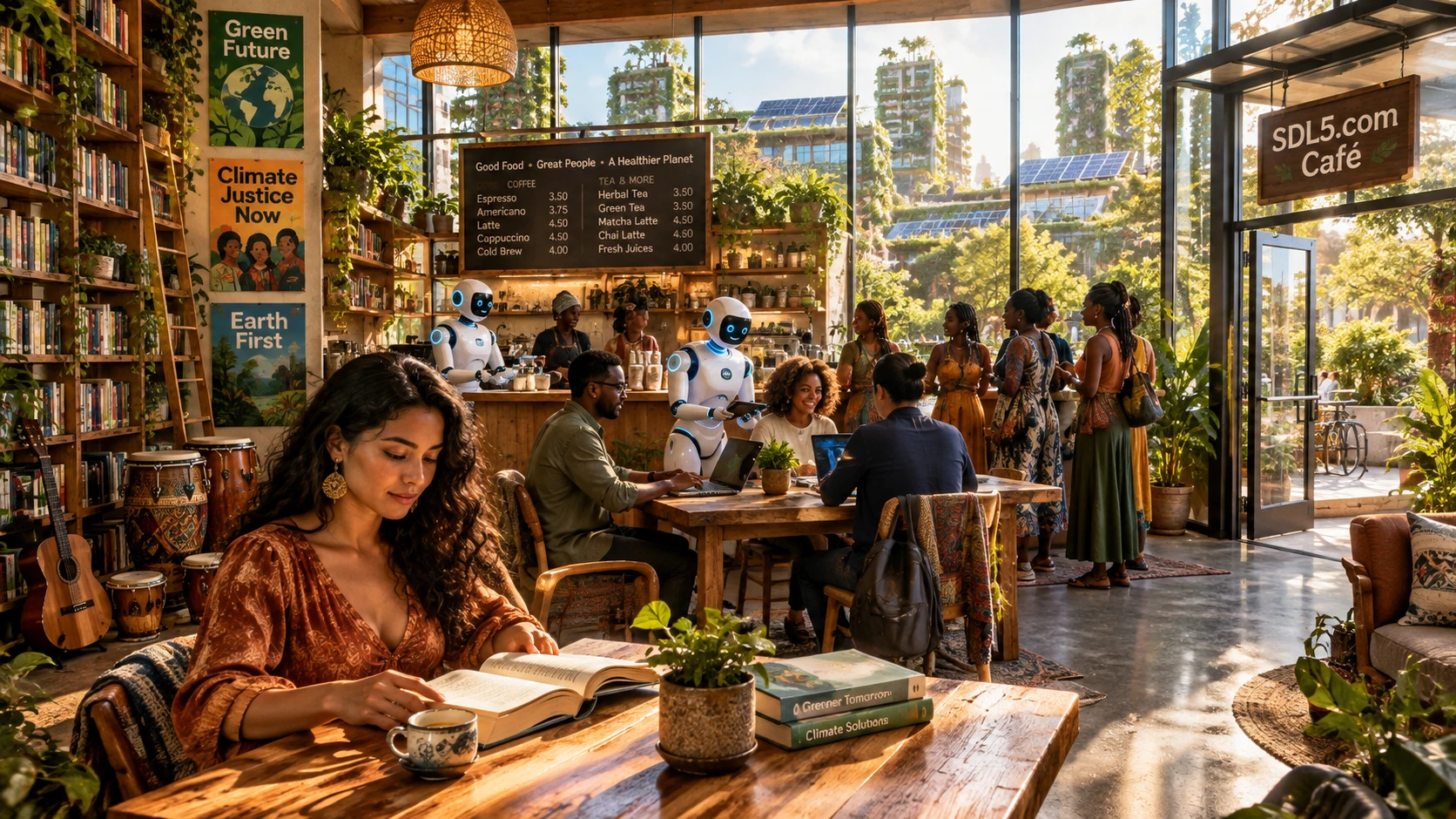
Green Tech Café explores tools, technology, and solutions: sustainable and green technology, responsible AI, digital privacy and safety, technological circularity, practical technology questions, climate innovation, and peer support. It also keeps something I carry from years of technology work — the spirit of a help desk. You should not have to be an expert to ask a question.
Resilient Generations
Resilient Generations develops people and families. This is where Adaptive Resiliency becomes personal and intergenerational, and where we explore the human capacities required to navigate change — individually, within families, across communities, and across generations.
Put together, the structure finally makes sense. Book Club Lab helps us understand. Green Tech Café helps us explore tools and solutions. Resilient Generations helps us develop human capacity.
At the time of this writing the Basic Plan is configured at $25.99 per year. It is not an artificially thinned membership designed to funnel you toward something expensive. It is meant to be a genuine foundation, and members should not feel obligated to participate equally in all three. A parent may live mostly in Resilient Generations. A reader may spend months in Book Club Lab. Somebody interested in renewable energy, Linux, digital privacy, or green AI may never leave Green Tech Café. That flexibility is deliberate.
The Response Hub Has Its Own Job
Part of why this restructuring works is that Resilient Generations no longer duplicates the Response Hub.
The Response Hub is where the community focuses on actual problems: disruptions, preparedness needs, emergencies, climate impacts, resources, collective response, practical action. Resilient Generations has a different job entirely — it strengthens the people who will carry out that response.
One area asks: what is happening, and how do we respond? The other asks: what kind of people and communities do we need to become in order to respond well?
That distinction may sound small. From a community-design standpoint it is enormous, and getting it wrong is why so many well-meaning platforms turn into a single undifferentiated feed of alarming news that nobody can act on.
From Isolated Spaces to Collections
We identified one more structural change that I think will make Climate Tribe Social considerably easier to understand: we are moving away from large numbers of isolated single-Space subscriptions, and most related Spaces will increasingly live inside Collections.
A Collection gives members a connected group of Spaces organized around a broader purpose. This matters because climate change does not occur in separate rooms. Technology connects to resilience. Resilience connects to health. Health connects to environment. Climate connects to economics. Economics connects to migration. Migration connects to everything human. Ecology connects to food and water. Education runs through all of it. Our structure should help people see those connections rather than forcing each subject into its own subscription.
So many standalone Space plans are being removed, consolidated, or reorganized into Collections. There will be exceptions where the subject genuinely warrants a defined home — a dedicated Health Support Space is one we expect to introduce, where the sensitivity of the conversation justifies clearer boundaries. But the general direction is: fewer disconnected rooms, stronger Collections, clearer pathways.
What You Will Find Inside Resilient Generations
As the Space develops, expect subjects including Adaptive Resiliency and Self- and Collective-Preservation; climate and ecological literacy for families; parent and caregiver discussions; age-appropriate climate communication; emotional maturity and resilience after setbacks; critical thinking and misinformation awareness; digital privacy and online safety; AI literacy, responsible AI, Green AI, and technology’s role in children’s lives; practical preparedness and household resilience; nature connection; community cooperation and intergenerational learning; communication skills, adaptability, independent learning, and problem-solving; realistic hope; future skills and preparing young people for uncertainty; and continuing discussion of the Green Emergency Manuscript.
That list will grow, and members will determine how.
Equally, it is worth stating what this Space is not. Resilient Generations is not a replacement for professional medical or mental-health care. It is not a substitute for qualified educational guidance. It is not legal advice. It is not professional emergency management. It is not a place where strangers tell parents how to raise their children. It is not a doom forum, and it is not a political loyalty test.
It is a learning community. A place to ask, explore, share, think, and prepare — and to help one another develop the capacities a changing world increasingly demands.
Safety Has to Grow With the Vision
Because this Space touches on children, young people, parents, and families, safety cannot be something we bolt on afterward.
Climate Tribe Social already emphasizes respectful conduct, privacy, anti-harassment, dignity, reporting, and responsible moderation. As youth-related participation grows, those safeguards have to grow with it. Adult-to-minor contact, private messaging, exploitation and grooming risk, harassment, inappropriate content, reporting systems, and urgent safety situations all require deliberate policy and real technical controls — not good intentions.
I would rather expand youth participation slowly and responsibly than move quickly because growth looks impressive on a counter. Children are not metrics. Their safety comes first, and if that means this part of the community opens narrower and later than I would like, that is the correct trade.
Resiliency Is More Than Bouncing Back
I have never been satisfied with the idea that resilience means bouncing back, because sometimes there is no back to bounce to.
A coastline changes. A species disappears. A technology transforms an industry in eighteen months. A community relocates. A job category evaporates. A family experiences a loss it does not recover from in any simple sense. An ecosystem crosses a threshold. A child becomes an adult. Life moves forward, and the old shape is not waiting for us.
Adaptive Resiliency means learning to move forward with it without surrendering our values, our humanity, our relationships, or our responsibility to the living world. Sometimes resilience is recovery. Sometimes it is adaptation. Sometimes it is transformation. Sometimes it is asking for help, and sometimes it is being the person who helps. Sometimes it is learning something you never expected to need. And sometimes it is admitting that the old way has stopped working and that we need to build something better.
That is precisely what happened with this Space.
I think often about Rachel Carson, who opened Silent Spring in 1962 with a line borrowed from the biologist Jean Rostand: “The obligation to endure gives us the right to know.” Carson was not writing about optimism. She was writing about the right of ordinary people to understand what is being done to the world they live in, and to act on that understanding. That is close to what I want this community to be for.
My own clock on this started in February 2007, when the IPCC’s Fourth Assessment Report landed and something in me shifted permanently. That was nearly twenty years ago. The generation being born now will inherit the consequences of what was decided in the years since — and they will need more from us than a list of things we failed to do.
We Did Not Lose Adaptive Resiliency. We Found Where It Leads.
When I started reconsidering this Space, I was afraid of losing something I care about. Instead I think we found its next chapter.
Adaptive Resiliency is still here. It runs through the Climate Tribe Social mission. It remains connected to GEM, to preparedness, to Self- and Collective-Preservation, to climate learning, to community cooperation. What it has now is a human destination.
Adaptive Resiliency is the pathway. Resilient Generations are the legacy.
Help Us Build It
If you are a parent, grandparent, caregiver, educator, young adult, resilience professional, climate professional, technologist, or simply somebody who thinks seriously about the world younger generations are inheriting, I want you to know that your perspective belongs in this conversation.
I do not want Resilient Generations to be my answer to what families need. I want it to be where we discover those answers together.
Tell us what worries you and what gives you hope. Tell us what your children are asking, what their schools handle well and what they miss entirely. Tell us which technologies concern you and which excite you. Tell us which practical skills you think young people should learn, and what you wish somebody had taught you when you were younger. Ask questions. Challenge ideas respectfully — including mine, and especially mine. Bring resources, experience, curiosity, and your humanity.
Resilience is not handed down as a finished instruction manual. It is taught, practiced, shared, adapted, strengthened, and passed forward.
For Those Who Have Been Waiting
Finally, to the people who have followed this work and waited for the Adaptive Resiliency part of Climate Tribe Social to fully emerge: thank you for waiting. The path here took longer than I originally said it would, and I would rather tell you that honestly than act as though the delays did not happen.
Climate Tribe Social has changed. The platform has changed. My thinking has changed. The organization has become more focused. Some ideas were closed. Some were consolidated. Some were renamed. Some moved into Collections. Some turned out to be unnecessary. And some — Adaptive Resiliency chief among them — turned out to be far larger than the box I originally built around them.
That is what healthy development looks like. Not refusing to change, but learning enough to change intelligently.
Which may itself be the best working definition of Adaptive Resiliency I have got.
When Resilient Generations opens, it will not simply be another online discussion area. It will be the next phase of a conversation that started years ago, about how we prepare for a changing climate, protect one another, strengthen communities, use technology responsibly, stay emotionally grounded, learn faster, cooperate better, and preserve what matters.
And now: how do we help prepare the generations who will carry this work forward after us?
I believe that may become the most important question Climate Tribe Social ever asks. I hope you will help us answer it.
Together.
Addendum:
Changes Applied Even Today
An extension of “Adaptive Resiliency Is the Pathway. Resilient Generations Are the Legacy.” This does not replace that post. It reinforces it and adds what has changed since I wrote it.
After reviewing that lengthy post — written with the help of an advanced AI model, and improved considerably by being argued with — I decided not to leave it as a finished statement. Some things needed reinforcing. Some needed adding. And a few needed to be said far more plainly than I said them the first time.
There are four points of deep concern I want to put on the record before Resilient Generations opens, plus several announcements about the Spaces themselves.
1. Resilient Generations Is Parent-Centered by Design
Resilient Generations is open to anyone. I want to be clear about that. But I also want to be clear about who it is built around, because a space that is designed for everyone is usually designed for no one.
This Space is parent-centered — parents with their children present, and, just as often, parents without them. A great deal of what parents and caregivers need to talk about is not appropriate to work through in front of the child it concerns. You need somewhere to think out loud about a worry before you decide how to bring it to your kid. That requires a focused room, not a general forum.
So the people I am specifically inviting are parents, grandparents, guardians, and caregivers; scientists, meteorologists, resiliency and adaptation specialists, and skilled professionals who are also parents; educators and youth workers; and anyone who has children in their life or simply cares about what happens to them.
This is not a departure for us. It is the reason Climate Change Community exists in the first place. What has driven this work from the beginning — and it says so on our front page — is anxiety and alarm about our children’s future in light of what the IPCC reports have been telling us for two decades. Peter Seidel, whose words we have kept at the top of our homepage for years, put his finger on the core problem: “We do not feel our planet changing” — and because we do not feel it, our response stays halfhearted. Resilient Generations exists to close that gap in the one place where it matters most, which is between a parent and a child.
My hope is straightforward. I want this to become a hopeful, welcoming, unhurried place that parents actually want to subscribe to and stay in.
2. Moderation Is a Founding Function, Not an Afterthought
Most platforms treat their subscribers as a means to an end. We are trying to do the opposite, and that only works if the room stays worth being in.
So at the inception of this Space I am openly recruiting people with a security, law-enforcement, safeguarding, or strong moderation mindset. Not to police opinion — to protect participation. There are people whose only agenda is to manufacture hardship, negativity, and disrespect, and whose real objective is to make everyone else stop showing up. That tactic works, and it works quietly. It is the reason so many good online communities feel empty.
This is a serious platform. It is built on respect for human dignity, on enforced kindness, and on helping one another in a mature and responsible way. Those are not decorative words.
I want to say plainly why law enforcement is welcome here, because I know that in some circles that is a controversial sentence. My uncle was a New York City police officer, loved by the community he served, and he worried tremendously about his own children — my cousins. The instinct that made him good at his job was not authority. It was worry about kids. That is exactly the instinct this Space needs.
There is also precedent for this in the climate world that we have been pointing to for years. Paul Netherton, Deputy Chief Constable of Devon and Cornwall Police in the United Kingdom, led the formation of the Devon Climate Impacts Group, and his framing has been on our homepage for a long time: “This is an emergency.” He went on to make the point that the timescale of this emergency is unlike the ones emergency services normally respond to, and that the consequences of not acting are severe. A senior police officer said that. He is not an outlier. He is an example of what we are asking for.
Two commitments attach to this, and I am making them now rather than after something goes wrong.
Moderation authority will be role-based, not identity-based. Nobody moderates here because of their profession. People moderate because they have accepted a defined role, agreed to a written standard, and — given that this Space involves discussion about children and eventually participation by young people — been properly vetted for it. A badge is not a qualification, and neither is a certificate. The role is the qualification.
Enforcement will be written down. I said in the main post that one of my objections to the large platforms is moderation decisions made by companies with no obligation to explain them. I am not going to reproduce that here on a smaller scale. Removals and bans will reference a published code of conduct, the person will be told which provision was breached, and there will be a route to appeal to a human being. I reserve the right to act quickly. I do not reserve the right to act unaccountably.
3. No Proselytizing. No Discrimination. No Exceptions.
This is not a place to push religious belief on other people, to attempt to control other people, or to attack what others believe.
Atheists are welcome. People of every faith are welcome. People of every sexual orientation and gender identity are welcome. People across the political spectrum are welcome, provided they arrive to talk rather than to recruit.
We will not discriminate, and we will not tolerate discrimination from anyone who comes aboard. I have watched at least one platform become relentlessly demeaning toward political affiliation, sexual orientation, and religious belief, and I have no intention of hosting a smaller version of it. I will not hesitate to remove an account — under the written standard and appeal process described above.
I want to add one thing that follows directly from the intergenerational purpose of this Space. Children and young people are watching how adults disagree. If the modeling they get here is contempt, we have taught them contempt regardless of what the curriculum says. How we argue is part of what we are teaching.
4. Share Your Work. Do Not Farm This Membership.
You are welcome to mention your company’s website, describe what you do, and invite people to look at what you make. That is normal, and in a community full of practitioners it is genuinely useful.
What it cannot be is your overall motivation for being here.
I hold myself to the same rule. I run a shop at greenrumba.com. You are welcome to visit it. That is the entirety of what I will say about it, and if I ever start saying more than that inside the community, someone should call me on it publicly.
Do not attempt to extort funds from members, and do not build a business on this membership. If your intention is commercial reach, ask for it honestly from us rather than working around the rules. We are considering a dedicated business or organization Space at $99.00 per year to give that activity a proper home instead of letting it leak into every conversation. That is under consideration, not yet available.
We do actively encourage a narrower kind of sharing: climate organizations, climate media, news outlets, and training platforms telling members what they do and where to find them. We intend to extend financial support to climate organizations and climate media that subscribe, because those are the institutions doing work we want to see continue.
On the Financial Support Program. Any membership above $19.99 is intended to place a subscriber on the FSP eligibility list automatically. I want to be very careful with the wording, because in the main post I said that joining should never be read as a guarantee of financial assistance, and I meant it. Being on the list means being in the pool the program will draw from once it exists. It is not a promise of payment, it is not a return on a purchase, and no amount of subscription buys an entitlement. The entire structure still has to be worked out with an attorney before a single dollar moves. Until that happens, this is a stated direction and nothing more, and I would rather you join because you want the community than because you are expecting a distribution.
Announcements
The Response Hub — Who It Is Actually For
I want to sharpen this, because I described the Response Hub broadly in the main post and it deserves more precision.
The Response Hub increasingly serves two related groups. The first is organizations, municipalities, and operators who face binding obligations — legal requirements, net-zero deadlines, compliance timelines, and financial exposure in the form of fines and penalties. These are people who do not have the luxury of treating decarbonization as a values exercise. They have a date and a number.
The second is everyone facing the sharp end of climate disruption directly: preparedness needs, active emergencies, resource coordination, and mutual support during and after events.
Those two groups belong in the same room more often than people assume, because a town facing a compliance deadline and a town facing a flood are frequently the same town, with the same budget and the same overstretched staff. But if you are coming to the Hub, know which door you are walking through.
And if you share this post — please share it with parents, and please share it with the people who genuinely need to be in the Response Hub.
Book Club Lab — Learning Out Loud Comes Home
We are bringing the Learning Out Loud series into Book Club Lab.
For those unfamiliar with it, Learning Out Loud is a series I have been producing several times a week, built around a quote or a cluster of quotes and then woven together with historical and current events, facts, stories, and lived experience. The purpose has never been to display knowledge. It is to strengthen wisdom and compassion, out loud, where other people can watch the thinking happen and argue with it.
Inside Book Club Lab, the series will occasionally focus on influential thinkers past and present. That fits the room. Book Club Lab was never meant to be a place where I assign reading — it is a lab, where members recommend titles, form their own reading groups, and run their own sessions. Learning Out Loud is simply me doing that in the open alongside everyone else.
Green Tech Café — Bringing In the Old Crew
I am inviting technical support experts and a number of my old technology friends to participate in Green Tech Café. Some of them are very good, and some of them have been doing this longer than I have.
One boundary on that: if a member arranges paid help from someone they met in the Café, that transaction happens outside the Space. We are not a marketplace, we do not take a cut, and we do not vouch for the work. The Café exists so that you can ask a question without being made to feel foolish for asking it. Anything commercial that grows out of that is between the two of you.
A Final Word on Your Information
This is the commitment underneath everything else in both of these posts, so let me state it precisely rather than sweepingly.
We do not profile our members. We do not build behavioral profiles from your activity, we do not assemble a picture of you from other people’s accounts, we do not sell or share member data with data brokers or advertisers, and we do not tailor what you see based on tracked behavior. We will not allow advertisements on the platform. Members may share their own links and describe their own work, as set out above; that is participation, not advertising inventory.
To be accurate rather than merely reassuring: any platform that takes payments and maintains accounts necessarily processes some information — your account details, your subscription and payment records through our processor, and the basic operational data our hosting platform requires to function. That is the unavoidable minimum. What we will not do is turn any of it into a product. If our practices ever change, you will be told before it happens, not discovered afterward.
That distinction — between the data a service needs and the data a business extracts — is the whole argument of the post this addendum extends.
Thank you for taking time out of a busy schedule to read something this long. Share it with others, especially with parents, and especially with the people who really need to be in the Response Hub.
Helping people meet the Climate Emergency with calm, clarity, and steady, shared action. That is the whole idea.
Sources and notes
-
Meta multistate settlement, August 2026: U.S. District Court for the Northern District of California, MDL No. 3047 (People of the State of California, et al. v. Meta Platforms, Inc.), Hon. Yvonne Gonzalez Rogers presiding; settlement documents published by the offices of the New York and California Attorneys General.
-
Homelessness figures: U.S. Department of Housing and Urban Development, 2025 Annual Homelessness Assessment Report to Congress, Part 1: Point-in-Time Estimates, released May 2026.
-
Mondragón Corporation pay-ratio and scale figures: Mondragón Corporation published materials and Co-operative News reporting.
-
Haudenosaunee Great Law of Peace: the seventh-generation principle as commonly quoted is a modern paraphrase; the recorded Law directs leaders to weigh the welfare of future generations.
-
Rachel Carson, Silent Spring (1962), epigraph quoting Jean Rostand.
-
Climate Tribe Social Basic Plan restructuring and Resilient Generations development, September 2026.
————————
Addendum: Changes Applied even today.
Mr. Alvarez
Content Curator | Climate Change Community LLC and its child-sites | Compiled & Mr. Alvarez’s Thoughts | AI Enhanced.