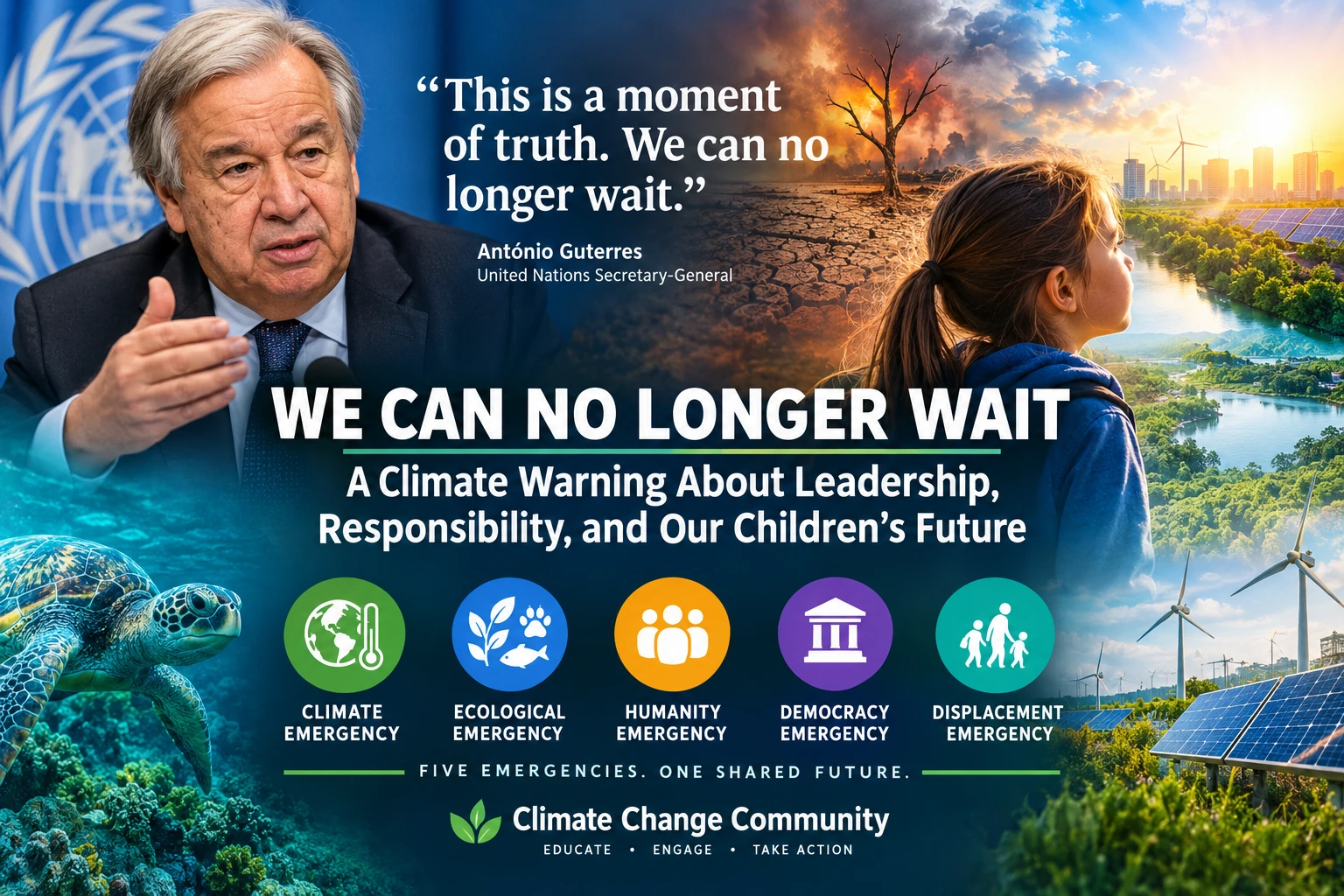
A Climate Change Community reflection on the UN Secretary-General’s final appeal as COP31 opens in Turkey
November 10, 2026
As the COP31 climate talks opened in Turkey this week, the departing Secretary-General of the United Nations gave the Associated Press what may be his last major climate interview in office. António Guterres’s second and final term ends with this year, and he chose to spend part of the time he has left repeating one phrase. AP science writer Seth Borenstein reports that he said it three times in twenty minutes: “This is a moment of truth.”
His point was plain. The waiting has to end, and every country, every sector and every one of us has to do more, starting now.
I have listened to Mr. Guterres’s warnings for years. What struck me this time is how far his words reach beyond the climate. Read closely, the interview touches every one of what we at Climate Change Community call the Five Emergencies: Climate, Ecological, Humanity, Democracy and Displacement. These are not five separate problems lined up for our attention. They are one predicament seen from five sides, and this interview shows all five.
The Climate Emergency: an honest admission about 1.5°C
For nine years Mr. Guterres told the world that holding warming to 1.5°C was still achievable. He told the AP that last year, while preparing a speech, he checked that line with scientists, and they told him he could no longer say it because it was no longer true. He described it as one of the hardest days of his life.
I respect him for saying so in public. But we need to be careful about what this admission means. Passing 1.5°C is a serious setback, and it is not permission to give up. Warming is not a cliff with safety on one side and ruin on the other. Every tenth of a degree we avoid means less dangerous heat, fewer floods and fewer failed harvests. The work now is to keep any overshoot as small and as short as we can, and to prepare our communities for the impacts already here.
There is also a reason for hope that rests on numbers. Mr. Guterres said the falling cost of wind and solar power gives him hope, and the data support him. The International Renewable Energy Agency reported in July that more than 90% of the utility-scale renewable projects commissioned in 2025 delivered power for less than the cheapest new fossil-fuel plant in their market, and that renewables spared the world an estimated 480 billion US dollars in fossil-fuel costs that year. He added that the energy shocks caused by war show that dependence on fossil fuels is a security risk as well as a climate one.
Cheap generation is not yet a finished energy system. Grids, storage and transmission have to catch up, and the transition has to be affordable for the households that can least absorb higher bills.
The Ecological Emergency: the living world does not negotiate
Mr. Guterres has stood beneath Mount Everest, and this month he spoke with a science team working on a drifting platform in the Arctic Ocean. He told the AP those encounters changed him and left him furious at those who still refuse to take the necessary measures.
Glaciers are fresh water for the people, farms and wildlife living downstream. Ice, rivers, soils, forests and oceans do not wait for summits to conclude, and they do not accept promises in place of protection. Biodiversity is the foundation that everything else stands on, including us.
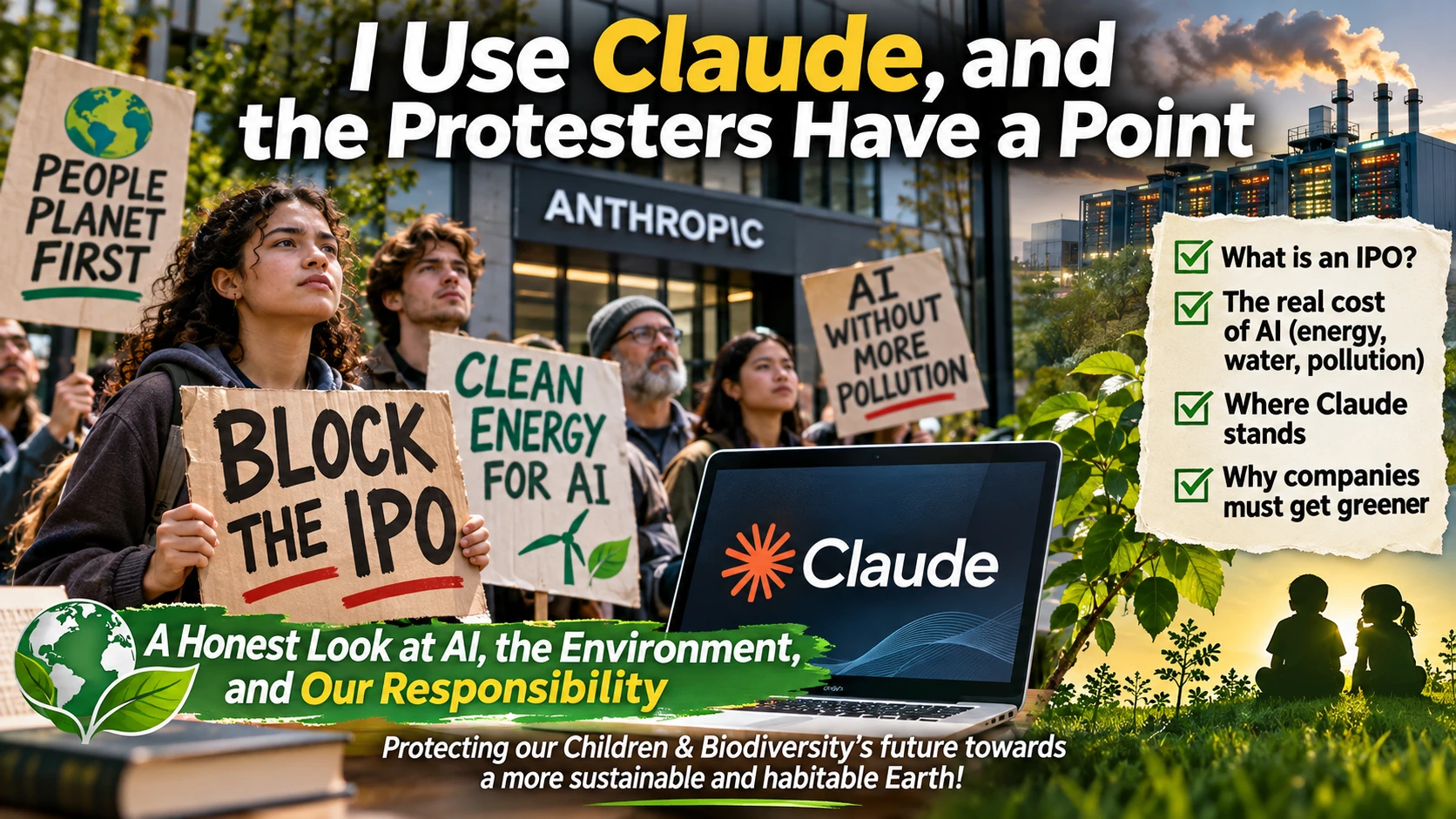
He also raised the footprint of artificial intelligence: the electricity it draws, the water it uses and the carbon it emits. We use AI in our own work, this post included, so that question applies to us as much as to anyone. We should hold the technology to the same standard we ask of every other industry: cleaner power, less water and open reporting of its footprint. The same goes for the energy transition itself. Solar farms and mines that destroy critical habitat would trade one kind of damage for another.
The Humanity Emergency: who suffers and who pays
Mr. Guterres told the AP that someone has to pay to help the victims of climate change, most of whom did little to cause it. That sentence is the heart of the Humanity Emergency.
The people with the least are hit first and recover last: families in poor housing, elders living alone, people with disabilities, children who will carry these decades for the rest of their lives. How we treat them is the measure of our response. Technology alone will not answer it. Dignity, fairness and the plain willingness to look after one another have to be part of the plan.
The Democracy Emergency: the leadership failed, not the world
His sharpest remark was aimed at governments. In his telling, the world has not failed. Its political leadership has, and he said that leadership has no strategic view.
I think he is right, and I think it explains why this is a democracy problem as much as an environmental one. Physics does not follow election calendars, yet most decisions are made with the next vote or the next quarterly report in mind. I spent close to fourteen years working inside the court system, and it taught me that accountability depends on records, on transparency and on people who are willing to ask questions.
So we should ask them. What has our government committed to? What has it carried out? Where is the public money going, and what happens when a target is missed? According to the AP, his advice to whoever succeeds him was simply to tell the truth. That is a good standard for leaders, for the press and for the rest of us.
The Displacement Emergency: when home is what is lost
In 2023 Mr. Guterres stood in Nepal and warned about melting glaciers and the floods that would follow. The AP reports that deadly floods struck Nepal this August, and he said the disasters arrived sooner than he had expected.
Displacement is more than people moving from one place to another. It is the loss of a home, a job, a school and a community, and for some small island nations it may mean the loss of a country. It is also closer than many of us like to think, in coastal neighborhoods where insurance is disappearing and in towns that flood again before they finish rebuilding.
Mr. Guterres argued that the windfall profits of fossil-fuel companies should be taxed to help the countries hit hardest. That is a policy proposal, and it deserves serious public examination: how the money would be collected, who would control it and whether it would reach the people who need it.
One predicament, five sides
Follow the thread and the connections are hard to miss. A heating climate strains the living world. Damaged ecosystems deepen human hardship. Hardship without accountable government turns into neglect, and neglect ends with people losing their homes.
The thread runs the other way too. Honest institutions make better climate decisions. Restored ecosystems protect communities from floods and heat. Protected, connected people are able to stay where they are. That is why we do not treat these emergencies one at a time, and why a response to one of them that ignores the others will fall short.
What we can do with a moment of truth
Mr. Guterres told the AP that the United Nations has little money, but it does have a voice. So do we. Here is how we can use ours:
-
Learn. Read past the headline. The AP interview and the IRENA report are listed below.
-
Ask. Find out what your local, state and national representatives have committed to and what they have delivered.
-
Prepare. Know the risks where you live, whether heat, flood or fire, and know your neighbors.
-
Protect. Support conservation and restoration close to home.
-
Connect. Join with others. None of this is work for one person alone.
I cannot promise our children that everything will turn out fine, and I will not pretend to. Reassurance tells people there is nothing to worry about. Hope is different. It looks at the danger honestly and still chooses to take part. The warning has been given, by a man with nothing left to campaign for. What we do with it is up to us.
Read posts at climatechangecommunity.com, and take a few minutes to explore the Climate Tribe Social Founders Library at climatechangecommunity.com/library.
Sources
Seth Borenstein, Associated Press, “AP Exclusive: Departing UN chief calls this ‘a moment of truth’ in fight to curb global warming,” first published November 6, 2026, updated November 8, 2026.
International Renewable Energy Agency, Renewable Power Generation Costs in 2025, July 2026, irena.org.
A note on authorship: Artificial intelligence is used as a tool to enhance my creativity and thinking, including the research and drafting of this article. The perspectives, values and commitments expressed here are my own.
Mr. Alvarez, Content Curator | Climate Change Community LLC
Protecting our Children & Biodiversity’s future towards a more sustainable and habitable Earth!
Compiled & Mr. Alvarez’s Thoughts | AI Enhanced.