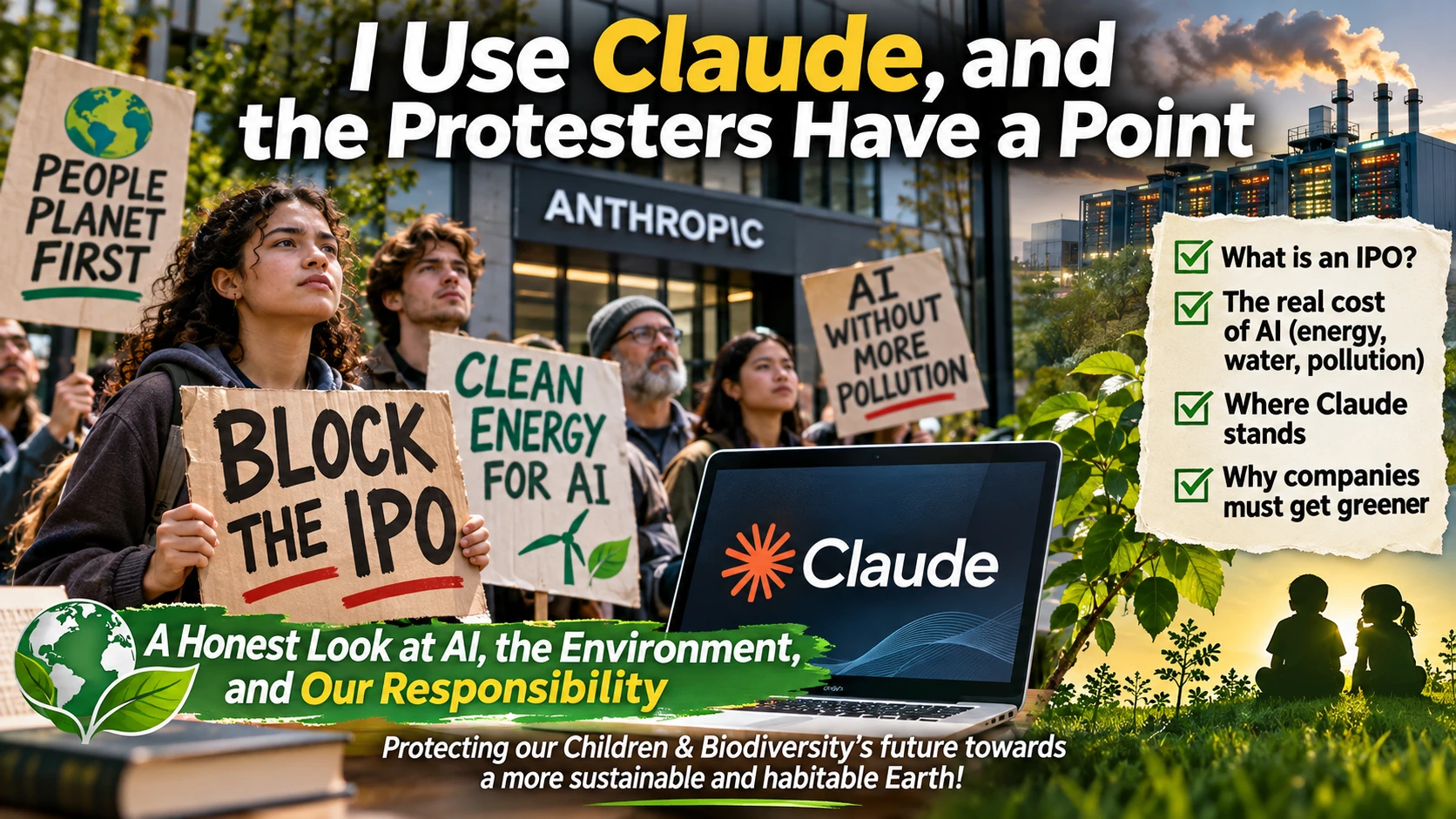
Protecting our Children & Biodiversity’s future towards a more sustainable and habitable Earth!
(Simplified version follows…)
Compiled & Mr. Alvarez’s Thoughts | AI Enhanced.
This week, protesters stood outside Anthropic’s offices behind a banner that read “Block the IPO.” Reporting describes the organizers as a coalition of labor, student and community groups, joined by climate activists. Anthropic is the company that makes Claude, and I use Claude almost every day in my work as Content Curator of Climate Change Community.
So I expect to be confronted about it. Someone will ask how a person who has spent years on the Climate and Ecological Emergency can lean on a tool that runs on enormous, power-hungry data centers. That is a fair question, and it deserves better than a shrug. This post is my answer: what an IPO is, what the evidence says about AI’s real carbon footprint, where Claude stands, and why I still believe these companies will be forced to get greener.
What an IPO Is, and Why People Are Protesting One
IPO stands for initial public offering. It is the first time a privately held company sells shares of itself to the general public on a stock exchange. Before an IPO, only founders, employees and private investors own the company. After it, anyone with a brokerage account can.
Anthropic began its investor roadshow on November 10, 2026. The company plans to sell 825 million shares at an expected $70 to $78 each, which could raise about $64 billion, and has applied to list on the Nasdaq under the ticker “ANT.”
Here is why that connects to climate:
-
The money builds data centers. Anthropic’s amended prospectus lists roughly $895 billion in purchase and lease commitments, and says nearly all of it is for computing capacity and infrastructure.
-
Ordinary savers end up owning it. The protesters’ central argument is that index funds would carry the stock into retirement accounts within weeks, whether savers choose it or not.
-
The company itself calls climate a business risk. Its filing warns investors about power and water demand, climate change, and community opposition to data centers that has grown more organized.
-
Voters just sent the same message. In this month’s midterm elections, communities came down against data centers in 40 of 41 related ballot measures.
None of this is investment advice. I am not telling anyone to buy or avoid a stock. I am explaining why a financial event has become a climate event.
Four Questions I Asked Before Writing This
I did not want to defend or condemn anything on instinct. So I put four questions to the research.
1. Who owns their infrastructure, and who rents it?
No major AI lab runs on its own renewable-powered infrastructure. Some own their data centers, some rent, and owning does not mean clean.
-
Google (Gemini): Owns its fleet. Power: Grid power plus large clean-energy purchases. Per-query disclosure: Most detailed: energy, carbon, water.
-
Meta: Owns its fleet; also rents some. Power: Grid plus renewable purchases; funding new gas plants. Per-query disclosure: None per query.
-
xAI (Grok): Owns its Colossus sites. Power: Grid plus on-site methane gas turbines. Per-query disclosure: None.
-
OpenAI (ChatGPT): Rents; partners build dedicated sites. Power: Mixed; on-site gas at several Stargate sites. Per-query disclosure: Energy only, no method.
-
Anthropic (Claude): Mostly rents; partner-built sites underway. Power: Varies by host, including a gas-turbine site. Per-query disclosure: None.
-
Mistral: Rents. Power: Depends on host and grid. Per-query disclosure: Full lifecycle study.
Two examples show why ownership settles nothing. xAI owns its hardware, yet aerial photos in April 2025 showed 35 gas turbines at its Memphis site, and in January 2026 the EPA ruled the company had operated turbines illegally. Meanwhile at least three of seven Stargate sites serving OpenAI are planned around on-site natural gas.
2. Whose data centers run on the cleanest power, and how do we verify it?
Nobody publishes a verified, hour-by-hour carbon figure for the specific data centers hosting an AI model. The nearest public measure is Climate Power’s tracker, which looks at the U.S. grids where each company builds. On that measure Amazon’s sites sit on the cleanest grids of the big four, averaging 716 pounds of CO2 per megawatt-hour, followed by Microsoft at 757, Meta at 802 and Google at 857.
To see past renewable energy certificate (REC) accounting, look for these:
-
Location-based emissions. This counts the real grid supplying the building, before any certificates are subtracted.
-
Hourly matching. Google reports about 65% carbon-free energy hour by hour in 2025, even though it matches 100% on an annual basis. The gap between those two numbers is the story.
-
Per-facility data. Meta publishes both location-based and market-based emissions for each data center, which is more than its peers offer.
-
Permits and photographs. Air permits, equipment orders and aerial images are how the public learned what was really powering xAI’s Memphis site.
One number shows how much certificates can hide. When Microsoft stopped counting cheap “unbundled” certificates, purchased electricity jumped from about 2% of its reported emissions to 13% in a single year.
3. How do the four biggest cloud owners compare?
-
Google: 100% annual match; about 65% hourly carbon-free. PUE: 1.09. Water efficiency (WUE): Not in sources reviewed; replenished 78% of freshwater used. Emissions: Rising: up 18% in 2025, over 80% above 2019.
-
Microsoft: Annual matching; dropped unbundled certificates. PUE: 1.17. Water efficiency (WUE): 0.27 L/kWh. Emissions: Rising: up 25% in fiscal 2025.
-
Amazon: 100% annual match, third year; says 24/7 remains aspirational. PUE: 1.14. Water efficiency (WUE): 0.12 L/kWh. Emissions: Rising: up 16% in 2025.
-
Meta: Annual renewable matching. PUE: Low 1.1 range at newest campuses. Water efficiency (WUE): 0.19 L/kWh. Emissions: Rising: location-based electricity emissions up nearly 150% from 2019 to 2024.
PUE measures how much extra energy a data center uses beyond its computers; closer to 1.0 is better. WUE measures water used per unit of computing energy; lower is better. All four companies are efficient. All four are also emitting more each year, because growth is outrunning efficiency.
4. Who is burning fossil fuel on site?
Climate Power’s Data Center Air Pollution Tracker scores eight companies from 0 to 100. Half the score reflects on-site gas burning and half reflects how clean the local grid is. The scores below are from its July 2026 release; the tracker updates daily, so check it for current numbers.
-
1. Amazon, score 68: Lowest share of on-site gas among the eight.
-
2. Microsoft, score 64: Named as a backer of gas projects in BloombergNEF’s count.
-
3 (tie). Google, score 61: Not detailed in the coverage reviewed.
-
3 (tie). Meta, score 61: Funding ten gas plants, about 7.5 GW, for its Hyperion campus.
-
5. Anthropic, score 59: Leases xAI’s Colossus 1, a gas-turbine site.
-
6. OpenAI, score 56: On-site gas at Stargate Abilene and other sites.
-
7. Oracle, score 51: Builds and hosts Stargate sites that use gas.
-
8. xAI, score 6: Gas turbines at Colossus in Memphis.
The wider trend is what worries me most. One industry tracker found 46 data centers planning their own on-site power, 56 gigawatts in all, with close to three-quarters of the planned equipment running on natural gas. BloombergNEF counted 99 gas plants proposed for AI data centers that could emit about 318 million metric tons of CO2 a year, enough to raise U.S. power-sector emissions by roughly 20%.
What a Single Query Really Costs
-
Google: 0.24 watt-hours and 0.03 grams of CO2 per median Gemini text prompt. That carbon figure subtracts clean-energy purchases. Counted on the real grids, it is about 0.09 grams, three times higher.
-
Mistral: 1.14 grams per average response when training and hardware are included. That is the fullest accounting any lab has published.
-
OpenAI: 0.34 watt-hours per average ChatGPT query, stated by its CEO with no published method.
-
Anthropic: No published energy or carbon figure per query for any Claude model.
A single query is small. Billions of them, plus training and construction, are not. And the same query can be several times dirtier depending on which building answers it.
Where Claude Stands
I will not soften this, because my credibility depends on it.
-
Anthropic publishes no per-query energy or carbon numbers, so I cannot tell you what my own use of Claude emits.
-
Claude runs mostly on rented capacity from Amazon, Google and Microsoft, so its footprint follows theirs. It also now runs on xAI’s Colossus 1 in Memphis, which Anthropic has leased in full since May 2026.
-
Anthropic ranks fifth of eight on the Climate Power tracker, ahead of OpenAI and xAI and behind the four big cloud owners.
-
The company has roughly $895 billion in computing commitments ahead of it. The power behind that build-out is the real question.
Why I Believe AI Will Get Greener by Necessity
I do believe it. But I want to be exact about what “necessity” means, because right now necessity is also what is pushing companies toward gas. Gas turbines can be installed in months while a grid connection can take years.
The forces pulling the other way are growing:
-
Communities can say no. Forty of 41 ballot measures is not a mood. It is a veto. Polling for Climate Power found that how a data center is powered makes a large difference in whether people accept it.
-
Investors now read the risk in writing. Anthropic’s own filing tells shareholders that climate and local opposition could raise costs and limit growth.
-
Public companies can be pushed from inside. Meta’s shareholders have already filed a formal request that it explain how its data center growth squares with its climate commitments. Once Anthropic is public, its shareholders can do the same.
-
Clean power is being bought at record scale. Google signed more than 12 gigawatts of new clean energy in 2025. Amazon’s portfolio has reached 42 gigawatts.
-
The accounting is getting harder to game. Microsoft dropped unbundled certificates, and Google began using hourly certificates in 2025.
So my belief comes with a condition. Necessity is not a law of nature. It is pressure, and pressure has to come from somewhere. It comes from voters, neighbors, shareholders, customers, and yes, from young people holding banners.
Does Anthropic Listen?
There is evidence that it does. In February 2026 Anthropic pledged to cover electricity price increases that its data centers cause for consumers, and to pay 100% of the grid upgrade costs needed to connect them. It moved before its rivals, and the White House’s later multi-company pledge followed the same outline.
There are also limits. That pledge does not apply to capacity Anthropic leases, which is most of what it uses. It addresses electricity bills, not emissions. And the company has not published the per-query figures that Google and Mistral have.
So I will hold “Anthropic listens” as something to be tested, not assumed. Here is my test. As a paying user, I am asking Anthropic to:
-
Publish energy, carbon and water per query for Claude, using location-based numbers and including training.
-
Disclose which data centers serve Claude and what powers each one, including Colossus 1.
-
Commit to hourly clean-energy matching and to no new on-site fossil generation.
If those answers come, my belief was right. If they do not, I will say so here.
What I Will Say When I Am Confronted
I will say that I use Claude, and that I will not hide it. I will say the protesters are asking the right question, and that I cannot yet give them the number they deserve, because the company has not published it. I will say that walking away from the tool would cost me my voice as a customer, and that I intend to use that voice.
We are neither anti-AI nor unquestioning advocates of AI. Adaptive resiliency means using the best tools we have while demanding that the people who build them answer for the cost. Our children should not inherit a second infrastructure crisis because we were too impressed, or too embarrassed, to ask.
Read posts at climatechangecommunity.com
A note on AI: I use AI to enhance my creativity and thinking. This post was researched and drafted with Claude, which is made by Anthropic, the company discussed here. Weigh that as you read, and check the sources below.
Sources
- Trending Topics: #BlockTheIPO, why opponents want to stop Anthropic’s stock market debut
- The Tribune / ANI: Anthropic launches IPO roadshow
- Dataconomy: Anthropic IPO faces investor doubts and AI backlash
- Business Standard: Anthropic IPO filing warns of power, water and climate-related risks
- Trellis: This tracker ranks AI data center leaders on emissions
- Climate Power: Data Center Air Pollution Tracker
- Climate Power: tracker announcement and polling
- Axios: The AI boom is making natural gas great again (Cleanview data)
- Forbes: Natural gas-powered data centers are a risk we can’t afford (BloombergNEF figures)
- ESG Dive: Google’s emissions continue to climb due to AI buildout
- Trellis: Google’s AI expansion weighs heavily on climate goals
- Google: Environmental Report 2026
- ESG Dive: Microsoft’s data center expansion drove 25% emissions spike
- CarbonCredits.com: Microsoft emissions, PUE and WUE
- Data Center Dynamics: Amazon’s carbon emissions grow by 16 percent in 2025
- Amazon Sustainability: AWS data center efficiency and water
- Computing: Meta’s sustainability surprise
- SEC: Meta shareholder filing on data center emissions
- Pulse: Meta funds ten natural-gas plants for Hyperion
- Data Centre Magazine: Meta PUE and WUE at newest campuses
- Epoch AI: OpenAI Stargate, where the US sites stand
- Wikipedia: Colossus (supercomputer)
- NewsBytes: EPA ruling on xAI turbines
- The Register: Anthropic’s electricity price pledge and its limits
- Data Centre Magazine: Anthropic pledges to cover AI data centre power costs
- Greenly: Gemini footprint one-pager
- CO/AI: Mistral environmental audit
- Brightest: Comparing AI model carbon footprints
Simplified Version: I Use Claude, and the Protesters Have a Point
Protecting our Children & Biodiversity’s future towards a more sustainable and habitable Earth!
Compiled with Mr. Alvarez’s thoughts | AI-assisted.
This week, protesters gathered outside Anthropic’s offices. Anthropic is the company that created Claude, an AI tool I use almost every day in my work with Climate Change Community.
The protesters carried signs calling on the company to stop its planned stock market launch. They are worried about the growing environmental costs of AI, including the huge amounts of electricity and water needed to run it.
I understand their concerns. And because I use Claude, I believe I should speak openly about them.
So let’s look at what is happening, why people are protesting, and what I believe needs to change.
What Is an IPO, and Why Does It Matter?
An IPO is when a private company sells shares of itself to the public for the first time. After that, people can buy and sell those shares on the stock market.
Anthropic is preparing to sell shares to investors. Its plans could raise about $64 billion.
Why does this matter to the environment?
Because AI companies need enormous buildings called data centers. These buildings hold the computers that power AI tools like Claude, ChatGPT, and Gemini.
They need large amounts of electricity and water to operate. Some also rely on natural gas, which adds pollution and greenhouse gases to the air.
The protesters worry that a growing AI business could mean more data centers, more energy use, and more pollution.
They also worry that ordinary people could end up owning shares in these companies through retirement and investment funds, even if they never chose to invest in AI.
These are fair concerns. AI companies should have to explain the costs of their growth, not just the money they expect to make.
Are AI Companies Using Clean Energy?
Some AI companies own their data centers. Others rent space or use buildings operated by other companies.
But owning a data center does not mean it runs on clean energy.
Here are a few examples:
- Google: Uses electricity from the power grid and buys clean energy. It reports more environmental information than many competitors.
- Microsoft and Amazon: Have made large clean-energy commitments, but their total emissions have continued to rise as their businesses grow.
- Meta: Uses renewable energy but has also been linked to plans for new natural-gas power plants.
- OpenAI: Uses outside data center partners. Some major AI projects are planned around natural-gas power.
- xAI: Has used natural-gas turbines to help power its large data center in Memphis.
- Anthropic: Mostly uses computing power from other companies, including Amazon, Google, and Microsoft. It has also leased a major data center site operated by xAI.
The lesson is simple: saying a company supports clean energy does not tell us exactly where its electricity comes from every hour of every day.
We need clear information about the actual power being used.
What Does One AI Question Cost the Planet?
One question sent to an AI tool may use only a small amount of electricity.
But think about millions of people asking questions every day. Add the energy needed to train AI systems, build data centers, cool computers, and supply water.
The total impact can become very large.
Some companies have shared estimates of the energy used by their AI tools. However, they do not all measure it in the same way.
Anthropic has not published a clear figure showing how much energy or pollution is caused by an average Claude question.
That means I cannot honestly tell you the environmental cost of my own daily Claude use.
I believe companies should publish these numbers so the public can judge their impact for themselves.
Where Does Claude Stand?
I use Claude, and I am not going to hide that fact.
But I also will not defend the company simply because I use its product.
Anthropic faces the same major challenge as other AI companies: its systems need more computing power, and that means more electricity, more buildings, and more pressure on local communities.
The company has also made a promise to help cover electricity price increases and the cost of power-grid upgrades caused by its data centers.
That is a step in the right direction. However, the promise has limits. Much of the computing power Anthropic rents is not covered by it. It also does not answer the larger question of how much pollution its AI systems create.
There is still work to do.
Why I Believe AI Companies Will Have to Get Greener
I believe AI companies will face growing pressure to use cleaner energy. But that change will not happen just because companies say the right things.
It will happen because people demand it.
Communities are already speaking out against data centers that could put pressure on local power and water supplies. Investors are asking questions about environmental risks. Customers are also beginning to ask where the electricity comes from.
And clean energy is growing.
Companies such as Google and Amazon are making major investments in renewable energy. Better reporting is also making it harder for companies to hide behind broad claims about being environmentally friendly.
Still, we must be careful. A company can buy clean-energy credits and claim to match all its yearly electricity use while its buildings may still receive power from fossil fuels during certain hours.
We need real progress, not just good advertising.
What I Am Asking Anthropic to Do
As someone who uses Claude, I believe I have every right to ask the company to do better.
Here are three things I want Anthropic to do:
- Show the numbers. Publish how much electricity, water, and pollution are linked to using Claude.
- Be open about its power sources. Tell the public which data centers run Claude and what energy each one uses.
- Make a real clean-energy commitment. Work toward using clean power every hour and avoid building new power systems that depend on fossil fuels.
These are reasonable requests. They should be basic responsibilities for a company building technology that affects millions of people.
What I Will Say When Someone Challenges Me
I will say that I use Claude, and that the protesters have raised important questions.
I will also say that I do not have all the answers because Anthropic has not shared all the information we need.
But walking away from a tool does not mean I have to give up my voice as a customer. I can use it, question the company, and demand better.
That is where I stand.
We are not anti-AI, but we are not blind supporters of AI either.
Technology should help people solve problems, not create new ones for our children and future generations.
Our children should not inherit another environmental crisis because we were too impressed by new technology to ask what it costs.
AI can be part of a better future. But only if the companies building it accept responsibility for the energy, water, and pollution involved.
That is a conversation worth having. And it is one we should not avoid.
Read more at: climatechangecommunity.com
A Note on AI: I use AI to support my creativity, research, and thinking. This post was researched and drafted with help from Claude, an AI tool made by Anthropic, the company discussed here. I believe readers deserve to know that. Please review the sources and make up your own minds.
Selected Sources and Further Reading:
- Anthropic – Company filings and environmental commitments
- Climate Power – Data Center Air Pollution Tracker
- Google – Environmental Report 2026
- Microsoft – Environmental reporting
- Amazon – AWS sustainability information
- Mistral – Environmental report on AI
- Axios – Reporting on natural gas and AI data centers
- BloombergNEF – Research on proposed gas power for data centers
- The Register – Reporting on Anthropic’s electricity-cost pledge
Protecting our Children & Biodiversity’s future towards a more sustainable and habitable Earth!