Test blog post… testing local-based AI…
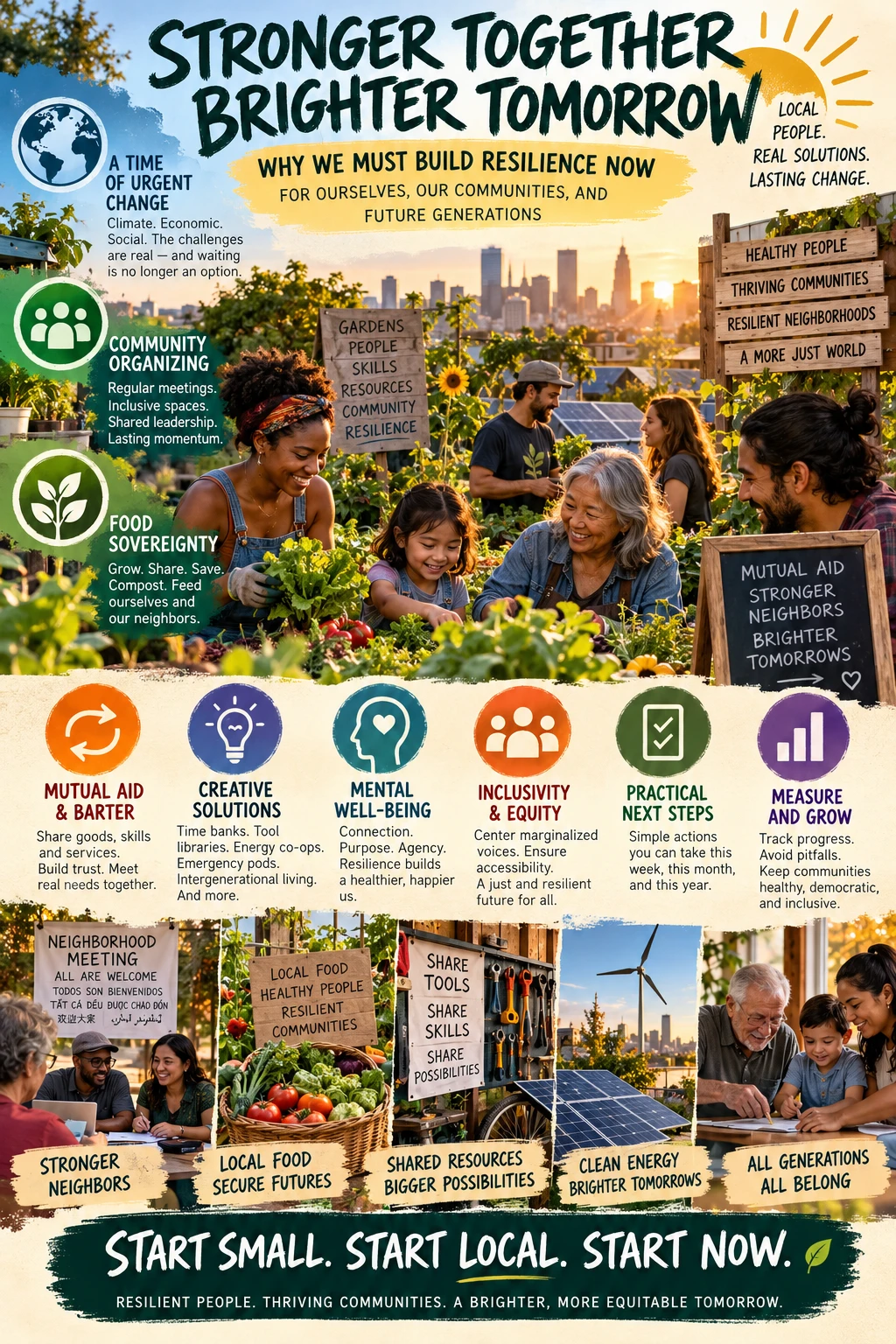
Preparing ourselves, strengthening our neighborhoods, reclaiming local resources, and rediscovering the power of collective action in an increasingly uncertain world.
Introduction: The Time to Build Resilience Is Before We Need It
There is an important distinction between surviving a crisis and preparing ourselves to live through a period of prolonged uncertainty. Survival is often reactive. Resilience is something we deliberately build before circumstances force our hand.
Across the world, communities are experiencing the consequences of interconnected challenges. Climate change is intensifying risks associated with extreme heat, flooding, drought, and severe weather. Food systems face increasing pressures. Housing and living costs strain household budgets. Economic insecurity affects people’s ability to save, relocate, or recover from unexpected disruptions. Political divisions, social fragmentation, and declining confidence in institutions make collective problem-solving more difficult precisely when cooperation is becoming more necessary.
These challenges are not isolated. They interact.
A severe storm can interrupt electricity, transportation, communications, employment, and access to food simultaneously. An extended heatwave can become a public health emergency, particularly for older adults, people with disabilities, outdoor workers, and households without reliable cooling. A sudden increase in food prices can place additional pressure on families already struggling with rent, healthcare, and utilities.
The question is no longer whether communities should become more resilient. The question is why we are not making resilience-building a much greater priority.
We should not interpret this as an argument that government, public institutions, or elected officials are unnecessary. Quite the opposite. Strong public institutions, responsible governance, effective emergency management, and meaningful climate policy remain essential.
But waiting for those institutions to solve every problem before we begin preparing ourselves is an increasingly dangerous assumption.
There are things we can accomplish without waiting for legislative approval, massive funding programs, or a national consensus. We can develop neighborhood relationships, establish food-growing initiatives, organize local resource networks, learn practical skills, and create systems of mutual assistance.
We can begin strengthening the places where we actually live.
This is about self-preservation and collective preservation. It is about recognizing that our individual well-being is connected to the well-being of the people around us.
And it is about understanding that resilience is not a destination. It is an ongoing community practice.
1. The Urgency of the Moment: Why Waiting Is No Longer a Strategy
The scientific evidence surrounding climate change has become increasingly difficult to dismiss.
The World Meteorological Organization’s State of the Global Climate 2025, published in March 2026, confirmed that 2015–2025 were the eleven hottest years in the observational record. The report also documented continuing ocean warming, increasing energy imbalance, and damaging extreme-weather events.
The Intergovernmental Panel on Climate Change has likewise documented how climate-related hazards interact with existing economic, social, and environmental vulnerabilities.
These findings matter because climate change is not simply about temperatures rising. It is about the systems that support everyday life becoming more exposed to disruption.
Consider the connections:
- Food production depends on predictable growing conditions, sufficient water, healthy soils, transportation, and energy.
- Healthcare depends on functioning facilities, trained personnel, electricity, supply chains, and accessible transportation.
- Employment depends on infrastructure, healthy workers, functioning businesses, and stable economic conditions.
- Household security depends on access to food, water, shelter, income, and supportive relationships.
When several of these systems experience stress simultaneously, the consequences multiply.
Economic pressures create another dimension of vulnerability. A household living paycheck to paycheck may have little ability to purchase emergency supplies, replace damaged appliances, temporarily relocate, or absorb an unexpected interruption in income.
Social fragmentation makes the situation harder. People who do not know their neighbors may have difficulty identifying someone who can check on an older resident, help a family obtain transportation, share information in another language, or assist someone who cannot independently access essential services.
We have become remarkably interconnected through global supply chains and digital technology, yet many neighborhoods have become disconnected from one another.
That contradiction deserves our attention.
Local resilience is not isolation
Building local resilience does not mean abandoning international cooperation or pretending that every neighborhood can become self-sufficient.
Modern communities depend on extensive systems of production, transportation, medicine, communications, utilities, and public services. No neighborhood should be expected to replace all of them.
Instead, the objective is to develop additional capacity.
A neighborhood that can distribute food during a temporary disruption, organize transportation for residents who need assistance, communicate reliably during an emergency, and identify vulnerable households is better positioned to withstand disruption than one with no established relationships.
The Federal Emergency Management Agency’s whole-community preparedness approach recognizes that preparedness involves individuals, households, neighborhood groups, businesses, nonprofit organizations, and all levels of government.
This is an important distinction: community resilience and institutional responsibility should reinforce one another.
We need both.
2. Rebuilding the Foundations of Community: Meetings, Councils, and Local Coordination
One of the most practical starting points is also one of the oldest: bringing people together regularly.
A community cannot coordinate effectively during a crisis if its members have never developed the relationships, communication channels, and mutual understanding required to work together.
That is why regular neighborhood meetings matter.
Establishing neighborhood gatherings
A neighborhood resilience meeting does not need to be elaborate. It could take place in a library, community center, faith-based facility, school, accessible apartment common room, or someone’s backyard.
The first objective is simply to bring interested people together.
For a new initiative, meeting every two weeks or monthly may provide enough consistency to establish relationships without overwhelming volunteers. As activities expand, smaller working groups can meet according to their needs.
An effective gathering might include:
- A short community check-in.
- Updates about local concerns and emerging challenges.
- Identification of resources and people willing to contribute.
- Discussion of one or two practical projects.
- Assignment of responsibilities.
- Agreement on the next meeting date.
Meetings should have a beginning and an end. An hour or ninety minutes is often enough for an ordinary gathering.
People have jobs, families, caregiving responsibilities, and personal commitments. Respecting their time is part of building a sustainable organization.
Create neighborhood councils or coordination circles
As participation grows, communities can establish a modest coordinating structure.
This might be called a Neighborhood Resilience Council, Community Preparedness Circle, or simply a neighborhood working group.
Its purpose should be coordination rather than control.
Possible responsibilities include:
- Maintaining a directory of voluntary community resources.
- Identifying local food-growing opportunities.
- Coordinating emergency preparedness activities.
- Organizing workshops and skill-sharing events.
- Connecting residents with public agencies and nonprofit organizations.
- Identifying accessibility concerns.
- Supporting local mutual aid initiatives.
Decisions should be transparent. Leadership responsibilities should rotate where practical, and important decisions should be documented.
No individual should become indispensable to the point that the entire initiative stops functioning when that person leaves.
Make participation genuinely inclusive
An English-only meeting in an inaccessible building at a time when working parents cannot attend is not an inclusive community meeting.
Think about language, transportation, physical accessibility, hearing and visual accommodations, childcare, digital access, and cultural differences.
Interpretation should be arranged when needed rather than assuming bilingual participants will volunteer to translate everything.
Offer several ways to participate: in person, remotely, through written contributions, or by helping with a specific activity.
Some people may have excellent organizational skills but little interest in public speaking. Others may be comfortable contributing behind the scenes.
Both forms of participation matter.
Prevent volunteer burnout
One of the most common weaknesses of grassroots organizing is relying too heavily on a handful of dedicated individuals.
The result is predictable: exhaustion, frustration, resentment, and eventually organizational collapse.
Build redundancy into every activity.
Share responsibilities. Establish realistic expectations. Allow people to step away without guilt. Celebrate modest achievements rather than measuring success exclusively by how much work gets completed.
A healthy community makes participation possible. It does not turn participation into an unpaid full-time obligation.
3. Food Sovereignty: Bringing Food Production Closer to Home
Few subjects illustrate the relationship between self-preservation and collective preservation as clearly as food.
Most households depend on complex systems to obtain everyday necessities. Food may travel through multiple production, processing, storage, transportation, and distribution networks before reaching a kitchen.
Those networks are essential, but they can also experience disruptions.
Developing local food-growing capacity offers another layer of security while improving access to fresh produce, practical knowledge, and meaningful community activity.
Importantly, food sovereignty is about more than growing vegetables.
It involves having greater participation, knowledge, and influence over the ways food is produced, distributed, and accessed.
Start at home: Even small spaces can produce food
A homeowner with a backyard has obvious opportunities, but home gardening should not be limited to people who own property.
A balcony, windowsill, patio, rooftop, or sunny indoor space can support small-scale food production.
Consider starting with:
- Basil, parsley, mint, and other culinary herbs.
- Lettuce and leafy greens.
- Cherry tomatoes in suitable containers.
- Peppers.
- Radishes.
- Microgreens.
- Sprouts grown using appropriate food-safe methods.
A few containers are enough to begin learning about soil, water, sunlight, pests, and growing seasons.
The objective is not necessarily to replace supermarket shopping. It is to develop knowledge and gradually increase household food production.
Community gardens and shared growing spaces
For people without suitable private space, community gardens offer an alternative.
Neighborhood groups can investigate vacant land, public growing spaces, school gardens, rooftop opportunities, and partnerships with existing urban agriculture organizations.
Detroit provides an interesting example. Its urban agriculture initiatives include resident-led projects that reclaim underused land, create growing spaces, build community relationships, and provide opportunities for education.
Neighbors Building Brightmoor, for example, combines gardening and orchard projects with a shared tool library and neighborhood collaboration.
These initiatives demonstrate that growing food can also become a way to restore neglected spaces and strengthen community connections.
Hydroponics and indoor food production
Hydroponics, which grows plants using nutrient-rich water rather than conventional soil, creates additional possibilities.
Small hydroponic systems can support leafy greens and herbs in limited spaces. Larger installations can be developed in community centers, educational facilities, or suitable commercial buildings.
However, hydroponics requires knowledge of water quality, nutrient management, lighting, sanitation, and equipment maintenance. It should be introduced as a learning initiative rather than marketed as an effortless solution.
Seed saving and protecting local growing knowledge
Seed saving can help communities preserve access to suitable plant varieties.
Residents can learn how to collect, dry, store, and label seeds from appropriate open-pollinated plants.
It is important to understand that not all seeds produce reliable offspring. Hybrid varieties may not reproduce their original characteristics, and some plants cross-pollinate readily.
Local seed exchanges, gardening workshops, and partnerships with experienced growers can make this knowledge more accessible.
Communities should also respect seed-sharing laws, plant health regulations, and Indigenous knowledge and sovereignty.
Composting: Turning waste into a resource
Composting connects household waste management with food production.
Fruit and vegetable scraps, appropriate yard waste, and other accepted organic materials can be transformed into useful soil amendments.
Neighborhood composting projects can reduce organic waste while supplying community gardens.
Small households can investigate compact composting systems or local drop-off programs.
For urban gardens, soil safety deserves particular attention. Before growing food directly in unfamiliar ground, communities should investigate possible contamination from historic land uses. Raised beds with verified clean growing media may be more appropriate.
Overcoming common barriers
Limited space does not eliminate the possibility of participation.
Rental restrictions do not necessarily prevent growing food in movable containers, windowsill planters, or approved shared spaces.
Lack of knowledge can be addressed through workshops, mentoring, seed exchanges, and partnerships with agricultural extension services.
Lack of money can be addressed through recycled containers, donated supplies, shared tools, and cooperative purchasing.
The guiding principle should be accessibility: people should be able to participate at a level compatible with their circumstances.
4. Mutual Aid: Building an Economy Around Relationships
Mutual aid is sometimes misunderstood as simply giving things away.
It is broader than that.
Mutual aid is an approach to organizing in which people recognize shared needs and capacities and develop voluntary systems for helping one another.
It can involve food, transportation, childcare, elder care, repairs, education, emergency supplies, professional skills, and countless everyday services.
Building a neighborhood exchange network
Imagine a neighborhood with the following participants:
A retired electrician is willing to explain basic electrical safety.
A young adult knows how to configure computers and assist with digital communications.
A parent has experience organizing childcare exchanges.
A gardener can share seedlings and teach others to grow vegetables.
A mechanic can offer basic bicycle maintenance.
Another resident has a vehicle and can occasionally help with transportation.
None of these people needs to provide everything. Each brings something different.
Over time, a network develops in which requests and contributions can circulate.
The objective is not to turn neighbors into unpaid service providers. It is to create additional options for exchanging assistance fairly and voluntarily.
Establishing trust and accountability
Trust is essential, but trust alone is not a substitute for organization.
A functioning mutual aid network should establish:
- Clear expectations about what participants are offering.
- Consent before personal information is shared.
- Respect for privacy.
- Agreed procedures for handling requests.
- Transparent records of shared resources.
- A process for resolving disagreements.
- Safeguards against harassment, coercion, and exploitation.
Sensitive services, particularly childcare, elder care, transportation, and home access, require appropriate safeguards. Informal relationships do not eliminate legal or safety responsibilities.
Barter and informal community credit
Traditional barter involves exchanging one good or service for another.
However, direct barter can become difficult when two people do not need what the other person offers.
A time bank provides another model.
In a time bank, an hour of assistance earns one hour of credit, which can later be exchanged for an hour of someone else’s assistance.
This approach recognizes that an hour spent teaching, gardening, repairing, or providing certain forms of support has equal time value, even when the activities differ.
The City of St. Louis has published guidance on establishing neighborhood time banks.
Communities can also develop modest internal accounting systems for shared supplies, volunteer hours, or other contributions.
The important distinction is that informal credit systems must remain transparent and voluntary. They should not quietly become systems of debt, obligation, or social pressure.
Preventing unequal exchange
Not every contribution has the same physical demands, qualifications, risks, or financial costs.
An hour of specialized professional work is not necessarily comparable to an hour of light gardening in every practical situation.
Communities should discuss these differences openly rather than assuming that one simple accounting system can resolve everything.
People with greater financial resources should not gain disproportionate influence simply because they can contribute more money.
People who cannot contribute labor should not lose access to essential community support.
A genuine mutual aid network is not a marketplace in which the people with the least resources are automatically placed at the bottom.
5. Out-of-the-Box Innovations: Rethinking What a Neighborhood Can Become
Some of the most interesting resilience ideas emerge when communities stop thinking exclusively in terms of traditional ownership, employment, and service delivery.
What if we shared more of what we already own?
What if our neighbors’ knowledge became a community resource?
What if emergency preparedness began with small groups of trusted people rather than enormous centralized plans?
Here are several opportunities worth exploring.
A. Time banks and skill-sharing economies
Create a neighborhood registry of voluntary skills.
Residents might offer sewing, translation, gardening, photography, computer assistance, tutoring, bicycle repair, cooking, or administrative support.
A time bank can provide a simple accounting framework.
The system should recognize both specialized and everyday contributions while protecting people from feeling obligated to participate.
B. Emergency preparedness pods
Not every emergency requires an organization of hundreds of people.
A small preparedness pod might consist of five to ten households or a similarly sized group of trusted participants.
Members can establish contact procedures, identify accessibility needs, share relevant emergency information, and determine who might require assistance during a disruption.
For example:
- One household has spare battery-powered lighting.
- Another has a vehicle.
- Someone has first-aid training.
- A resident speaks several languages.
- Another has experience caring for older adults.
Each pod should establish backup contacts and understand its limitations.
These groups do not replace emergency responders, medical professionals, or official evacuation instructions. They create additional capacity for checking on one another and communicating during difficult circumstances.
C. Tool libraries and shared resource hubs
How many households own tools that are used only occasionally?
Lawn equipment, ladders, gardening implements, drills, repair tools, sewing machines, and specialized equipment can be expensive to purchase and store.
A tool library allows residents to borrow what they need without owning everything individually.
Berkeley Public Library established its Tool Lending Library in 1979. It demonstrates how lending equipment can become an ongoing public resource rather than a temporary volunteer project.
Neighborhood resource hubs could expand this concept to include:
- Gardening equipment.
- Food-preservation supplies.
- Camping and emergency equipment.
- Repair tools.
- Reusable event supplies.
- Educational materials.
- Accessible technology where feasible.
A responsible borrowing system requires inventory records, maintenance, appropriate training, and clear lending policies.
D. Intergenerational living arrangements
Housing affordability and social isolation present overlapping challenges.
Intergenerational living arrangements offer one possible response.
This might involve unrelated adults sharing a suitable home, older residents sharing space with younger adults, multiple families combining resources, or cooperative housing arrangements.
Such arrangements can reduce certain expenses while creating opportunities for companionship, practical assistance, and shared responsibilities.
However, they require appropriate privacy, clear agreements, financial transparency, and protection against exploitation.
Nobody should be pressured into sharing their home or providing unpaid caregiving.
E. Energy cooperatives and microgrid experimentation
Energy resilience deserves more attention.
Solar energy, battery storage, community solar, and microgrids can potentially improve local energy reliability when designed appropriately.
A microgrid is a smaller electricity system that can operate alongside the larger grid and, under suitable conditions, independently during an outage.
New York provides a real-world example at Marcus Garvey Village in Brooklyn.
The residential complex developed a microgrid integrating rooftop solar, a fuel cell, and battery storage. The New York State Climate Impacts Assessment describes how this project can support electricity availability during grid disruptions and provide an emergency gathering space with critical services.
This is particularly important because energy resilience is not just about keeping lights on.
It can involve refrigeration for medications, communications, charging equipment, and maintaining more livable conditions during severe weather.
Community energy projects are technically, financially, and legally complex. They require qualified professionals, utility coordination, appropriate regulations, and long-term maintenance planning.
But communities can begin by learning about shared solar programs, energy cooperatives, building efficiency, and local energy planning.
F. Digital platforms without excessive centralization
Modern technology offers enormous opportunities for local coordination.
A neighborhood platform could provide:
- Community announcements.
- Resource directories.
- Volunteer opportunities.
- Food-sharing coordination.
- Emergency contact procedures.
- Workshop schedules.
- Local discussion spaces.
- Mutual aid requests.
However, communities should not become completely dependent on a single platform or technology provider.
Maintain alternative communication methods.
Important information should be available in offline formats, through printed notices, telephone trees, and trusted local contacts.
Protect personal information. Do not publish sensitive details about vulnerable residents or expose private household circumstances.
Technology should strengthen relationships, not become a substitute for them.
G. Language-accessible communication networks
Language diversity should be treated as a community asset rather than an administrative obstacle.
Create voluntary networks of qualified interpreters and translators, multilingual announcements, translated emergency information, and culturally accessible public gatherings.
Where possible, establish relationships with existing immigrant-serving organizations, cultural associations, libraries, and community institutions.
Communication becomes especially important when residents need to understand evacuation information, cooling-center locations, food distributions, or emergency assistance procedures.
A community that cannot communicate with all its members cannot claim to be fully prepared.
6. The Psychological Dimension: Resilience Begins With People, Too
We should acknowledge something that is often overlooked in discussions of preparedness.
People are tired.
Many are anxious about the future. Some are overwhelmed by climate information. Others are frustrated by economic insecurity, political hostility, or the feeling that important decisions are being made without their participation.
It can be difficult to absorb another warning about something that may happen tomorrow, next year, or decades from now.
Constant exposure to problems without meaningful opportunities to act can create feelings of helplessness.
This is where community participation becomes psychologically important.
Moving from helplessness to agency
When people participate in constructive activities, their relationship with a difficult situation can begin to change.
Planting a garden does not solve climate change.
But it provides a tangible activity, develops useful knowledge, and connects a person with others who share an interest in food and environmental stewardship.
Participating in a neighborhood meeting does not resolve political polarization.
But it creates opportunities to listen, cooperate, and discover that people with different backgrounds can work toward a shared objective.
Helping someone prepare for an emergency does not eliminate uncertainty.
But it builds confidence that support may be available when circumstances become difficult.
These actions can support a sense of purpose, connection, and personal agency.
Connection is a form of resilience
Social isolation can make difficult circumstances harder to navigate.
Knowing the people around us creates opportunities for practical assistance and emotional support.
It also creates opportunities for ordinary joy.
A shared meal, a music gathering, a gardening afternoon, a creative workshop, or a neighborhood celebration may seem unrelated to emergency preparedness.
They are not.
Communities are more likely to maintain relationships when their activities are meaningful and enjoyable rather than centered exclusively on fear.
Preparedness should include living well, not simply preparing to suffer.
It is also important to recognize that community activity is not a substitute for professional mental health support when someone needs it.
Resilience includes knowing when additional help is necessary.
7. Equity and Inclusion: Resilience Must Be Available to Everyone
There is a danger in discussing self-reliance without discussing inequality.
A wealthy household can purchase backup batteries, install solar panels, stock emergency supplies, and relocate when conditions deteriorate.
A low-income family may have difficulty purchasing a week’s worth of groceries.
A person with limited mobility may need assistance that cannot be resolved through an ordinary neighborhood exchange arrangement.
An older adult living alone may be particularly dependent on reliable communication and transportation.
These differences matter.
Resilience must not become another system in which people with the most money and resources receive the greatest protection.
Put marginalized voices at the center
People experiencing the greatest vulnerabilities often understand local problems better than outside organizers recognize.
Invite them into planning and decision-making from the beginning.
Do not simply ask them to attend meetings after all the important decisions have already been made.
Provide opportunities for paid participation when funding permits, particularly when people are contributing specialized knowledge, translation, professional experience, or sustained organizational labor.
Accessibility is not optional
Community initiatives should consider:
- Accessible meeting locations and bathrooms.
- Wheelchair-accessible routes.
- Sign-language interpretation when needed.
- Large-print and accessible digital materials.
- Transportation assistance.
- Flexible meeting formats.
- Quiet spaces and sensory accommodations.
- Communication methods for people without reliable internet.
New York City Emergency Management’s guidance on inclusive emergency planning specifically recognizes the needs of people with disabilities, older adults, children, and residents with limited English proficiency.
These considerations belong in everyday community planning, not merely in emergency response documents.
Do not make property ownership a requirement
A community should include renters, homeowners, unhoused residents, young adults, older residents, and people living in temporary arrangements.
Gardening initiatives should not assume everyone has a backyard.
Community meetings should not assume everyone has flexible working hours.
Mutual aid systems should not assume everyone has money or physical capacity to contribute.
The test of a resilient community is not how comfortable its most privileged members become.
It is whether the community can improve conditions for people who otherwise have the fewest options.
8. The Practical Roadmap: What Can We Do This Week, This Month, and This Year?
The ideas described above may sound ambitious, but the beginning does not need to be complicated.
The mistake would be believing that resilience requires a fully developed organization before anyone can take the first step.
It does not.
This week: Begin with something manageable
Start with your own household.
Choose one practical action:
- Plant one herb or small food-producing plant.
- Check your emergency supplies.
- Learn where your household’s drinking water comes from.
- Identify the nearest accessible emergency gathering locations.
- Get to know one neighbor you have not spoken with.
- Write down three practical skills you could share.
- Identify one local community garden or food-sharing program.
Have a conversation about what would happen if your household experienced a power outage lasting several days.
Not to frighten anyone, but to discover what you have not considered.
This month: Bring a few people together
Invite a handful of neighbors, friends, or community members to a potluck or informal resilience gathering.
Keep the initial gathering simple.
Ask three questions:
- What concerns us most about the resilience of our neighborhood?
- What resources, skills, and experiences do we already have?
- What is one modest project we could complete together?
Do not attempt to solve every problem.
Choose something achievable, such as organizing a neighborhood resource directory, arranging a seed exchange, or establishing a monthly community gathering.
This year: Build something that lasts
Over the next twelve months, communities can gradually establish:
A neighborhood asset map: Identify gardens, food resources, accessible public spaces, community organizations, transportation options, skills, and available equipment.
A regular gathering: Establish a dependable monthly meeting.
A mutual aid directory: Create a voluntary, privacy-conscious way for residents to offer and request appropriate assistance.
A food initiative: Start a garden, composting project, seed-sharing program, or partnership with an existing urban farm.
A preparedness network: Establish several small groups that know how to communicate and coordinate appropriate support.
A shared resource system: Start with a small tool collection or equipment exchange.
An educational program: Organize workshops on first aid, food preservation, gardening, home energy efficiency, repair skills, and emergency preparedness.
The important thing is to develop continuity.
A single successful community event is encouraging. A community activity that continues year after year becomes an asset.
9. Common Objections: Reasonable Concerns Deserve Honest Answers
Not everyone will be enthusiastic about these ideas. Some objections are understandable, and others deserve thoughtful consideration.
“I don’t have time.”
This may be the most common objection, and it is entirely reasonable.
People have responsibilities. Not everyone can attend meetings or volunteer regularly.
But participation does not have to mean making a major commitment.
Someone might contribute an hour every few months, donate unused supplies, share gardening knowledge, or help circulate information.
The purpose of a resilient community is to distribute responsibility, not create additional burdens.
“One person cannot make a difference.”
One person cannot accomplish everything.
But almost every community initiative begins with someone deciding to initiate a conversation.
One person can plant a garden. Two people can establish a seed exchange. Five households can create a preparedness pod. Several neighbors can organize a shared resource system.
Collective capacity emerges through the combination of individual contributions.
The relevant question is not whether one person can solve a global problem.
It is whether individual contributions can help create a community that is better prepared than it was before.
“This sounds cultish.”
This objection should not be dismissed.
Any community initiative can become unhealthy if it demands unquestioning loyalty, treats leaders as unquestionable authorities, isolates members, or discourages outside relationships.
A healthy resilience network should encourage independent thinking.
Participation must be voluntary. People should be free to disagree, leave, question decisions, and maintain their existing relationships.
There should be no personality cult, ideological test, compulsory belief system, or demand for personal allegiance.
The goal is cooperation, not conformity.
“Government should handle this.”
Government absolutely has responsibilities.
Public institutions must protect public health, maintain infrastructure, provide emergency services, enforce safety standards, support vulnerable populations, and develop effective climate adaptation strategies.
Community resilience should never become an excuse for governments to abandon these responsibilities.
However, public agencies cannot personally maintain every neighborhood relationship or know every household’s circumstances.
Community organizing can strengthen public preparedness by helping agencies understand local needs and coordinate with residents.
We need capable governments and capable communities.
This is not an either-or proposition.
“It’s too late anyway.”
This objection often emerges from genuine exhaustion.
The problems are serious. Some environmental damage is already occurring, and additional changes are unavoidable.
But the conclusion that nothing can be done does not follow.
Climate mitigation still matters. Adaptation still matters. Reducing harm still matters. Protecting ecosystems still matters. Helping vulnerable people still matters.
Even when we cannot prevent every disruption, we can influence how severely it affects people.
There is a tremendous difference between a community that has relationships, knowledge, resources, and a plan and one that has none.
It is never too late to make that difference.
10. Measuring Success: Healthy Resilience Versus Unhealthy Dependency
Community resilience should be evaluated through meaningful outcomes rather than simply counting meetings, social media members, or volunteer hours.
Ask whether the community is becoming more capable, more connected, and more equitable.
Signs of healthy growth
A healthy initiative gradually demonstrates:
- More residents know whom to contact when assistance is needed.
- Community activities continue without depending on one person.
- More households have practical preparedness plans.
- Food-growing and resource-sharing opportunities become accessible to more residents.
- Residents from different cultural and economic backgrounds participate meaningfully.
- Decisions are transparent.
- People feel comfortable disagreeing.
- Projects have realistic funding and maintenance plans.
- Community partnerships become stronger.
- Residents are better connected to public services.
These are meaningful indicators of progress.
Red flags: When resilience initiatives go wrong
Community resilience can become counterproductive when organizational structures begin to undermine individual independence or community trust.
Watch for the following warning signs.
Leadership becoming authoritarian. A small group makes decisions without meaningful consultation and treats criticism as disloyalty.
Financial secrecy. Contributions, donations, or shared resources are poorly documented.
Dependency on personalities. One organizer becomes the sole decision-maker, administrator, communicator, and source of authority.
Exclusionary behavior. People are denied participation because of income, housing status, disability, nationality, language, political disagreement, or personal beliefs unrelated to the initiative’s legitimate purpose.
Unhealthy obligations. Mutual aid becomes a system of pressure, guilt, unpaid labor, or informal debt.
Isolation from outside institutions. Organizers discourage members from contacting public agencies, professional services, other organizations, or people outside the group.
Preparedness becoming paranoia. Meetings focus increasingly on fear, suspicion, and hypothetical enemies rather than practical solutions.
No accountability. There are no mechanisms for resolving disagreements, reporting misconduct, replacing leaders, or auditing shared finances.
The purpose of community resilience is to increase freedom, security, and mutual support.
It should never reduce personal autonomy.
A good community makes its members more capable of functioning independently while also making it easier for them to cooperate.
11. A Different Vision of the Future: From Vulnerable Neighborhoods to Resilient Communities
Imagine neighborhoods where people know one another.
Where older adults are not forgotten. Where children can learn about growing food, protecting nature, and participating in their communities.
Where residents have access to shared tools, community gardens, repair workshops, and educational opportunities.
Where families facing temporary financial difficulties can access practical assistance without humiliation.
Where people who speak different languages can communicate during an emergency.
Where energy projects help protect essential services, and where local organizations collaborate with public agencies rather than competing with them.
Where community gatherings are not simply meetings about problems, but occasions for music, creativity, learning, friendship, and meaningful participation.
This is not an unrealistic vision.
Individual elements of this approach already exist in different places. Community gardens, time banks, tool libraries, energy cooperatives, mutual aid networks, and neighborhood preparedness programs demonstrate that alternative forms of local cooperation are possible.
What is often missing is the decision to connect these efforts into a broader, sustained approach to resilience.
We do not necessarily need to invent everything again.
We need to learn from what is working, understand what has failed, adapt successful ideas to local circumstances, and make participation more accessible.
Most importantly, we need to recognize that resilience should be part of ordinary community life rather than something we discuss only when a disaster is approaching.
Conclusion: We Don’t Have to Wait for a Crisis to Become a Community
There is a difficult reality we must acknowledge.
The coming years will require adaptation. Climate change will continue presenting challenges. Economic pressures will remain a concern for many households. Political and social tensions will not disappear simply because we would prefer a different world.
We cannot control every external circumstance.
But we have considerably more influence over the strength of our relationships, the knowledge we develop, the resources we share, and the communities we help build.
We can become more prepared without becoming fearful.
We can become more self-reliant without becoming isolated.
We can organize without becoming authoritarian.
We can cooperate without surrendering our independence.
And we can build stronger communities without pretending that any of us has all the answers.
The most important step is to stop imagining resilience as something that begins after everything else has failed.
It begins when someone plants the first seed.
It begins when a neighbor knocks on another neighbor’s door.
It begins when people decide to meet, listen, learn, and organize.
It begins when we recognize that the well-being of the person next door is not entirely separate from our own.
We do not need to wait for a national movement, a government directive, a major grant, or a perfect plan.
We need people who are willing to start, people who are willing to participate, and people who understand that small actions become meaningful when they are connected to something larger.
Start with yourself. Include your household. Reach out to your neighbors. Build relationships. Share what you know. Grow something. Repair something. Organize something. Make room for people who have been left out.
Do not wait until the power goes out to discover who lives next door.
Do not wait until food becomes difficult to obtain to learn how to grow something.
Do not wait until someone needs help to discover whether your neighborhood has a way of providing it.
And do not wait until a crisis forces people together to begin building the trust that makes cooperation possible.
We cannot guarantee what tomorrow will bring.
But we can make deliberate choices about the kind of people, households, and communities we become today.
Our future will be shaped not only by the challenges we face, but also by how well we learn to face them together.
The time to begin is now.
Further Reading and Sources
The following resources provide scientific context, practical guidance, and real-world examples supporting the ideas discussed in this article.
- World Meteorological Organization — State of the Global Climate 2025. Climate observations and global trends.
- Intergovernmental Panel on Climate Change — AR6 Synthesis Report, Summary for Policymakers. Climate risks, vulnerability, adaptation, and societal impacts.
- World Food Programme — Impact of Global Warming on Food Security. Research examining relationships between temperature increases and acute food insecurity.
- USDA Natural Resources Conservation Service — Urban Agriculture. Community gardens, hydroponics, urban farming, soil health, and technical assistance.
- FEMA — The National Preparedness System. Whole-community emergency preparedness.
- New York State Climate Impacts Assessment — Marcus Garvey Village Microgrid. A real-world Brooklyn energy resilience project.
- City of St. Louis — Launch a Neighborhood Timebank. Practical guidance on time-based community exchanges.
- Berkeley Public Library — Tool Lending Library History. An example of long-running shared-resource infrastructure.
- U.S. Solidarity Economy Network — About Solidarity Economy. Community gardens, cooperatives, time banks, tool libraries, mutual aid, and other cooperative economic models.
- NYC Emergency Management — Community Planning for People with Disabilities, Access and Functional Needs. Inclusive emergency planning and accessibility.
The examples demonstrate existing approaches, not guarantees of success. Projects should always be adapted to local needs, legal requirements, available resources, and community input.