

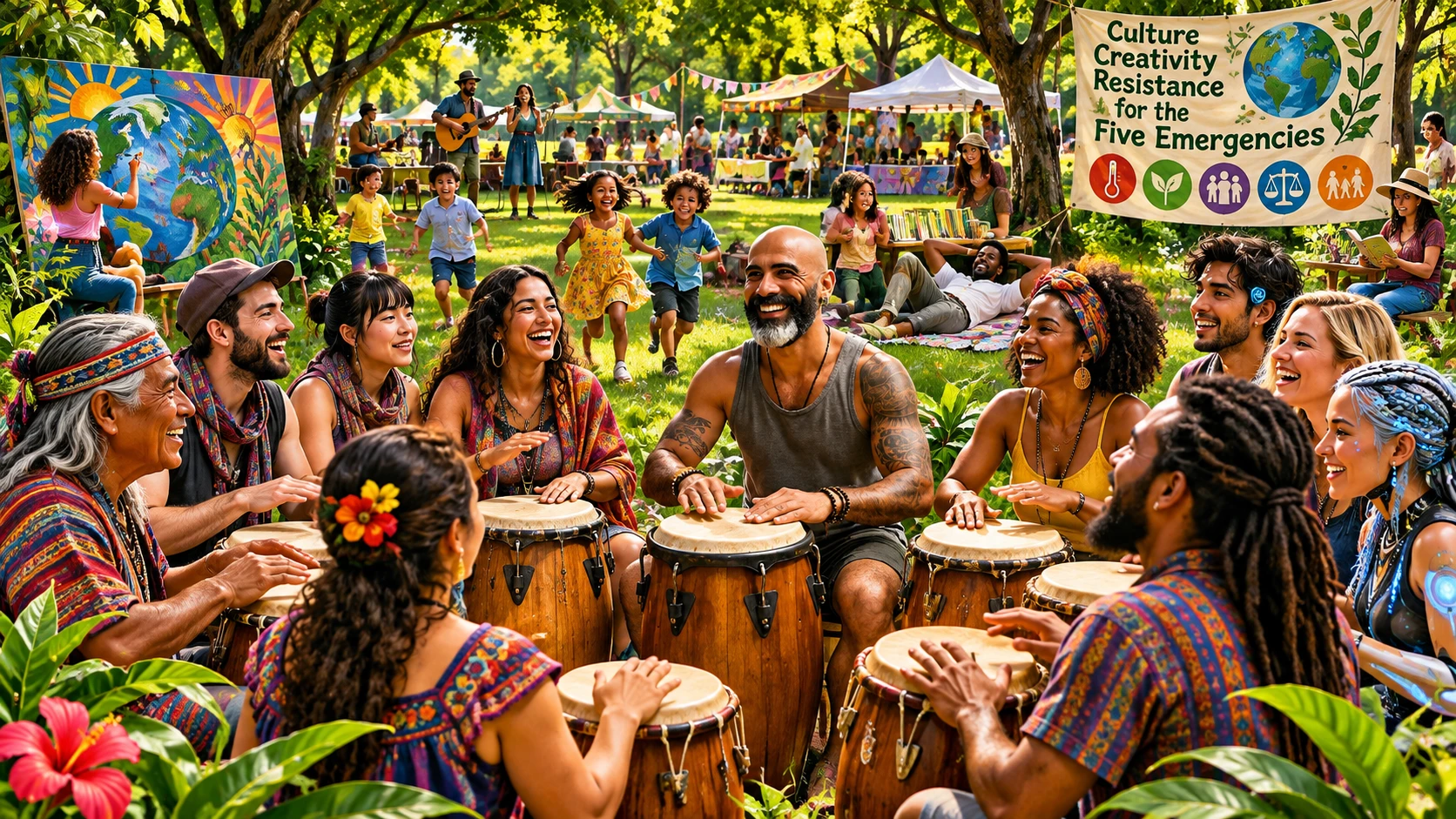
A song can carry a demand for freedom. A dance can affirm an identity others want erased. A painting can make suffering impossible to ignore. A poem can hand someone the words they have been searching for: “My life matters, and so does my future.”
Culture is never only entertainment. Again and again, it has been one of the ways ordinary people defend their dignity, resist injustice, and rehearse the world they want to live in. When the facts are overwhelming and the institutions are slow, culture is often where courage is gathered first.
Today, we can bring that same creative spirit to what we call the Five Emergencies: Climate, Ecological, Democracy, Humanity, and Displacement. In this post, these five terms serve as a framework for connecting our responsibilities to the Earth and to one another—and for asking what role our songs, stories, and images can play in meeting them.
From Self-Expression to Collective Resistance
Freedom of expression makes room for people to question authority, describe their own experiences, and challenge the stories told about them. Self-expression gives that freedom a human voice—through movement, color, rhythm, language, and imagination. When many voices join, self-expression becomes something larger: a shared language of resistance.
Lessons From the Civil Rights Movement
During the United States Civil Rights Movement, songs such as “We Shall Overcome” and “This Little Light of Mine” helped people endure intimidation and keep moving together. Singing was not a pause between the important work—it was part of the work. Music strengthened resolve, spread the movement’s message, and helped raise funds for organizing (Library of Congress).
The reach of that culture became unmistakable in March 1965. Urging Congress to pass voting-rights legislation, President Lyndon B. Johnson declared, “And we shall overcome.” A movement’s anthem had entered the center of national policy debate (Library of Congress). A song alone did not change the law. But it shows how cultural expression can carry a demand for justice from church basements and jail cells all the way into the halls of power.
A Global Tradition
This is not only an American story. Freedom songs sustained the struggle against apartheid in South Africa. Under dictatorship in Chile, women stitched arpilleras—hand-sewn textile scenes—that documented the disappearance of their loved ones when speaking openly was dangerous. Across continents and generations, people have turned to culture when other doors were closed.
The Price Some Paid
We should be honest about something else: many who used art and culture to resist were persecuted for it—sometimes in brutal ways. Those in power rarely bother to silence what they believe is harmless.
Víctor Jara, the Chilean singer and a pioneer of the nueva canción movement of politically charged songs, was seized after the 1973 coup, tortured in a Santiago stadium, and killed by Pinochet’s forces. Even with his hands broken, he answered his captors by singing. The stadium now bears his name (Britannica).
Ken Saro-Wiwa, the Nigerian writer and television producer, used his pen to expose the destruction of Ogoni land and water by oil drilling. On November 10, 1995, Nigeria’s military government hanged him and eight fellow Ogoni activists despite a worldwide outcry—the same year he received the Goldman Environmental Prize (EBSCO Research Starters). His story is a reminder that environmental defenders and artists have often been the same people, facing the same dangers.
Persecution of artists is a warning sign for every one of the Five Emergencies. When creative voices are threatened, it is usually because they are telling truths someone does not want heard. Remembering those who paid the price is part of our responsibility—and so is defending the artists who speak out today.
The lesson is consistent: culture works alongside organizing, legal challenges, public pressure, and political action—never as a replacement for them.
Bringing Creativity to the Five Emergencies
What follows are ways we can use culture to support action. None of them is a claim that art alone can resolve these emergencies. Each is an invitation to let creativity strengthen the work we must do together.
1. Climate: Make the Future Personal
Climate communication needs evidence. But data alone rarely moves people to act. We also need space to express what we love—and what we are afraid of losing.
A song about a changing hometown, a mural imagining a cooler and greener neighborhood, or a poem written to a grandchild in 2050 can invite people into a conversation that charts and graphs cannot open on their own. These creative expressions become most powerful when they travel alongside clear demands: cleaner energy, safer housing, and real protection from dangerous heat and flooding.
UNESCO’s MONDIACULT 2022 declaration recognizes a role for culture in climate action, including the traditional and Indigenous knowledge systems that have long guided how communities live with the land (UNESCO).
2. Ecological: Express Our Relationship With Living Nature
Art, dance, music, and storytelling let us ask a deeper question: What kind of relationship do we want with the living world?
A community exhibition could celebrate local wildlife and the people working to protect it. Poetry could explore our responsibilities to rivers, forests, pollinators, and other species. A public performance could close with an invitation to join a habitat-restoration day that same weekend.
The purpose should be more than admiring nature from a distance. It should connect appreciation with care—and care with action.
3. Democracy: Keep Space Open for Dissent
A healthy democracy depends on room for criticism, uncomfortable questions, and voices outside the mainstream. When that room shrinks, artists are often among the first to feel it.
We should defend the freedom to write a challenging poem, perform political satire, paint a protest mural, or sing against injustice. UNESCO explicitly includes artistic freedom and freedom of expression among the rights governments should protect (UNESCO).
That freedom also carries responsibility. Our creative work can and should challenge harmful policies—without spreading falsehoods or denying anyone’s humanity. Truthfulness is what gives protest art its lasting power.
4. Humanity: Put Dignity Before Labels
Within this framework, the Humanity Emergency means confronting cruelty, dehumanization, and the treatment of people as disposable.
Our cultural response begins by making room for people to tell their own stories. Rather than speaking over those experiencing injustice, we can support their writing, performances, exhibitions, and gathering spaces—and then step back so their voices lead.
The goal is never to turn suffering into spectacle. It is to listen, recognize dignity, and connect that recognition to practical solidarity.
5. Displacement: Honor What People Carry
When people are forced from their homes, they lose more than an address. They may also lose language, memory, traditions, a sense of belonging, and the freedom to practice their culture. Yet people also carry their songs, recipes, and stories with them—and those can become anchors in an uncertain place.
UNESCO has identified forced displacement as a challenge to cultural rights and has reported initiatives that support migrants and internally displaced people through culture (UNESCO MONDIACULT report).
Community storytelling, music gatherings, and creative spaces can be part of our response. But they must accompany—not substitute for—safety, housing, legal rights, and meaningful support. As climate impacts grow, this work will only become more urgent.
Turn Expression Into Action
For our community, the next steps can be simple and practical:
-
Pair every creative moment with a clear call to action. An exhibition or performance should leave people knowing exactly one verified thing they can do next.
-
Let affected people lead. Give those living through these emergencies a leading role in telling their own stories.
-
Respect creators. Credit artists and seek permission before sharing their work.
-
Connect culture to organizing. Link creative gatherings with local organizing, public meetings, mutual aid, or restoration projects.
-
Open the door wide. Welcome participation without requiring professional artistic skill. Everyone has a voice worth adding.
We do not have to choose between serious action and creative expression. The strongest movements in history refused that choice—and so can we.
Solidarity: The Thread That Connects Us
The word that ties these efforts together is solidarity—not everyone expressing themselves the same way, but people using their different voices to defend one another’s dignity and future.
So let us make room for the dancers, musicians, painters, poets, singers, and storytellers—not at the edges of our work for justice, but at its heart.
Why This Matters to Me
I write this post from a personal place. For as long as I can remember, I have dreamed of becoming a conguero—an advanced conga player. The rhythm of the conga carries history, memory, and resistance in every beat.
But I made a choice. I set that dream aside so I could spend far more of my time on the work of protecting our children and biodiversity. I do not regret that choice, but I feel its weight. I know I am not alone: many people put their art on hold because the emergencies in front of us feel too urgent to wait.
What I never let go of is a love I have carried since childhood: creating Quoted Images. Pairing powerful words with images has become my own way of bringing culture into this work—a way to make an idea stick, travel, and spark a conversation. It reminds me that we do not always have to choose between creativity and service. Sometimes our creativity finds a new form inside the service itself.
If you have set aside a song, a sketchbook, or a dance to answer this moment, I hope this post gives you permission to bring a piece of it back. Our movement needs it.
A Question for You
What song, story, image, or tradition gives you courage when the emergencies feel overwhelming? Share it with our community—it may be exactly what someone else needs to hear today.
Mr. Alvarez, Content Curator | Climate Change Community LLC
Read posts at climatechangecommunity.com. Explore the Climate Tribe Social Founders Library: climatechangecommunity.com/library
Artificial intelligence is used to enhance my creativity and thinking in preparing this post. The ideas, experiences, and commitments are my own.
Protecting our Children & Biodiversity’s future towards a more sustainable and habitable Earth!
Compiled & Mr. Alvarez’s Thoughts | AI Enhanced.
