

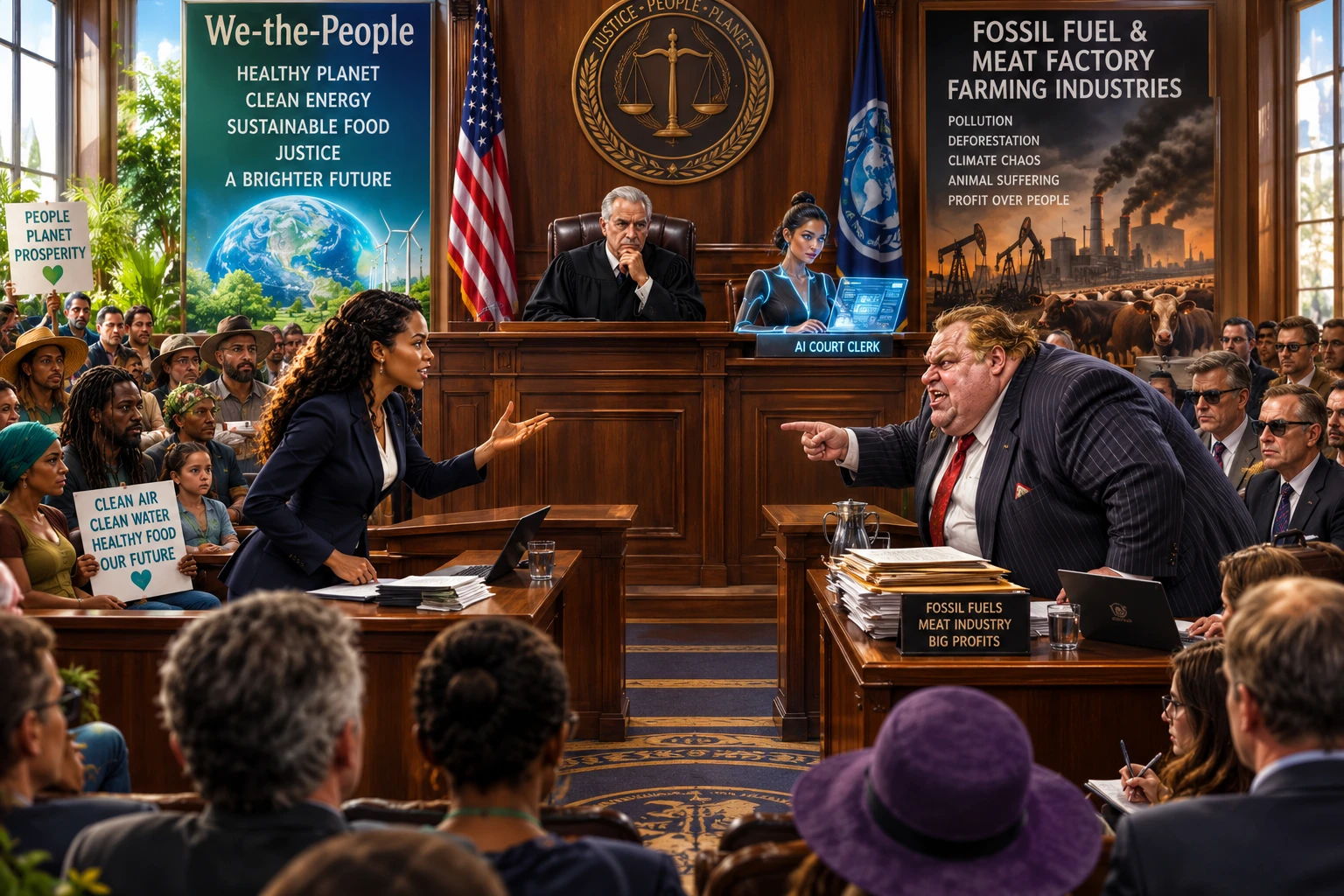
Why lawsuits brought by young people, states, cities, and villages have become a necessity — and why our children and our health are the common ground we all share
A note on how this post is arranged. The reflections below are my own, written as they came to me. With the help of advanced AI, they have been arranged — and in places rearranged — so that the main point lands clearly: the people who knowingly harmed our planet must help pay to repair it. Where the AI adds historical, legal, or statistical context, you will see it set apart as Advanced AI Commentary, so you always know which voice is speaking.
Why This Post, and Why Now
This blog post is about holding the meat factory farming industry accountable for deforestation, and holding the fossil fuel industry accountable for misleading us about what excess CO2 would do to our planet. But it is also about something deeper: the commonality we share with every person who should be holding them accountable — and even with the people who run those industries themselves.
Among hundreds of reasons, there are two that tell me these industries must now pay communities — states, cities, neighborhoods, and villages — not only in the United States but around the planet. I will get to those two reasons in a moment.
Their financial wealth is vast, and I believe much of it comes from all of us paying more and more for fuel, especially in countries where electric vehicles are not yet the main way people get around. Meanwhile, some people pay absolutely nothing to “fill the tank,” because they charge their electric vehicles from solar panels on their own homes. So yes, it is possible to pay zero dollars at the pump — but this post is not about that.
The Two Things We All Have in Common
Let me begin with my own experience of this commonality — one that even the executives of the fossil fuel and deforestation-driven factory farming companies can relate to. It is two-fold: our children and our health.
I have fixed computers for about 26 years and worked in office administration for about 19, so I have roughly 45 years combined in office administration and tech support. I started back in the days of the Wang computer — some of you may remember those big floppy disks — and I was super proud when I could finally afford my first 486DX2 with a 100 MB hard drive and 4 MB of RAM. It was considered top of the line back then. But again, this post is not about that, so hold on while I get to the point.
I worked in the Judiciary just shy of 14 years, at a cereal company for several months, and was assigned to a college in Brooklyn for six months once. I have been in hundreds of homes and businesses, fixing computers or working as a temp Office Assistant in one capacity or another. I have worked for judges, court officers, celebrities, once a well-known rapper, and many others, both in their offices and, as a side job, in their homes. Thank you for being patient — here is the point.
Every one of us — you, reading this right now — shares at least one of two things. The first is our health. We all desire it; many have it, and many others work hard to regain or maintain it. The second is children. Almost everyone has children in their lives, whether their own or those they love.
A few of the judges and court officers I worked with — extremely ethical, fair, and super kind people with whom I shared real chemistry — invited me into their homes to fix their devices. One had four children, another three. Two were struggling with health issues, and others worried about the future of nieces and nephews they were close to, having no children of their own. I listened a lot and learned quite a bit. The judge with four children was deeply worried, because two of them were about to leave for college. The others shared similar concerns.
Health and children. That is the common ground. And it is common ground the fossil fuel and factory farming executives share with every family they are harming.
Advanced AI Commentary: Mr. Alvarez’s point here is powerful because it refuses to treat these executives as cartoon villains. They have children and they worry about their health too. That is exactly what makes the historical record so damning: the companies were not ignorant. A 2023 study published in Science examined ExxonMobil’s own internal climate projections from 1977 to 2003 and found that its scientists predicted global warming with striking accuracy — roughly 0.2°C per decade — while the company publicly cast doubt on climate science for decades. The industry knew what was coming for everyone’s children, including its own.
The meat sector tells a parallel story. Cattle ranching has long been identified as the leading driver of Amazon deforestation, and livestock as a whole is a major source of methane. One recent analysis found that JBS — the world’s largest meat company — produced more methane in 2023 than Shell and ExxonMobil combined.
We Can Now See the Damage
We can now literally see the ugly and devastating effects of the Five Emergencies. The advanced AI I use to help me locate statistics and compare current and historical data does an amazing job — not only of providing that information, but of educating me, and even holding me accountable when I say something that could come back to bite me in the you-know-where.
Advanced AI Commentary: Here is where we stand, according to Europe’s Copernicus Climate Change Service: 2024 was the warmest year on record at about 1.60°C above pre-industrial levels, and 2025 was the third warmest at 1.47°C. Most alarming, 2023–2025 became the first three-year period whose average exceeded 1.5°C — the threshold the Paris Agreement was built around. Carbon dioxide at Mauna Loa reached a seasonal peak of about 432 parts per million in May 2026, more than 50% above pre-industrial levels.
This is what “spiraling” looks like in data: each year adds more heat-trapping gas than the planet can absorb, and the damage — heat domes, wildfires, floods, crop losses — arrives in communities that did little to cause it. The only way to stop the spiral is to stop adding fuel to it, which means moving to renewable energy far faster than we are now.
Why Lawsuits Are Now a Necessity
Not only do the fossil fuel and deforestation-driven factory farming goons need to be held financially accountable, with funds going directly to states, cities, neighborhoods, and villages around the world — they should also help pay for the transition to a truly clean and green world.
I recently learned, even as I was writing this, that many places have already started holding the fossil fuel industry accountable through lawsuits. Good on you for being brave and caring this deeply.
Advanced AI Commentary: Lawsuits have become necessary because the other doors are closing. In 2025 and 2026 the U.S. federal government moved in the opposite direction: a presidential executive order in April 2025 directed the Justice Department to stop state “overreach” on energy, the Justice Department then sued Hawaii, Michigan, New York, and Vermont to block their climate actions, and in February 2026 the EPA rescinded its 2009 “endangerment finding” — the legal foundation for regulating greenhouse gases. When lawmakers and agencies retreat, courts are often the last place where evidence must be heard under oath. Below is a snapshot of where the major cases stand as of mid-October 2026.
Cities and States vs. Big Oil
-
Suncor Energy v. Boulder County (U.S. Supreme Court). Boulder, Colorado sued Suncor and ExxonMobil in 2018, arguing they deceived the public about climate risks. The Supreme Court heard arguments on October 5, 2026; a decision is expected by June 2027. The ruling could decide whether nearly 60 similar suits nationwide (the companies’ own count) can go to trial.
-
Multnomah County, Oregon. Filed in 2023 over the 2021 heat dome that the county says killed 69 residents. It seeks damages and a roughly $50 billion fund to weatherproof the county. Motions to dismiss were argued in June 2026.
-
Hawaii and Honolulu. The State of Hawaii filed suit against seven oil and gas companies in 2025 despite the federal government’s attempt to block it; Honolulu’s long-running case continues as well. Both are largely on hold pending the Boulder decision.
-
Baltimore, Annapolis, and Anne Arundel County, Maryland. Dismissed at the trial level, but now before the Maryland Supreme Court, which in March 2026 refused the companies’ request to pause review.
-
New York’s Climate Superfund Act. This law would have required the largest emitters to pay up to $75 billion toward climate costs. On August 31, 2026, a federal judge ruled it preempted by the Clean Air Act. Vermont’s similar law still faces its own challenges.
Young People Take the Lead
-
Held v. Montana. Sixteen young Montanans won the first youth climate trial in U.S. history in 2023, and the Montana Supreme Court upheld their right to a clean and healthful environment in December 2024.
-
Navahine F. v. Hawaii Department of Transportation. In June 2024, thirteen young people reached a historic settlement committing Hawaii to plan for zero emissions from its transportation system by 2045.
-
Lighthiser v. Trump. Twenty-two young people challenged executive orders expanding fossil fuels. A three-judge Ninth Circuit panel affirmed dismissal on June 2, 2026; the plaintiffs have asked the full Ninth Circuit to rehear the case.
-
Youth petition against the EPA. In February 2026, eighteen young people petitioned the D.C. Circuit to review the EPA’s repeal of the endangerment finding, alongside a challenge by 25 states and territories, Washington, D.C., and 12 local governments.
Holding the Meat Industry Accountable
-
People of New York v. JBS USA. New York’s Attorney General sued JBS in 2024 over “net zero” claims. After an early dismissal without prejudice, JBS settled in November 2025, agreeing to pay $1.1 million toward climate-smart farming, stop unsubstantiated environmental claims, and accept three years of monitoring.
-
Greenpeace Netherlands v. JBS (in preparation). In 2026, Greenpeace began the legal steps toward suing JBS in Dutch court over the climate and human rights impacts of its expansion, including about $2.5 billion in planned slaughterhouses in Nigeria.
Around the World
-
International Court of Justice (July 23, 2025). The world’s highest court issued a unanimous advisory opinion that nations have legal obligations to prevent climate harm, and that failing to act — including through fossil fuel production and subsidies — can be an internationally wrongful act.
-
Lliuya v. RWE (Germany, May 2025). A Peruvian farmer sued German utility RWE over glacial flood risk to his town. Although his specific claim was dismissed on the facts, the court confirmed that major emitters can, in principle, be held liable for climate harms abroad.
Advanced AI Commentary: Not every case is a win, and readers deserve that honesty: Juliana v. United States ended without a trial, Lighthiser was dismissed, and New York’s superfund law was struck down for now. But the pattern is clear. Each case forces evidence into the public record, each settlement changes corporate behavior, and each legal theory that survives — Montana’s constitutional right, the ICJ’s opinion, the RWE ruling — becomes a tool for the next community. That is why Mr. Alvarez’s call is so timely: states, cities, neighborhoods, and villages do have rights, and more of them are learning to use them.
The United States Is Falling Behind
The United States in particular is now behind the curve. To make the point: BYD is sending its electric vehicles all around the world, and its reach is growing amazingly fast, even as you read this. It is starting to feel like everyone outside the United States will soon be driving one. Meanwhile, the U.S. market for electric vehicles is truly stagnant.
It is amazing how a president and cabinet not focused on the well-being of the people can become a regressive fixture standing in the way of what must be a progressive Green Way Forward — precisely for our children’s and our health’s sake.
Advanced AI Commentary: The reports Mr. Alvarez remembers are real, and the numbers have only grown. In September 2026 alone, BYD sold 180,700 vehicles outside China — up more than 150% from a year earlier — bringing its overseas sales to about 1.34 million in the first nine months of the year, a 93% increase. BYD has told analysts it is targeting up to 2 million overseas sales in 2026 and more than 2.5 million in 2027, with factories in Brazil and Indonesia already operating and a plant in Hungary set to begin assembly this winter.
In the United States, the story runs the other way. After the federal EV tax credit ended on September 30, 2025, electric vehicles fell from 11.4% of new car sales to around 5–6%, where they have remained throughout 2026. By comparison, more than half of all new cars sold in China in 2025 were electric, and over 30% in Europe. The world is not waiting for the United States — it is moving on without it.
Nature Has Rights, Too
There is a book I keep in storage. I have never read it cover to cover, but I sometimes pick it up and read a chapter or two, as I do with many of my books about climate change. I believe it is called The Rights of Nature, or Nature Has Rights. Whatever its exact title, its message is true: Nature should have rights. Animal species still hunted — and those already slaughtered or killed for sport — should have rights. The Ocean and its species should have rights. And those rights should include living on a planet where simply being themselves improves the planet, which is 100% true.
Everything is connected, and everything helps maintain life on this planet. The air we breathe, the plants we eat, and the water we drink all pass through these living systems. It is humans who disrupt them — at least those ruled by avarice, ignorance, arrogance, and the need to grab or hold on to power. It is also those who hold a distorted religious belief and try to reshape society to fit it, and those whose apathy and doomism have taken over their thinking.
Advanced AI Commentary: The book Mr. Alvarez describes may well be The Rights of Nature by environmental lawyer David R. Boyd, who later served as the UN Special Rapporteur on Human Rights and the Environment — though several books share similar titles. Either way, the idea has moved from philosophy into law: Ecuador wrote the rights of nature into its constitution in 2008, and courts and legislatures in countries such as Colombia, India, New Zealand, and Spain have since recognized rivers, forests, and ecosystems as having legal standing. When nature has rights, the communities that defend it gain a stronger voice in court.
Self-Transformation and the Power of We-The-People
We can break through all of this with Self-Transformation — a kind of transformation many of us are not used to, rooted in total compassion and respect. When it comes to accountability, We-The-People hold the key through elections. I cannot vote myself, because of a specific law I was unaware of, but I can encourage you — and that is exactly what I am doing. Please vote for those who care about our struggles.
We need universal health care, and while it will not happen in a single election, moving truly capable candidates into office is a start. We also need the accountability this post is about: accountability for the suffering caused to people and the planet by those who know what they are doing and keep doing it. Under no circumstances can we allow our children to inherit a planet so riddled with problems that it overwhelms them and puts their very existence in question.
We cannot keep harming our planet and the life it holds, from the oceans to the mountaintops. So if you are a state, city, neighborhood, or village: you have rights, and nature has rights. It is time we combine them and hold those who are destroying us accountable.
Advanced AI Commentary: This is the heart of the post. Lawsuits are one tool; elections, consumer choices, community organizing, and the shift to renewable energy are others. Each works better when people understand how they connect — which is exactly the kind of climate competence Climate Change Community exists to build.
What You Can Do Now
I am working hard right now to open SDL5 and Climate Tribe Social, and I guarantee that what you will find there — even now — is not only informative but encouraging. Until they are ready, please read the blog posts at climatechangecommunity.com or adaptive-resiliency.info (the latter loads faster, and I have already started adding a few extra posts there).
I am sending out invitations to Climate Tribe Social, and I have already sent many to friends in the United Kingdom and Ireland. If you would like to be on the list, send an email to invite@climatetribe.social or contact@climatechangecommunity.com. Please send it in plain text only — no links.
And finally — thank you. Thank you for reading, for caring, and for standing with every community brave enough to demand accountability.
Read posts at climatechangecommunity.com
Protecting our Children & Biodiversity’s future towards a more sustainable and habitable Earth!
Compiled & Mr. Alvarez’s Thoughts | AI Enhanced.
Mr. Alvarez, Content Curator, Climate Change Community
A note on AI: Artificial intelligence is used to enhance my creativity and thinking — to research, organize, and fact-check — while the reflections, experiences, and convictions in this post are my own.
Sources
-
Supreme Court hears climate liability case (Ballotpedia, Oct. 13, 2026) — https://news.ballotpedia.org/2026/10/13/supreme-court-hears-climate-liability-case/
-
What to Know About Suncor v. Boulder (Earthjustice) — https://earthjustice.org/brief/2026/what-to-know-about-suncor-energy-v-boulder-county
-
Climate Litigation Updates, March 23, 2026 (Sabin Center, Columbia Law) — https://climate.law.columbia.edu/news/climate-litigation-updates-march-23-2026
-
Federal court holds NY Climate Superfund law preempted (Jones Day) — https://www.jonesday.com/es/insights/2026/09/federal-court-holds-new-yorks-climate-superfund-law-preempted-by-caa
-
DOJ sues Hawaii, Michigan, New York, and Vermont (National Law Review) — https://natlawreview.com/article/doj-files-suit-against-hawaii-michigan-new-york-and-vermont-related-climate-legal
-
Multnomah County heat dome lawsuit (Hoodline, June 2026) — https://hoodline.com/2026/06/heat-dome-showdown-portland-takes-big-oil-to-court-over-50-billion-tab/
-
Appeals court affirms dismissal of Lighthiser v. Trump (Inside Climate News) — https://insideclimatenews.org/news/03062026/appeals-court-dismisses-lighthiser-v-trump-youth-climate-case/
-
Youth climate lawsuit seeks full Ninth Circuit hearing (Daily Montanan) — https://dailymontanan.com/2026/07/28/youth-climate-lawsuit-seeks-full-ninth-circuit-hearing/
-
Historic agreement settles Navahine climate litigation (Hawaii Governor’s Office) — https://governor.hawaii.gov/newsroom/office-of-the-governor-news-release-historic-agreement-settles-navahine-climate-litigation/
-
JBS settles New York green claims suit (Just Food) — https://www.just-food.com/news/jbs-settles-green-claims-suit/
-
Greenpeace plans to sue JBS (Inside Climate News) — https://insideclimatenews.org/news/31052026/greenpeace-lawsuit-against-jbs-nigeria-expansion/
-
ICJ Advisory Opinion on climate change, July 23, 2025 (ELAW) — https://elaw.org/resource/icj_climateao_2025
-
Lliuya v. RWE ruling (Germanwatch) — https://www.germanwatch.org/en/93166
-
Copernicus: 2025 was the third hottest year on record — https://climate.copernicus.eu/copernicus-2025-was-third-hottest-year-record
-
Annual carbon dioxide peak reaches 432 ppm (UC San Diego) — https://today.ucsd.edu/story/annual-carbon-dioxide-peak-reaches-432-parts-per-million
-
BYD September 2026 sales and overseas boom (Yahoo Finance) — https://finance.yahoo.com/energy/articles/byd-shakes-off-weak-start-024500104.html
-
BYD targets up to 2 million overseas sales in 2026 (China EV Home) — https://chinaevhome.com/2026/09/08/byd-targets-up-to-2m-overseas-sales-in-2026-eyes-over-2-5m-in-2027/
-
One year after the end of the EV tax credit (NPR via KUNC) — https://www.kunc.org/npr-news/2026-09-30/one-year-after-the-end-of-the-ev-tax-credit-is-the-future-still-electric




