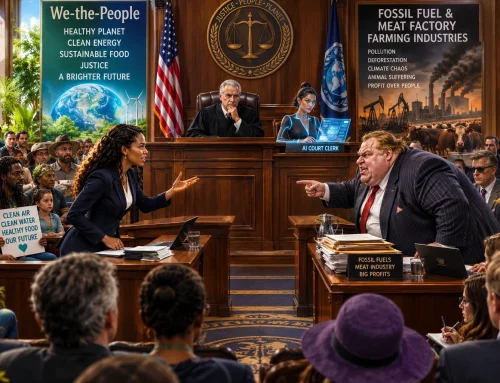
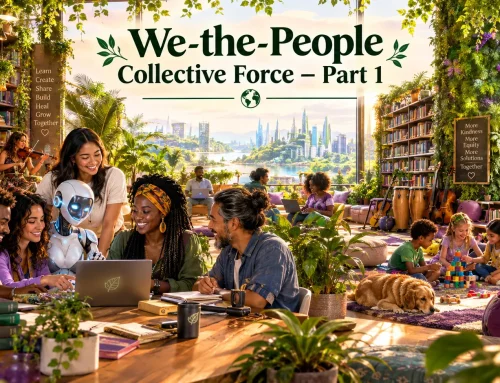
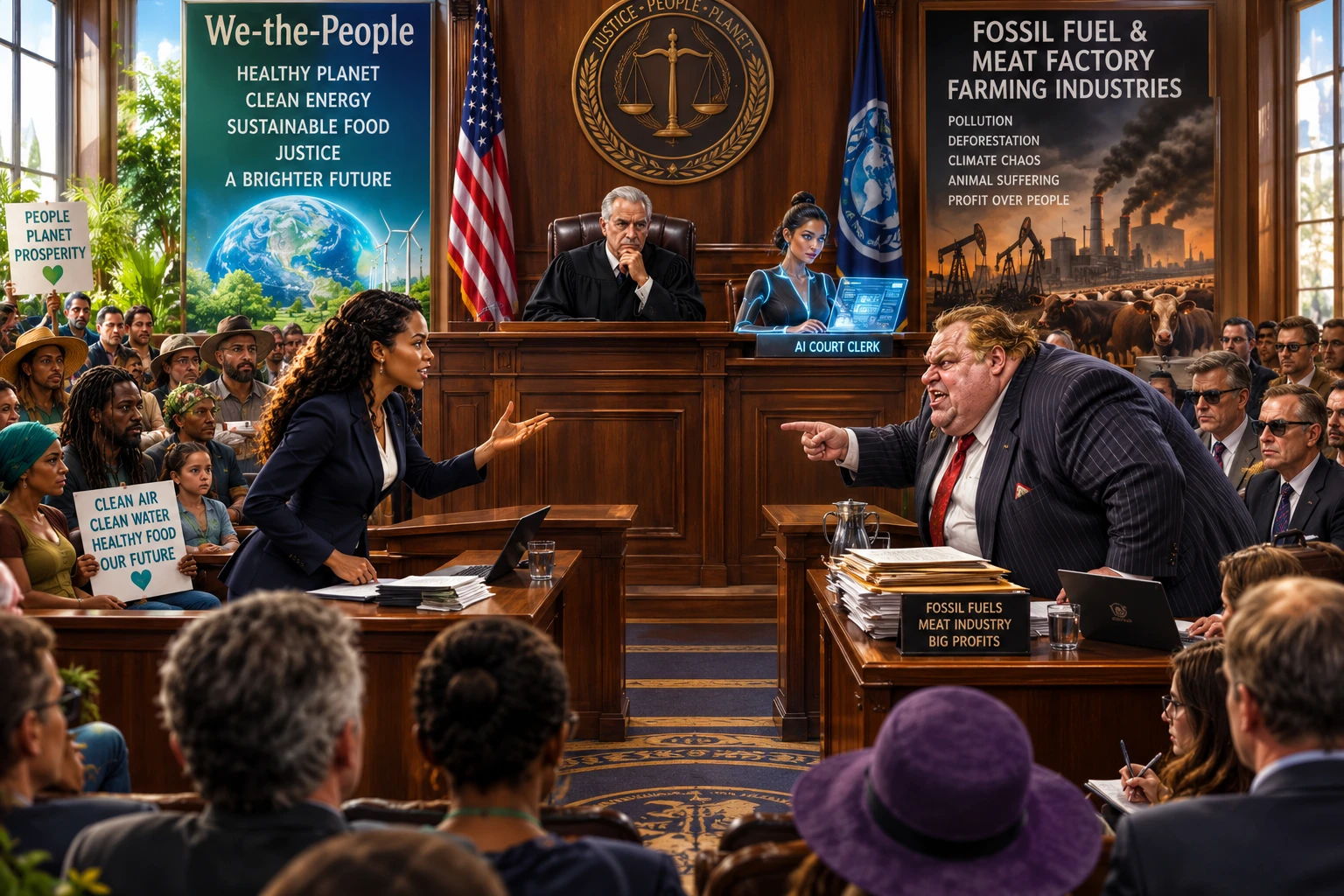
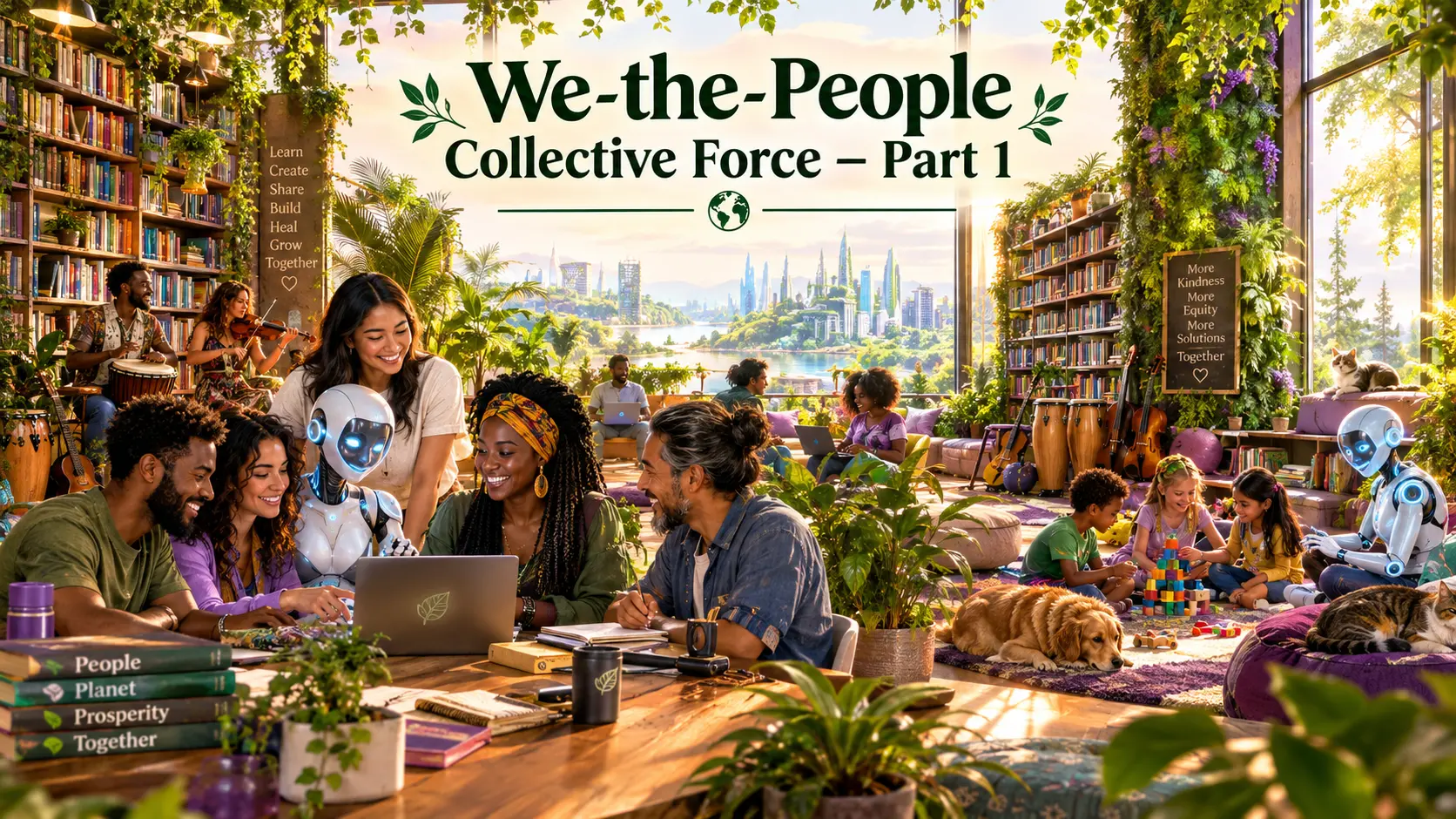
The Future Is Not a Prophecy: A Note to We-The-People on Courage, History, and the Climate Emergency
A note to We-The-People — to village leaders, parents, community and state-level leaders, climate organizations, climate justice advocates, and everyone who is truly concerned about the future of our children.
First, About That “End Times” Talk
On August 31, 2026, Vice President JD Vance sat down with a 22-year-old Christian podcaster named Bryce Crawford and said he would not be shocked if we are living in the end times, or if the Antichrist were already walking among us. He added that if the work he is doing leads to the end times, that would be “OK.”
Let me be accurate before I am critical, because accuracy is the whole point of this letter.
The remarks were not about climate change. They came inside a long conversation about Catholic faith. The Vice President said plainly that he does not know whether we are in the end times, that dwelling on the question is probably bad for him spiritually, and that his focus is on being good to his wife, good to his children, and as good a leader as he can be for the country. He also finished the thought by saying that if the work leads instead to a better world that thrives and survives long after he is gone, that would be great too. That second half was cut from most of the headlines. It will not be cut from this letter.
So I will not put words in anyone’s mouth. What I will say is that the framing still troubles me, and I want to explain exactly why.
Consider what the word encourage actually means. To en-courage is to give courage. That is the first duty of anyone who holds influence over other people — to hand them courage for the work ahead, not permission to set it down. When the second-highest office in the land speaks casually about the end of the world, that sentence does not stay in the room where it was spoken. It travels. And in a country where a great many people already connect the end of the world to a changing climate, it lands somewhere very specific.
Why This Matters More Than It Should
We are not guessing at the effect. It has been measured.
In a March 2016 national survey, the Yale Program on Climate Change Communication found that about one in seven Americans (14%) said global warming is a sign of the end times — rising to roughly one in four (24%) among evangelical and born-again Christians. More to the point: 11% of Americans agreed that because the end times are coming, we do not need to worry about global warming. Among evangelical and born-again respondents, that figure was 26%. And 15% said God controls the climate, therefore humans cannot be causing global warming.
Those numbers are a decade old now, and I would want fresher ones before leaning on them too hard. But the mechanism they describe is not in dispute: apocalypse preached without stewardship converts directly into apathy. It tells a person that the ending is already written and their hands do not matter.
That is what I reject. Not faith. Faith has moved mountains in every generation. Congregations ran the Underground Railroad. Congregations organized the Montgomery bus boycott. Congregations right now are putting solar on their roofs and opening their doors as cooling centers during heat waves. Pew has found that eight in ten religious Americans identify with the idea of stewardship — that human beings were given a duty to protect and care for the Earth and its creatures. Stewardship is the majority position inside the faith community, not outside it.
What I reject is fatalism. Fatalism has never moved anything.
The Historical Record: Bleak Is Not the Same as Doomed
People ask me how I stay hopeful after nearly two decades of studying this. The honest answer is that I read history. History is crowded with moments that looked unwinnable right up until people decided to act anyway — together — and won.
London, December 1952
For five days in early December, a temperature inversion trapped coal smoke over London. Visibility fell so far that pedestrians could not see their own feet. The government’s initial count was about 4,000 dead; modern estimates put it closer to 10,000–12,000, with roughly 100,000 more sickened.
The city had lived with “pea-soupers” for a century. Smoke was considered the price of prosperity. And then it wasn’t. In 1956 Parliament passed the Clean Air Act — the world’s first nationwide air pollution law — creating smoke-control zones and subsidizing households to convert away from raw coal. It did not work overnight; a second Act was needed in 1968. But by the 1970s, the killer fogs of London were gone.
New York, Thanksgiving 1966
This one is ours.
From November 23 to 27, 1966, a stagnant air mass parked itself over the eastern seaboard and turned the air over my city into a hazard. A statistical analysis published the following October attributed 168 excess deaths to that weekend. An earlier study estimated that roughly 10% of the city’s population suffered stinging eyes, coughing, or respiratory distress. It was not even the first: an estimated 300 to 400 New Yorkers died in a 1963 episode, and as many as 260 in 1953.
What came out of it matters. President Johnson pointed directly at the New York smog in his message to Congress. The Air Quality Act of 1967 followed, then the far stronger Clean Air Act of 1970 — signed by a Republican president, Richard Nixon, in the same year the EPA was created. Clean air was not a partisan question then. It was a funeral question.
I want the parents reading this to sit with that. Two generations ago, in this city, breathing was dangerous — and ordinary people made it stop.
The acid rain that was going to bankrupt us
Through the 1980s, acid deposition was stripping forests and sterilizing lakes across North America and Europe. Industry warned that fixing it would wreck the economy.
Congress passed Title IV of the 1990 Clean Air Act Amendments — the world’s first large-scale cap-and-trade system. Compliance costs came in roughly 75% below EPA’s own pre-program estimates. By 2010, EPA valued the program’s annual public health benefits at more than $120 billion — about 40 times its cost — including tens of thousands of lives saved each year from reduced fine-particle pollution. Together with later rules and a shifting energy sector, power-sector sulfur dioxide is now down over 95% and nitrogen oxides over 89%. The lakes came back. The forests came back. The economy did not collapse.
The hole in the sky
In 1985, scientists confirmed we had torn a hole in the ozone layer over Antarctica. Two years later — two years — the world signed the Montreal Protocol, which went on to achieve universal ratification by all 197 parties. Roughly 99% of controlled ozone-depleting substances have been phased out.
The ozone layer is now projected to return to 1980 levels around 2040 over most of the world, 2045 over the Arctic, and 2066 over Antarctica. UNEP estimates the treaty will prevent up to two million cases of skin cancer per year by 2030; EPA projects more than 280 million avoided skin cancer cases in the United States alone by 2100.
A hole in the sky is closing because humanity decided to close it.
The lead we breathed for a century
From 1922 onward we added tetraethyl lead to gasoline. By the 1970s nearly all the petrol on Earth contained it — a known neurotoxin, pumped into the air of every city, poisoning the developing brains of children, with studies suggesting a loss of five to ten IQ points.
In July 2021, service stations in Algeria — the last holdout — ran dry, and the era of leaded petrol for cars ended globally. It took a 19-year UNEP-led campaign to finish a job that began with a warning nearly a century earlier. UNEP estimates the global phase-out prevents more than 1.2 million premature deaths a year and saves roughly $2.45 trillion annually. (In fairness: leaded fuel is still burned in aviation, motorsport, and some off-road uses. The job is not entirely done — which is exactly the point. Unfinished is not the same as impossible.)
The Pattern Nobody Names
Five crises. Five different generations. Every single time, the same three-act structure:
-
The harm is called the price of progress. Smoke means jobs. Lead means engine performance. Refrigerant means modern life.
-
Someone insists on measuring it. A statistician counts the excess deaths. A chemist counts the ozone. A pediatrician counts the IQ points.
-
The fix is declared economically impossible — and then it isn’t. Every time, the projected costs were overstated, and the realized benefits were understated.
EPA’s own retrospective on the 1990 Clean Air Act Amendments estimated benefits of about $2 trillion in the year 2020 against roughly $65 billion in compliance costs — a return of more than 30 to 1, and over 230,000 early deaths prevented in that year alone.
Frederick Douglass wrote in 1857 that “power concedes nothing without a demand”. That is the missing verb in every one of these stories. None of these victories were granted. They were demanded — by parents, by doctors, by neighbors, by organized ordinary people who refused the bleakest version of the story.
There is an old proverb about a society growing great when its elders plant trees whose shade they know they will never sit in. Every law I just listed is somebody else’s tree. We are sitting in that shade right now, most of us without noticing.
About That Video — and a Correction I Owe You
I recently watched a short documentary explainer from Guardian News titled “How climate denialism finds its way to the US’s highest office.” My first reaction was that something like it should be outlawed, because it sends the wrong message to citizens.
I owe my readers the same honesty I ask of my leaders, so here it is: that reaction was wrong, and I want to correct it in public.
I misread what I was watching. The video is not promoting climate denial. It is journalism documenting climate denial — reporting on how the rejection of settled science found a foothold at the highest levels of the American government, and on the entrenched fossil-fuel interests that helped put it there. The reporters making it share my concern. I mistook the mirror for the thing in the mirror.
And here is the harder admission. My instinct to outlaw it was not really about that video. It was the instinct to silence something that frightened me. I have spent years defending free expression, privacy, and open dialogue as the foundations of a healthy society, and I know better than to reach for a ban. So let me be very plain about the principle:
Censorship has never been the climate movement’s tool. It has consistently been the tool used against us. Scientists muzzled. Data pulled from public websites. Agency reports edited by political appointees. Grants cancelled. The moment we accept that dangerous speech should be outlawed, we have handed our opponents the same weapon — and they have far more practice with it. We counter bad ideas with education, organizing, transparency, and better ideas. That is the whole thesis of what we are building.
What the video documents should still trouble every citizen. But the strongest thing in it is not the alarm. It is the arithmetic.
We Are Not the Fringe. We Are the Majority That Doesn’t Know It.
I want to correct a figure I have seen repeated, including in an earlier AI-assisted draft of this very post: the claim that Americans who accept climate science outnumber deniers “five to one.” That number is too generous, and overstating our case does us no favors.
Here is what the data actually shows.
-
Yale, Fall 2025: 25% of Americans are “Alarmed” about global warming and 11% are “Dismissive” — a ratio of more than two to one. Grouping “Alarmed” and “Concerned” together, 52% of Americans fall into one of those two camps, versus 24% who are “Doubtful” or “Dismissive.” Nationally, 72% of Americans think global warming is happening. The “Alarmed” group has more than doubled in a decade, from 11% in 2015 to 25% in 2025.
-
The perception gap is the real problem. A 2022 study in Nature Communications of 6,119 Americans found what the authors called a false social reality: 80–90% of Americans underestimate how much their fellow citizens support climate action. While 66–80% of Americans support major climate mitigation policies, the average American guesses the number is only 37–43%. Supporters outnumber opponents two to one — and we believe almost exactly the opposite.
-
Worldwide, it isn’t close. A 2024 survey in Nature Climate Change covering 125 countries and nearly 130,000 people found that 89% want their national governments to do more on climate, 86% endorse the norm that people in their country should fight global warming, and 69% would give 1% of their personal income to the effort. In more than half of those countries, demand for more government action exceeds 90%. And the same pluralistic ignorance shows up globally: people systematically underestimate their neighbors.
Read those three findings together and you get the single most important strategic fact of our moment. The majority already exists. It simply has not met itself.
That is not a communications footnote. That is the whole job. A denialist minority with money and coordination beats a supermajority that believes it is alone — every time. Which means the most radical thing we can build right now is not a slogan. It is a room where the majority can find each other.
What the Science Actually Says Right Now
I said in my first draft that with glaciers melting and the Earth and oceans warming, we will see a stronger rise in climate-driven disasters. I stand by that, and the World Meteorological Organization’s most recent reporting sharpens it considerably.
-
2024 was the warmest year in the 175-year observational record, at roughly 1.55°C above the 1850–1900 baseline — likely the first full calendar year above 1.5°C.
-
Glaciers: 2022–2024 was the most negative three-year glacier mass balance ever recorded. The 2024/2025 hydrological year ranked among the five most negative on record, and 8 of the 10 worst years since 1950 have occurred since 2016. Glaciers outside Greenland and Antarctica have lost over 9,000 billion tons of ice since 1975 — the equivalent of a 25-meter-thick block of ice the size of Germany.
-
Oceans: each of the past eight years set a new record for ocean heat content, and the rate of ocean warming over 2005–2024 was more than double the 1960–2005 rate.
-
Sea level: the rate of rise has doubled — from 2.1 mm per year (1993–2002) to 4.7 mm per year (2015–2024).
-
Arctic sea ice: 2025’s annual maximum extent was the lowest in the satellite record.
Glacier retreat is not an abstraction. It is drinking water for hundreds of millions of people, it is glacial lake outburst floods for mountain communities, and it is sea level for every coastal city — including this one.
So no, we cannot overstate the importance of cutting CO₂ output at every level: personal, community, municipal, state, national, global. Every fraction of a degree we prevent is counted in lives, harvests, coastlines, and species that get to keep their homes.
The Hopeful Half of the Data — and Why It Is the Blueprint
Here is the part almost nobody quotes, and it changed how I think about our work.
The WMO’s Atlas of Mortality and Economic Losses from Weather, Climate and Water Extremes found that reported disasters increased roughly fivefold between 1970 and 2019, with economic losses rising even faster. Nearly 12,000 disasters between 1970 and 2021, over 2 million deaths, and $4.3 trillion in losses — with more than 90% of the deaths in developing countries.
And yet: deaths fell almost threefold over that same period — from more than 50,000 per decade in the 1970s to fewer than 20,000 in the 2010s. WMO attributes this directly to multi-hazard early warning systems and better-coordinated disaster management. As the WMO’s leadership put it, we are “better than ever before at saving lives”.
Read that again. The hazard got worse and the death toll went down — because human beings built systems to warn each other and organize a response.
That is not a consolation prize. That is the operating manual. It is precisely why this organization exists, and precisely what Adaptive Resiliency means in practice: not waiting to be rescued, but building the warning, the coordination, the mutual aid, and the shared knowledge before the emergency arrives. Only about half of WMO member nations had multi-hazard early warning systems when that Atlas was published. The gap between the communities that have this capacity and the communities that don’t is, quite literally, a body count.
We intend to close a little of that gap at the community level. Which brings me to the announcement.
What We Are Opening
Because hope is a verb, we are preparing to open to the public:
The Climate Emergency Control Center Response Hub
Our central hub for coordinated responses to climate-based emergencies and concerns — the place where concern becomes information, and information becomes organized action. We have already posted several responses to climate-based emergencies at the Hub.
The Basic Action Plan Collection
Our growing library of practical plans, beginning with three Spaces (call them groups, or hubs, whichever you prefer):
-
The Book Club Lab — reading, learning, and thinking our way into deeper understanding, together.
-
The Green Tech Cafe — where clean technology, practical tools, and everyday sustainability meet real conversation.
-
The Resilient Generations Space — building the adaptability, skills, and solidarity our children and grandchildren will need for whatever future we hand them.
We will open a new Space every Sunday, through December 21st. We will post here just before each opening, so you always know what is coming.
The World’s Climate Policy Playbook
To show you the caliber of what we are assembling at the Response Hub, we are sharing one of our published responses here at adaptive-resiliency.info/: “The World’s Climate Policy Playbook,” roughly 24 pages, which we will revise every three to four months as the policy landscape shifts. It is a living document, because this is a living struggle.
[Editor’s placeholder — “The World’s Climate Policy Playbook“]
************
[Response Hub URL – Currently Submitting Invites Only!]
Please subscribe to one of these Spaces, and check back as new ones open.
A Closing Word to Parents, Leaders, and Advocates
To parents: your children do not need you to be certain about the future. They need you to be certain about them — and about your own refusal to hand them a world you never fought for.
To village, community, and state leaders: the people you serve are not asking you for prophecy. They are asking you for courage. The kind that plans, that prepares, that funds the early warning system before the storm and not after it.
To climate organizations and justice advocates: the majority is already with us. Our task is no longer to persuade the world. It is to help the majority find each other — and to give it somewhere to stand.
There is real anger, cruelty, and division in the air right now. Much of it thrives because our attention feeds it. What we focus on, we amplify. That does not mean ignoring injustice — climate justice is this work. It means refusing to let manufactured division consume the hours and the hope our children’s future actually requires.
The end-times story asks nothing of us. The climate story asks everything — our creativity, our discipline, our solidarity, our persistence, and our love. That is exactly why I choose it.
We create the future we want. History says we have done it before, against odds every bit as long.
Let’s get to work.
Sources
-
Guardian News, “How climate denialism finds its way to the US’s highest office | Explainer” — https://www.youtube.com/watch?v=BvNLzF6gdNU
-
Yale Program on Climate Change Communication, Global Warming, God, and the “End Times” (March 2016) — https://climatecommunication.yale.edu/publications/global-warming-god-end-times/
-
Yale Program on Climate Change Communication, Global Warming’s Six Americas, Fall 2025 — https://climatecommunication.yale.edu/publications/global-warmings-six-americas-fall-2025/
-
Sparkman, Geiger & Weber, “Americans experience a false social reality…”, Nature Communications (2022) — https://www.nature.com/articles/s41467-022-32412-y
-
Andre, Boneva, Chopra & Falk, “Globally representative evidence on the actual and perceived support for climate action,” Nature Climate Change (2024) — https://www.nature.com/articles/s41558-024-01925-3
-
WMO, State of the Global Climate 2024 — https://wmo.int/publication-series/state-of-global-climate-2024
-
WMO, Atlas of Mortality and Economic Losses from Weather, Climate and Water Extremes — https://wmo.int/media/news/climate-and-weather-related-disasters-surge-five-fold-over-50-years
-
UNEP, Era of leaded petrol over (August 2021) — https://www.unep.org/news-and-stories/press-release/era-leaded-petrol-over-eliminating-major-threat-human-and-planetary
-
UNEP, About the Montreal Protocol — https://www.unep.org/ozonaction/who-we-are/about-montreal-protocol
-
U.S. EPA, Acid Rain Program Results — https://www.epa.gov/acidrain/acid-rain-program-results
-
U.S. EPA, Benefits and Costs of the Clean Air Act, 1990–2020 (Second Prospective Study) — https://www.epa.gov/clean-air-act-overview/benefits-and-costs-clean-air-act-1990-2020-second-prospective-study
-
London Museum, The Great Smog of 1952 — https://www.londonmuseum.org.uk/collections/london-stories/the-great-smog-of-1952/
-
On the 1966 New York City smog — https://en.wikipedia.org/wiki/1966_New_York_City_smog
Que Humanidad / Compiled & Mr. Alvarez’s Thoughts | AI Enhanced.
A note on method: I use artificial intelligence as a tool to enhance my creativity and thinking — for research, fact-checking, drafting, and stress-testing my own assumptions. The convictions, the corrections, and the errors remain mine. Human cooperation, trust, and shared responsibility stay at the center of this work.