Billionaire Branding, Broken Trust, and Why Climate Tribe Social Builds Differently
A fortune can finance innovation. It can also finance a persuasive story about the person who owns it.
That tension sits at the center of Patrick Cc’s compilation, “The Worst Billionaires in Modern Day History,” which looks at how some of the world’s best-known wealthy figures manage the gap between their public image and their conduct. It is a provocative starting point, but commentary is not evidence. The stronger investigation begins where personality talk ends: with regulatory findings, court verdicts, documented business practices, and the people who carry the consequences.
The question here is not whether every wealthy person is secretly malicious. It is whether extraordinary wealth lets its owners collect the rewards of their decisions while shifting the risks onto everyone else — including our children and the living systems they will inherit.
This is where accountability matters more than likability.
The Scale of the Problem in 2026
Start with the numbers. Oxfam’s January 2026 inequality report, “Resisting the Rule of the Rich,” found that global billionaire wealth rose more than 16% in 2025 to a record $18.3 trillion, roughly three times the average pace of the previous five years, and up 81% since 2020. The number of billionaires passed 3,000 for the first time.
Oxfam’s deeper warning is about power, not just money. The report found billionaires are about 4,000 times more likely than ordinary citizens to hold political office, and it documented a growing grip on media: more than half of the world’s largest media companies have billionaire owners, and nine of the top ten social media companies are run by just six billionaires.
That last figure deserves a pause. The places where most people now get their news, organize their communities, and talk to one another are controlled by a handful of the richest people who have ever lived.
Mark Zuckerberg: Privacy Promises Meet the Business of Personal Data
A more relaxed interview style or a new wardrobe tells us little about whether users have real control over their information. A more substantial benchmark is Facebook’s 2019 settlement with the Federal Trade Commission, which imposed a $5 billion penalty for violating a 2012 order by deceiving users about their ability to control the privacy of their personal information.
The settlement required an independent board privacy committee, and Zuckerberg and designated compliance officers had to certify compliance with the mandated privacy program every quarter. The $5 billion penalty fell on the company, not on Zuckerberg personally — but the certification requirement was designed to make privacy commitments harder to dismiss as somebody else’s problem.
The lesson: a founder’s apparent authenticity is not a substitute for enforceable privacy protections.
When Platforms Harm Children: The 2026 Verdicts
For years, parents, teachers and pediatricians warned that social media was being designed to hook young people. In 2026, juries began to agree.
On March 25, 2026, a Los Angeles jury found Meta and Google’s YouTube liable in the first social media addiction case to reach trial. The plaintiff, now 20, said she became addicted as a child and that it worsened her mental health. The jury awarded $6 million, including $2.1 million in punitive damages against Meta and $900,000 against YouTube. TikTok and Snap settled before trial. Meta disagrees with the verdict and has appealed.
One day earlier, a New Mexico jury ordered Meta to pay $375 million after finding the company misled users about the safety of its platforms, in a case involving allegations that it enabled child sexual exploitation. Meta has said it will appeal that verdict as well.
Appeals are pending, and verdicts can change. But thousands of similar lawsuits are waiting, and for the first time ordinary citizens sitting on juries have looked at the evidence and concluded that design choices made in boardrooms reached into children’s lives. For a community whose first commitment is protecting our children’s future, that is not a side issue. It is the issue.
Elon Musk: When a Personal Platform Moves Financial Markets
In 2018, Musk announced on Twitter that he could take Tesla private at $420 per share and that “funding secured.” The Securities and Exchange Commission alleged he had not discussed specific deal terms, including price, with potential financing partners, and that the statements lacked an adequate factual basis.
Musk and Tesla settled without admitting or denying the allegations. Each paid a separate $20 million penalty, Musk stepped down as Tesla’s chairman for three years, and Tesla added independent directors and other governance reforms.
A civil settlement without admission is not a criminal conviction. But it is also more than an argument about posting habits. When a casual-looking post can move markets, a public persona built on spontaneity does not erase responsibility. Today Musk is also the first person in history to pass $500 billion in net worth, according to Oxfam — and the owner of one of the world’s most influential social platforms.
Purdue Pharma and the Sacklers: Corporate Profit, Public Consequences
On November 24, 2020, Purdue Pharma pleaded guilty in federal court to three felony offenses involving conspiracies to defraud the United States and violate the federal anti-kickback statute. The resolution included a $3.544 billion criminal fine, $2 billion in criminal forfeiture, and a $2.8 billion civil settlement structured as a bankruptcy claim — headline numbers that should not be confused with immediate cash payments.
Separately, Sackler family members agreed to pay $225 million to resolve civil False Claims Act liability. Purdue’s corporate guilty plea was not a personal criminal conviction of those family members.
These distinctions make ethical scrutiny more precise, not weaker. Who benefited? Who held authority? What misconduct was established? And did the consequences reach the people who made the decisions — or only the families who buried loved ones?
Sam Bankman-Fried: When Trust Became a Vehicle for Fraud
Some cases involve allegations or settlements. This one involved a jury conviction. On March 28, 2024, the FTX founder was sentenced to 25 years in prison after being found guilty of seven fraud and conspiracy offenses. The Justice Department said he misappropriated billions in customer funds, defrauded FTX investors of more than $1.7 billion and Alameda Research lenders of more than $1.3 billion, and ordered him to forfeit $11 billion.
This case exposes the core danger of founder-centered trust: confidence in a famous individual becomes a substitute for checking what an institution actually does with other people’s money. Business failure can happen honestly. Fraud is a breach of trust that no amount of optimism excuses.
Beyond Scandals: What the Tax System Rewards
Not every troubling feature of extreme wealth is illegal. ProPublica’s investigation of IRS data found that the 25 richest Americans gained an estimated $401 billion in wealth from 2014 through 2018 while paying $13.6 billion in federal income taxes — a 3.4% “true tax rate.”
That figure compares taxes to wealth growth, not taxable income, so it is not a conventional tax rate and does not prove evasion. But it raises a fair policy question: should what the wealthiest contribute depend so heavily on how and when their gains are classified? The debate is not only whether a tax return follows the rules. It is whether the rules distribute obligations fairly.
The Great Trust Recession: Why People Are Walking Away
Across YouTube, podcasts and independent media, one theme keeps coming up: people are losing faith in the platforms that dominate their daily lives. The research backs that up.
-
Pew Research Center found in late 2025 that only 37% of both Republicans and Democrats say they have at least some trust in information from social media sites — one of the rare areas where the two parties agree.
-
A Sprout Social survey of 2,250 users in the US, UK and Australia, released in March 2026, found that 88% report declining trust in news on social media because of the rise of AI-generated content — even as social media has become the top source for breaking news.
-
The 2026 Edelman Trust Barometer, surveying nearly 34,000 people in 28 countries, described a world retreating into “insularity.” Trust in national government leaders and major news organizations fell, while trust in neighbors, family and friends rose by 11 points. People are pulling trust back to the circles they can see and verify.
Then came this weekend. On Saturday, October 17, 2026, during the fourth nationwide round of No Kings demonstrations and early-voting mobilization, Meta suspended the No Kings coalition’s official Instagram account for roughly 90 minutes at the peak of the day, and organizers reported being locked out of posting even after the page came back. Meta’s spokesperson said the account’s high posting frequency triggered automated systems, called the action an error, and apologized. Organizers were not persuaded and demanded answers.
We should be fair about what is known: Meta says it was an automated mistake, and there is no public proof otherwise. But fairness cuts both ways. Whether by design or by accident, a single company’s system silenced a civic movement at its most important moment — and the people affected had no recourse except to wait. That is exactly the vulnerability that drains trust. When your community lives entirely on someone else’s platform, your voice exists at their discretion.
Stop Confusing a Compelling Story With a Clean Record
These cases should not be flattened into one accusation. A privacy settlement, a securities settlement, a corporate guilty plea, a civil resolution, jury verdicts under appeal, and a criminal conviction are different things with different levels of established responsibility. But they point toward one standard for evaluating powerful people — and powerful platforms:
-
Judge conduct rather than charisma.
-
Distinguish allegations, settlements, admissions, verdicts and convictions.
-
Ask who received the benefits and who absorbed the risks.
-
Examine whether a penalty changes incentives, not just whether it makes headlines.
-
Demand safeguards that do not depend on a wealthy person’s goodwill.
“Avarice” describes a motive, and outsiders cannot prove anyone’s private intentions. What we can examine is behavior: deception, misuse of entrusted resources, disregard for privacy, products designed to hook children, and arrangements that insulate decision-makers from consequences.
Enter Climate Tribe Social and SDL5
If trust is retreating to the circles people can see and verify, then the answer is not another giant platform asking for blind faith. It is smaller, purpose-built communities whose priorities are written down and whose incentives point in the right direction.
That is what Climate Tribe Social and SDL5 (Self-Direct Learning about the Five Emergencies) are being built to be. Our common goal, stated in the Climate Change Community Mission Statement, is simple: protecting our children’s future and Earth’s biodiversity. Everything else — the Spaces, the dialogues, the learning paths — serves that goal.
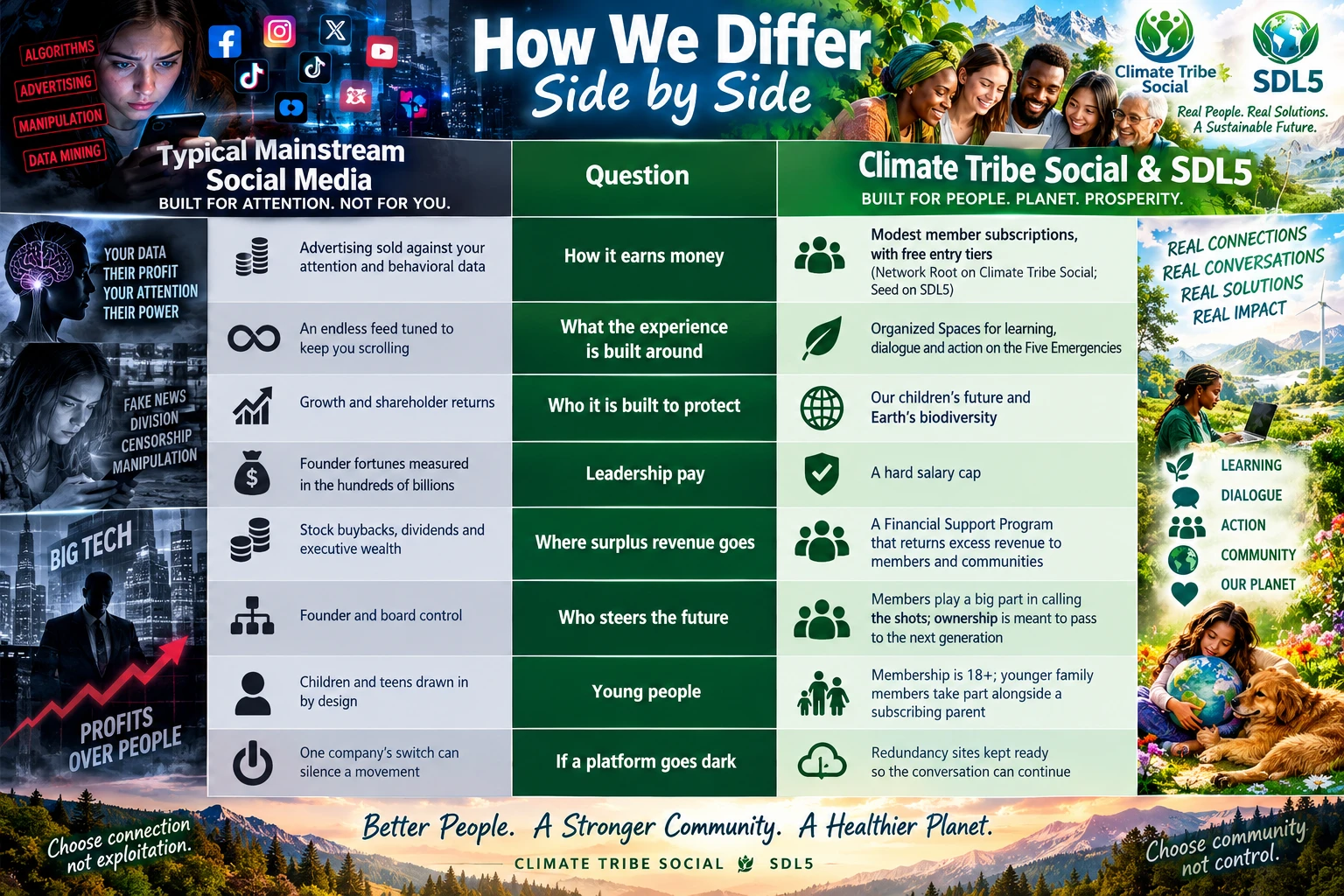
How We Differ, Side by Side
| Question | Typical mainstream social media | Climate Tribe Social & SDL5 |
| How it earns money | Advertising sold against your attention and behavioral data | Modest member subscriptions, with free entry tiers (Network Root on Climate Tribe Social; Seed on SDL5) |
| What the experience is built around | An endless feed tuned to keep you scrolling | Organized Spaces for learning, dialogue and action on the Five Emergencies |
| Who it is built to protect | Growth and shareholder returns | Our children’s future and Earth’s biodiversity |
| Leadership pay | Founder fortunes measured in the hundreds of billions | A hard salary cap |
| Where surplus revenue goes | Stock buybacks, dividends and executive wealth | A Financial Support Program that returns excess revenue to members and communities |
| Who steers the future | Founder and board control | Members play a big part in calling the shots; ownership is meant to pass to the next generation |
| Young people | Children and teens drawn in by design | Membership is 18+; younger family members take part alongside a subscribing parent |
| If a platform goes dark | One company’s switch can silence a movement | Redundancy sites kept ready so the conversation can continue |
Built Around the Five Emergencies, Not the Feed
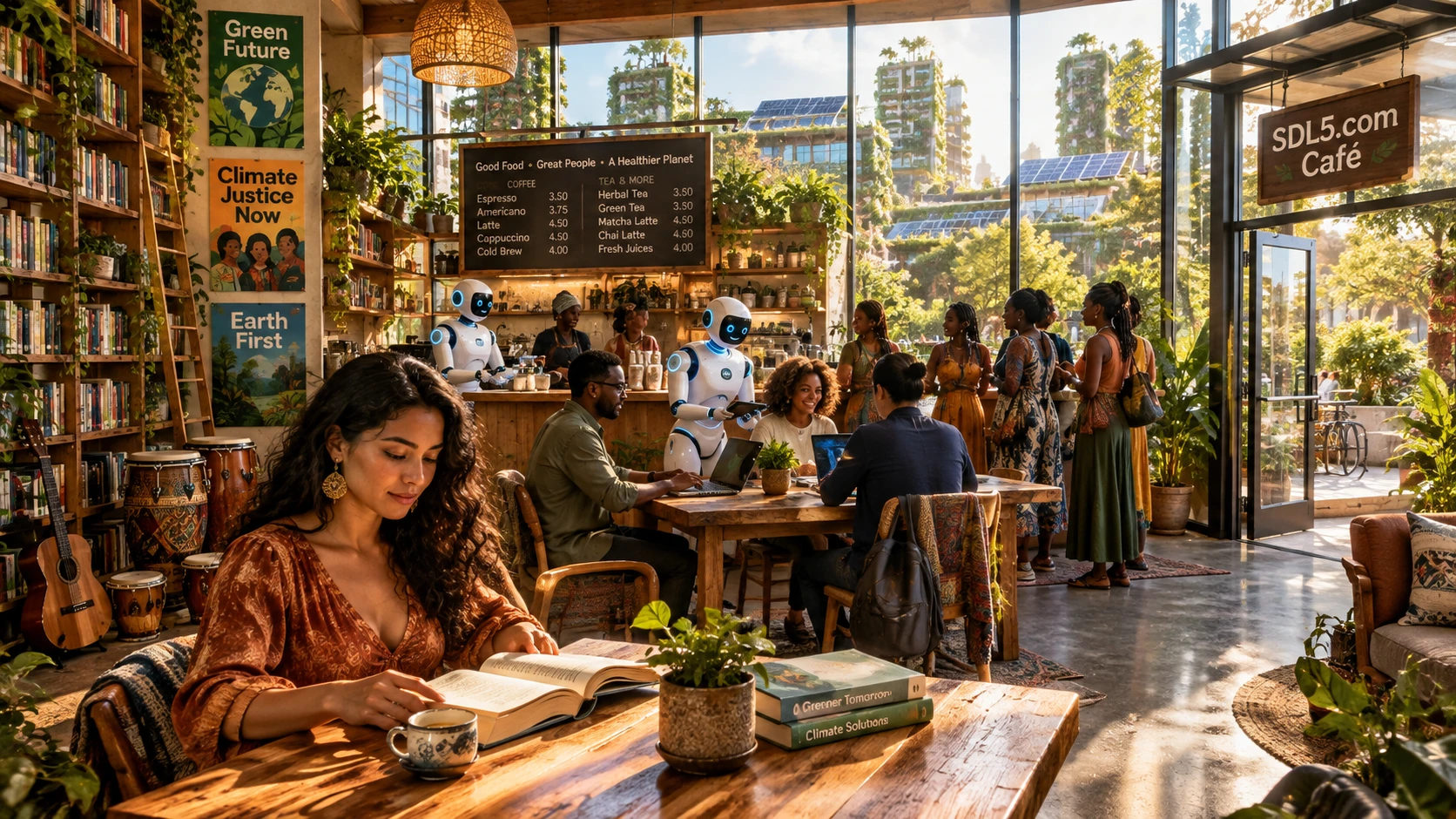
Climate Tribe Social is organized into Collections and Spaces covering the Climate, Ecological, Humanity, Democracy and Displacement Emergencies, along with practical Spaces for front-line workers, educators, public officials, families and elders. SDL5 carries the self-directed learning side of the work, including the Learning Out Loud series. The goal is not to keep you scrolling. It is to help you learn, connect with people who take the crisis seriously, and act where you live.
Science-Based and Open to Everyone
Our Spaces are science-based and welcome people of every faith and of none. They exist for collaboration and cooperation, not for pushing beliefs on one another or for the outrage-driven debate that mainstream algorithms reward.
Resilient by Design
Redundancy is one of the oldest lessons in technology work: never let one point of failure take everything down. That is why Climate Change Community keeps backup sites ready. If any single platform goes dark — by error or by decision — the conversation does not have to end.
The Only Billionaires Here Will Be Rich in What Matters
So let us be plain, because plainness is what has been missing.
No one will become a billionaire from Climate Tribe Social or SDL5 — not the Content Curator, and not anyone who comes after.
A hard salary cap limits what leadership can take. Revenue beyond what it takes to run and grow the platforms is meant to flow back through the Financial Support Program to members and communities. Ownership of Climate Change Community LLC is intended to pass to the next generation, and the membership is meant to play a big part in deciding how the community grows. That is why I call myself the Content Curator rather than the owner or founder.
If anyone grows rich here, let it be the members — rich in knowledge, in skills, in trusted relationships, in neighborhood resilience, and in the confidence that comes from facing hard truths together instead of alone.
And by the standard this post has applied to everyone else, you should not take that on charisma. Hold us to it. Ask how the salary cap works. Ask what the Financial Support Program has returned. A community that asks you to judge conduct over charisma has to be willing to be judged the same way.
How to Join
Climate Tribe Social and SDL5 are currently in an invitation-only phase while founding members are welcomed in stages. Public access for Climate Tribe Social is set for December 21, 2026. If you would like early access, request a Zoom dialogue by sending an email with no links to contact@climatechangecommunity.com.
A Closing Thought
The most useful question is not whether a billionaire seems relatable. It is whether the systems surrounding that billionaire protect everyone else when trust proves misplaced. Our children cannot afford platforms that treat their attention as inventory, and biodiversity cannot afford a public square owned by people with every incentive to keep the status quo. We can build something better — not by trusting one person, but by building together and holding each other accountable.
Read posts at climatechangecommunity.com or the ones here (first four or five with same featured image).
Links Used in This Post
- Patrick Cc: “The Worst Billionaires in Modern Day History” — starting point; commentary rather than a legal finding
- Oxfam — Global Inequality Report 2026: Resisting the Rule of the Rich
- Daily Sabah (dpa) — Oxfam on billionaire ownership of media and social platforms
- FTC — Facebook’s $5 Billion Penalty and New Privacy Restrictions
- Law360/Mealey’s — $6M verdict against Meta and YouTube in addiction trial
- AP via WSLS — Meta appeals landmark social media addiction verdict
- Red Sky Alliance — Los Angeles verdict and New Mexico $375M verdict
- SEC — Elon Musk and Tesla’s 2018 Settlements
- Justice Department — Purdue Pharma’s Guilty Plea
- Justice Department — Purdue and Sackler Criminal and Civil Resolutions
- Justice Department — Sam Bankman-Fried’s 25-Year Sentence
- ProPublica — How It Calculated the Wealthiest Americans’ “True Tax Rates”
- Pew Research Center — Americans’ trust in news organizations and social media sites
- Sprout Social — Q1 2026 Pulse Survey on trust in social media news
- Edelman — 2026 Trust Barometer: Society Slides into Insularity
- Statista — Edelman 2026: trust rising in neighbors, family and friends
- Common Dreams — Fears of Big Tech Censorship Grow After Meta Suspends No Kings Instagram Account
- TheWrap — No Kings Instagram Account Disappears Amid Nationwide Protests
- Mediaite via Yahoo — Meta’s explanation and apology
A note on how this post was made: I use artificial intelligence as a tool to enhance my creativity and thinking — to research, organize and sharpen ideas. The convictions, the priorities and the responsibility for what is said here remain human and remain mine.
Protecting our Children & Biodiversity’s future towards a more sustainable and habitable Earth!
Compiled & Mr. Alvarez’s Thoughts | AI Enhanced.