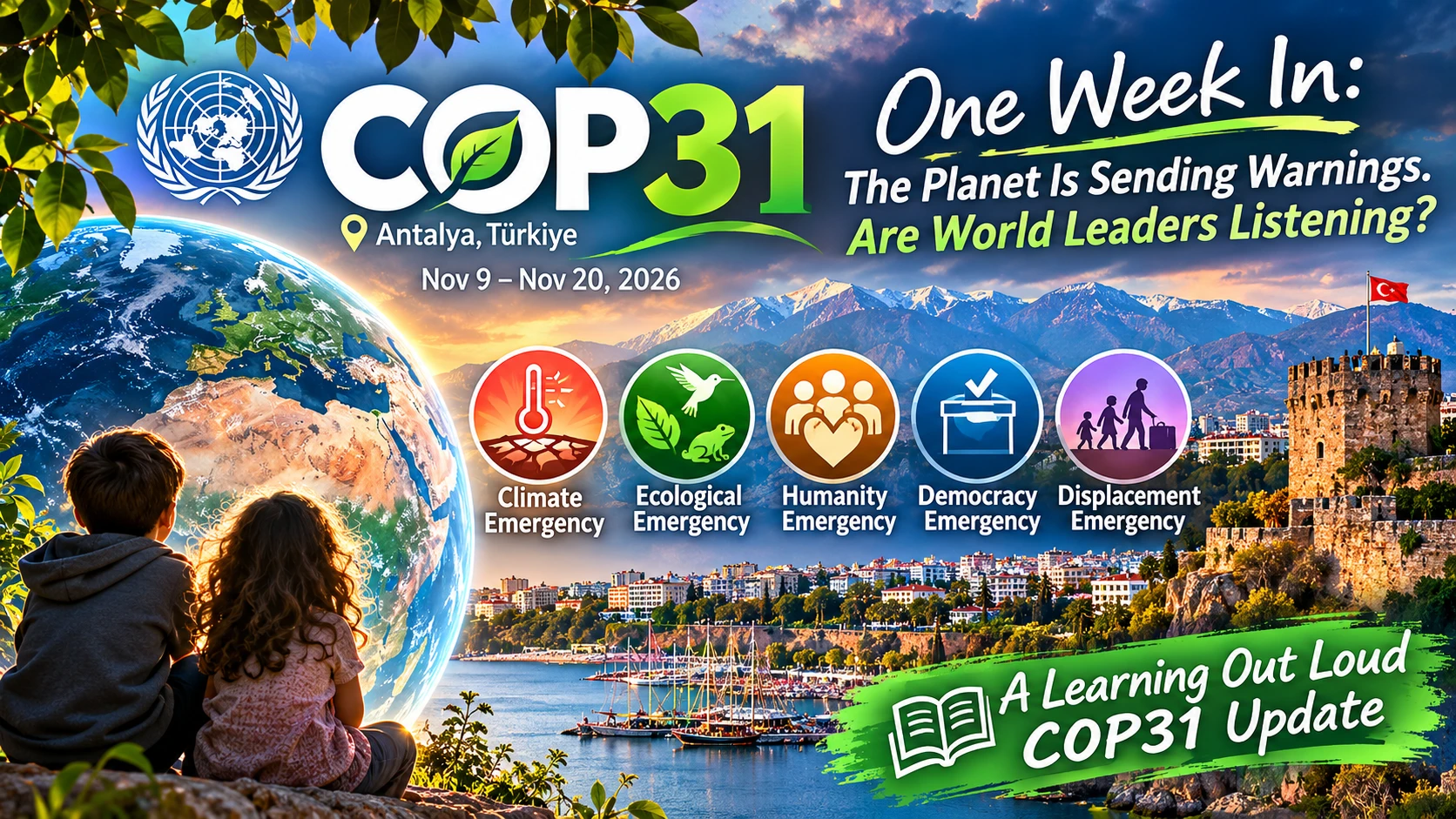
A Climate Tribe briefing on the first week of the UN Climate Change Conference in Antalya, Türkiye (November 9–20, 2026), plus the climate news around it that deserves our attention. Written Friday, November 13, 2026, with the summit still underway.
Learning Out Loud: Why I’m Writing This
Several of you asked me for an update on COP31. Here is the honest truth: I had not been following it closely. So rather than pretend, I did what I ask all of you to do. I sat down, read the reports, checked the claims, and tried to understand what is really happening in Antalya and why it matters to us.
What I found is a summit that is part diplomatic experiment, part financial standoff, and part referendum on whether the world is still willing to act together. It is unfolding during a year of record ocean heat, a deadly glacier flood in Nepal, a war-driven energy crisis, and the second straight year without an official United States delegation at the table.
One important qualification before we begin: COP31 is only halfway done. The negotiations run through November 20. This is an update on week one, not a verdict on the outcome.
What COP31 Is, and Why This One Is Different
COP stands for Conference of the Parties, the yearly meeting of nations that signed the UN Framework Convention on Climate Change. This is the 31st. Representatives from nearly 200 countries are meeting at the Antalya Expo Center on Türkiye’s Mediterranean coast.
This COP has a twist no previous summit has had: the presidency is split in two. Türkiye and Australia both wanted to host, and neither would back down. The compromise, struck at last year’s COP30 in Brazil, gave Türkiye the formal presidency. Turkish Environment Minister Murat Kurum is COP31 President and runs the venue, the opening and closing sessions, and the “Action Agenda” of voluntary initiatives. Australia’s climate minister, Chris Bowen, holds a newly invented title, “President of Negotiations,” with authority over the formal negotiating texts.
Some analysts have called the arrangement messy, and it carries real procedural risk. A summit that spends its final night arguing over who is in charge tends to produce thinner results. But the arrangement also preserved something important: Australia’s original plan to center Pacific Island nations. A pre-COP leaders’ gathering was held in Fiji and Tuvalu in October, where leaders saw rising seas up close.
The organizers call this an “implementation COP.” After decades of targets and promises, the question in Antalya is whether those commitments can be turned into money, projects, and measurable emissions cuts.
The Empty Chair: America’s Second Year on the Sidelines
For the second year in a row, the United States sent no official negotiating delegation. That is remarkable when you consider that the US is the largest historical emitter of greenhouse gases.
The Trump administration has withdrawn the US from the Paris Agreement, and that withdrawal took effect in January 2026. It has also begun withdrawing from the UN Framework Convention itself, the parent treaty underneath the whole COP process. The US is technically still a party until February 2027, which makes Antalya the last COP at which America holds a seat as a treaty member. It is leaving that seat empty. If the withdrawal stands, the US will be the first country ever to formally quit the Convention.
A White House spokesperson summed up the administration’s position by saying the country is focused on “common sense, not climate nonsense.” In practice, US funding to help vulnerable countries adapt has stopped, and support for climate science research has been cut.
Who showed up anyway
America is not entirely absent. More than 100 US governors, mayors, and state and city officials are attending, organized by America Is All In, Climate Mayors, and the U.S. Climate Alliance. Representative Sean Casten of Illinois is also leading a 19-member congressional delegation. These lawmakers cannot negotiate on behalf of the country, but their presence signals that American climate commitment runs deeper than any one administration.
Interestingly, not every delegate mourns the absence. Some told reporters they were relieved, since during the previous Trump term the US delegation had actively worked against progress. And many are already looking toward 2028 and whether a future administration might return to the table, especially after Democrats performed strongly in last week’s midterm elections.
For our community, the uncomfortable headline is simple. The nation with the deepest historical responsibility for the crisis has stepped out of the room just as the science says the window is narrowing.
The Backdrop: A War-Driven Energy Crisis
It is impossible to understand this COP without understanding the energy shock that preceded it. Since the US-Israeli strikes on Iran began in late February 2026, Iran has effectively blocked the Strait of Hormuz, a chokepoint for roughly a fifth of the world’s oil and gas. Fuel prices surged worldwide. The head of the International Energy Agency has described it as the largest energy crisis in history.
That crisis has cut both ways. Some governments are scrambling for new oil and gas supplies and locking in fossil infrastructure. Others are drawing the opposite lesson: that homegrown renewable energy is a matter of national security. Chris Bowen put it plainly earlier this year: “Renewable energy cannot be interrupted by a war.”
This is the most important framing for understanding Antalya. Climate action and energy security are no longer competing priorities. For many countries, they have become the same priority.
The Science Hanging Over Every Negotiation
Two major reports landed just before and at the start of the summit. Both are sobering.
WMO: 2026 is “off the charts”
The World Meteorological Organization released its State of the Climate Update on COP31’s opening day. Its key findings:
-
2026 will be one of the four warmest years on record. Global temperatures from January to September averaged about 1.47°C above pre-industrial levels.
-
The past 12 years (2015–2026) are individually the warmest on record.
-
Sea level reached its highest point in the satellite record, with June, July, and August 2026 setting new highs.
-
Ocean heat content is at a record high again. The oceans absorb about 90% of the excess heat we trap.
-
A very strong El Niño has been building since August and is expected to peak around December, raising the risk of extreme heat, drought, and flooding into 2027.
A useful scientific clarification: a single year near or above 1.5°C does not, on its own, mean the Paris Agreement goal has been formally breached. That goal refers to long-term average warming over decades. But the trend is unmistakable.
UNEP: The “Point of Return”
The UN Environment Programme’s Emissions Gap Report 2026, subtitled The Point of Return, delivers the hardest message yet. It concludes that keeping warming below 1.5°C with no or limited overshoot is no longer possible. The task now is to keep the overshoot as small and short as possible, then bring temperatures back down to 1.5°C by 2100.
To do that, the report says global emissions must fall, compared with 2025 levels, by:
-
18% by 2030
-
45% by 2035
-
69% by 2040
Even under this best-case pathway, peak warming would reach roughly 1.7–1.8°C around mid-century, and large amounts of carbon would have to be removed from the atmosphere. By contrast, if every country fully delivers on its current pledges, warming is still projected to reach about 2.6°C. Current policies point toward 2.8°C. UNEP notes that projections worsened in part because of the US withdrawal.
Every fraction of a degree matters. Overshoot is not permission to keep going as usual. It is a demand to move faster.
Money, Mountains, and Survival: The Finance Fight
If week one had a beating heart, it was money: who pays, how much, and how quickly it reaches the people already living through climate disaster.
Nepal: the test case
In late August, part of a glacier on Langtang Lirung, near the Nepal-China border, collapsed and sent a wall of rock, ice, and water down the Bhote Koshi valley. More than 1,400 people were killed, thousands remain missing, and Nepal’s government estimates the damage at about $2.7 billion. Nepal produces less than 0.1% of global greenhouse gas emissions.
Nepal applied to the UN Fund for Responding to Loss and Damage, which was created specifically for situations like this. In October the fund provisionally set aside about $21.6 million, its first-ever response to a specific disaster. Campaigners with the Fill the Fund campaign noted that the amount covers less than half a percent of what Nepal needs to rebuild. The fund has received roughly $820 million in pledges, while facing requests worth about $2.8 billion.
The numbers behind the frustration
-
Pledges are shrinking. Carbon Brief analysis published this week found that developed countries’ public climate finance pledges for the rest of the 2020s are about 70% lower than before 2026. Note: that refers to new public pledges, not all climate finance worldwide. The causes include the US exit and aid cuts across Europe.
-
The big target is slipping. A report released by Brazil’s outgoing COP30 presidency finds global climate finance on track to fall about $840 billion short of the goal of $1.3 trillion per year by 2035.
-
Adaptation is badly underfunded. UNEP estimates developing countries need around $305 billion a year by 2035 to adapt. Even tripling adaptation finance, the current aspiration, would cover less than a third of that.
Developing countries fought for, and won, a standalone Climate Finance Work Programme on the official agenda on day one, despite objections from the European Union. Meanwhile, the EU has signaled it will focus on delivering existing commitments rather than offering new pledges in Antalya.
Signs of solidarity
There were bright spots. On November 12, Solomon Islands became the first country to pledge to the Green Climate Fund’s next replenishment. Solomon Islands is both a small island developing state and one of the world’s least developed countries. Its Prime Minister, Matthew Wale, said: “In Solomon Islands, climate change is not something we read about in reports.” When one of the most vulnerable nations on Earth steps up first, it sends a message wealthy nations cannot ignore.
A day earlier, the Asian Development Bank, the Green Climate Fund, and Pacific partners launched a program to mobilize more than $1 billion to help 14 Pacific island economies build roads, ports, water systems, schools, and clinics that can withstand rising seas and stronger storms. It is backed by a $250 million Green Climate Fund grant and aims to reach about 3.7 million people.
Guterres’ Final COP: A Call for a Climate Justice Compact
UN Secretary-General António Guterres, attending his final COP before leaving office in December, did not soften his message. “The brutal truth is that the climate crisis is outrunning us,” he told world leaders on November 11, calling the current path one of mutually assured destruction.
He proposed a new Climate Justice Compact built on four pillars: a just transition away from fossil fuels, protection for vulnerable people, adequate finance, and multilateral cooperation. He urged countries to phase out unabated coal by 2040, cut oil and gas use by a third, and tax fossil fuel windfall profits.
It is a strong proposal. Its real test will be whether governments attach dates, dollars, and accountability to it.
What the Summit Has Produced So Far
-
The “35-by-35” electrification pledge. The presidency’s flagship goal is to raise electricity’s share of global final energy use from about 23% today to 35% by 2035, electrifying transport, buildings, and industry. A group of countries endorsed it at the Leaders’ Summit on November 11, and an Electrify Now Finance Coalition launched to steer investment toward developing countries. Two cautions: India has rejected the pledge, and the pledge does not require new electricity to come from clean sources. Electrifying with coal power simply moves the pollution from the tailpipe to the smokestack.
-
Brazil’s fossil fuel roadmap. On November 10, Brazil’s COP30 presidency formally presented a voluntary global Roadmap for Transitioning Away from Fossil Fuels. It invites countries to assess their fossil fuel dependence and draw up national plans. It is a call to action, not a negotiated agreement.
-
Early warnings that save lives. A new WMO and UNDRR report found that 136 countries now report multi-hazard early warning systems, up 143% since 2015. Countries with comprehensive systems recorded disaster death rates about six times lower. But only 64 of those 136 countries have all four pillars of an effective system in place.
-
A cover decision in the works. Bowen’s team is collecting written inputs through Saturday, November 14, and a draft overarching decision is expected early next week.
The Fights Ahead in Week Two
-
Fossil fuels. Major producers and some large consumers continue to resist firm commitments on phasing out coal, oil, and gas.
-
Finance and adaptation. Whether the tripling of adaptation finance gets a real baseline, a timeline, and grant-based money rather than more loans.
-
The timing of climate science itself. For the sixth time since 2024, governments failed to agree on when the next major IPCC reports will be published. Saudi Arabia, India, Russia, and others favor publishing two key reports in 2029, after the 2028 global stocktake, citing scientific rigor and inclusive participation. Vulnerable nations want the science ready before the stocktake. IPCC Chair Jim Skea used the opening ceremony to urge COP31 to break the deadlock.
Beyond Antalya: Climate Accountability in the Courts
Some of the most consequential climate news this week did not come from Antalya at all. On Friday, November 13, Norway’s Supreme Court ruled against the government in the long-running case over three North Sea oil and gas fields: Breidablikk, Tyrving, and Yggdrasil. Greenpeace Norway and Young Friends of the Earth Norway had argued the government approved the fields without properly assessing the emissions from eventually burning the oil and gas produced.
This matters well beyond Norway. It reinforces a principle we have seen in courtrooms around the world: governments must account for the full climate impact of the fossil fuel projects they approve. As someone who spent nearly fourteen years in the court system, I never underestimate what happens when a judge asks, “Did you follow the law?”
Details on what happens next to production are still coming in, so I will follow up as the full ruling is reported.
Looking at COP31 Through the Five Emergencies
At Climate Change Community and Climate Tribe Social, we look at the world through five interconnected emergencies. COP31 shows how tightly they are woven together.
The Climate Emergency
Record ocean heat, record sea levels, and a projected 2.6–2.8°C of warming under current plans. The science is not ambiguous. The only question is how fast we respond.
The Ecological Emergency
Warming oceans damage marine ecosystems and their ability to absorb carbon. Glaciers that supply water to billions are retreating. A climate deal that overlooks nature is an incomplete deal.
The Humanity Emergency
Nepal’s families, Pacific islanders, and people in every disaster zone are paying for a crisis they did least to create. Millions in aid against billions in need is not justice.
The Democracy Emergency
Who gets a voice? A handful of countries can slow down the publication of science itself. One government can walk away from a treaty its own states and cities still support. Accountability must continue after the cameras leave.
The Displacement Emergency
Some low-lying communities in Vanuatu, the Solomon Islands, and Fiji are already facing forced relocation. Displacement is not just moving people. It is the loss of culture, identity, and home.
What I’m Watching, and What You Can Do
As week two begins, here is what I will be watching on our behalf:
-
Whether the final text names the transition away from fossil fuels with real dates, or retreats into vague language.
-
Whether adaptation and loss and damage finance arrive as grants that vulnerable nations can actually access quickly.
-
Whether the 35-by-35 pledge comes with a commitment to clean electricity, not just more electricity.
-
Whether governments break the deadlock and protect the IPCC’s timeline.
And here is what each of us can do this week:
-
Follow the second week with me. I will post an update once the final outcome is in.
-
Contact your local and state leaders. Since the federal government has stepped back, states and cities are where American climate commitments now live. Thank the ones showing up and ask the others why they are not.
-
Learn about early warning systems in your own area. The data are clear: preparation saves lives, and that is true in New York as much as in Nepal.
-
Challenge misinformation. Share sources, not just headlines.
My Reflections: The Green Way Forward Requires Showing Up
I started this post needing to catch up. What I learned is that COP31 is not a story about one conference. It is a story about who shows up when it matters.
Solomon Islands showed up, pledging money it can barely spare. Nepal showed up, asking the system to work the way it promised. Over a hundred American mayors and governors showed up when their federal government would not. Norway’s courts showed up and asked hard questions. Meanwhile, the largest historical polluter left its chair empty, and wealthy nations’ pledges shrank just as the need grew.
The Green Way Forward has always been about two things: the well-being of our children and the health of the biodiversity they will inherit. Neither one is served by empty chairs or empty promises. Both are served by people, communities, and nations willing to learn, act, and hold one another accountable.
We do not have to know everything to take part in this conversation. But we do have a responsibility to keep learning, ask hard questions, and pay attention to what happens after the speeches end. COP31 is not over, and neither is our attention.
Read posts at climatechangecommunity.com
Artificial intelligence is used to enhance my creativity and thinking in preparing this post. The ideas, experiences and commitments are my own.
Protecting our Children & Biodiversity’s future towards a more sustainable and habitable Earth!
Compiled & Mr. Alvarez’s Thoughts | AI Enhanced.
Sources
- WMO – State of the Climate Update for COP31
- UNEP – Emissions Gap Report 2026: The Point of Return
- Just Security – COP31 and the US retreat from climate leadership
- Good Morning America – COP31 begins without a US delegation
- Citizen Tribune (AFP) – Renewables key to buffer fossil fuel energy shock
- Down To Earth – Loss and Damage Fund sets aside $21.6 million for Nepal
- Carbon Brief – Climate-finance pledges fall 70% as countries meet at COP31
- Carbon Pulse – Brazil outlines $1.3 trillion climate finance roadmap
- Green Climate Fund – Solomon Islands makes historic first pledge
- ADB – $1 billion program to protect Pacific communities
- Türkiye Today – Guterres proposes Climate Justice Compact
- WRI – Countries endorse 35×35 electrification pledge
- WRI – Brazil unveils fossil fuel transition roadmap
- UNDRR – Global Status of Multi-Hazard Early Warning Systems 2026
- Carbon Brief – IPCC meeting ends in “profound disappointment”
- DK Havenergi – Norwegian state loses oil field case