Who We Are and Where We Stand
My name is Mr. Alvarez, and I serve as the Content Curator for Climate Change Community (cCc) and its family of child-sites. Although the company is owned by a minor who chooses to stay out of the public eye, she holds a private profile within our platform — a quiet but powerful guiding presence behind our mission.
Because cCc is a legitimate company operating under federal guidelines, we must complete all licensing and tax requirements before fully reopening. That work is underway now, and we expect the remaining steps to be completed in the months ahead. While they move forward, I am focusing on improving my health — my most urgent personal challenge — and rebuilding Climate Change Community and its child-sites, starting with Climate Tribe Social (climatetribe.social).
What we are creating is rare: a non-capitalist, ethical, community-powered social platform built on kindness, compassion, accountability, and respect. We do not mine, sell, or exploit anyone’s private information. We do not reward chaos, cruelty, or division. Instead, we create space for connection, cooperation, and thoughtful dialogue. Everything we do — from Climate Tribe Social to our Adaptive Resiliency work — is rooted in the belief that people, when united, can reshape a world in crisis.
Our mission reaches far beyond an online platform. We are living through a time of profound global change — ecological, economic, political, and emotional — and we choose to meet it with imagination, responsibility, and courage.
The World We Are Living In
When this vision was first drafted, the warning signs were already clear. Today, the data leaves no room for doubt:
-
The World Meteorological Organization confirmed that 2024 was the warmest year on record — and the first calendar year to average more than 1.5°C above pre-industrial levels (about 1.55°C).
-
Hurricane Helene (September 2024) became the deadliest hurricane to strike the U.S. mainland since Katrina, killing more than 200 people and causing an estimated $78.7 billion in damage, much of it from record rainfall and flooding in western North Carolina.
-
The January 2025 Los Angeles wildfires destroyed more than 12,000 structures and rank among the costliest disasters in U.S. history.
-
In July 2025, flash flooding along the Guadalupe River in the Texas Hill Country killed at least 135 people — the deadliest inland flooding event in the United States since 1976.
-
The United States experienced 23 billion-dollar weather and climate disasters in 2025, causing an estimated 276 deaths and $115 billion in damage (Climate Central).
-
Disasters triggered 45.8 million internal displacements worldwide in 2024 — the highest annual figure since monitoring began in 2008 (IDMC). By the end of that year, 83.4 million people were living in internal displacement, more than double the number from just six years earlier.
-
Without decisive action, the World Bank projects that climate change could force up to 216 million people to migrate within their own countries by 2050.
Fires. Floods. Heatwaves. Water shortages. Rising costs. Housing instability. Health challenges. These are not distant threats — they are the lived reality of millions. And the systems meant to protect us have too often failed to prepare, respond, or evolve. We have been told to “adapt” and “transition,” but no one has shown us what a truly ethical, resilient future looks like.
That is the purpose of our work. Not theory. Not fantasy. Practical, community-built resilience infrastructure that any place on Earth can create. Resilience must never be a privilege. It must be a right.
Our Endeavors and Commitments
Below are the projects and commitments we are working toward — each one shaped by the belief that community is the most powerful technology we have.
Adaptive Resiliency Centers (ARCs)
Community hubs around the world, each shaped by local culture and needs, each with its own identity and logo.
11-Person Dialogue Circles
In-person or hybrid sessions with experts, climate scientists, community leaders, and members. The 11-person format encourages deeper listening and meaningful conversation.
Member-Led Decision Making
Community choices will be guided by polls and collective agreements. Members have a real voice in shaping the space.
Financial Support Program (FSP)
Once our financial baseline is secured, we will begin supporting members harmed by climate-related emergencies — including those who lose homes or loved ones.
Affiliate Earning Opportunities (Projected for 2027)
Members will eventually be able to earn income through ethical affiliate programs.
Advanced Networking Tools
Helping members find others who share their interests, such as gardening, pollinator protection, food security, or renewable energy.
A Learning Ecosystem
Members can share articles, news, essays, research, and blogs — all held to community standards of truthfulness, responsibility, and respect. Members may also challenge or question content as part of thoughtful learning.
A Culture of Kindness
Instead of platforms that amplify hostility, we foster a place where compassion becomes natural and expected.
Questions, Factoids, and Dialogue Prompts
Designed to spark curiosity, encourage deeper conversations, and help members learn from one another — including those with degrees or real-world expertise.
An Invitation to Constant Feedback
Ideas, critiques, refinements, and suggestions are always welcome. We grow stronger with every voice.
The GEM (Green Emergency Manuscript) Collection
A series of writings created between 2016 and 2022, covering ideas such as:
-
Increasing salaries for critical professions
-
Paying workers without relying on government budgets
-
Reshaping relationships with law enforcement
-
Incentivizing companies to move away from fossil fuels
These writings will be added to the Adaptive Resiliency pod on Climate Tribe Social for members to read, comment on, and expand.
Our Two Most Urgent Priorities
Although every part of our mission matters, two initiatives stand at the center.
1. Adaptive Resiliency Centers (ARCs)
Practical, community-built hubs for training, healing, learning, and collaboration.
2. The Financial Support Program (FSP)
Direct assistance for members experiencing climate-driven disasters.
To support these priorities, I will be speaking directly with people in my community in the months ahead, asking for their membership and support. I will explain our mission plainly and honestly: help us grow this resilient, ethical, community-powered network.
A New Form of Ethical Green Capitalism
We need a new economic model — one that strengthens communities instead of draining them. A model where cities, villages, and towns become stable, supported, and financially resilient without exploiting the planet or each other.
This is not untested idealism. The Mondragon Corporation in Spain’s Basque Country, founded in 1956, has grown into one of the world’s largest worker-owned cooperative networks, employing tens of thousands of people. Online, the non-profit, open-source Mastodon network and the wider “fediverse” have shown that social platforms can thrive without ads, surveillance, or algorithms designed to provoke. Platform cooperatives such as social.coop go further still — owned and governed by the very members who use them.
Climate Tribe Social and the ARC network are the foundations of this model. They are not just ideas. They are practical blueprints designed for a world in crisis.
Standing on Strong Shoulders: A Living Tradition
The ARC vision is new, but its roots run deep. Communities have always built shared infrastructure to survive hard times.
-
Indigenous communities around the world have practiced reciprocal community care for millennia, grounded in the interconnectedness of people and the Earth.
-
In the United States, mutual aid societies date back to the 18th century, and fraternal and immigrant mutual aid societies flourished in cities like New York and Chicago in the late 19th and early 20th centuries.
-
Settlement houses such as Hull House, founded by Jane Addams in Chicago in 1889, offered childcare, education, healthcare, and the arts under one roof — an early ancestor of today’s community resilience hub.
-
The Black Panther Party’s Free Breakfast for Children Program, begun in Oakland in 1969, grew from a single church into a nationwide effort serving some 20,000 meals a week.
-
During the COVID-19 pandemic, the number of mutual aid groups in the United States jumped from roughly 50 to about 800, according to the Mutual Aid Hub.
-
Today, cities are formalizing the idea as “resilience hubs.” Austin, Texas, began piloting six hubs after Winter Storm Uri left millions without power in 2021; Minneapolis is building three solar-and-battery-equipped hubs; and researchers at C2ES have documented community-led hubs in Atlanta, Wilmington, Denver, and Fremont.
ARCs are the next chapter of this proven tradition — updated for an era of climate emergency, and open to everyone.
The ARC: A New Kind of Community Space
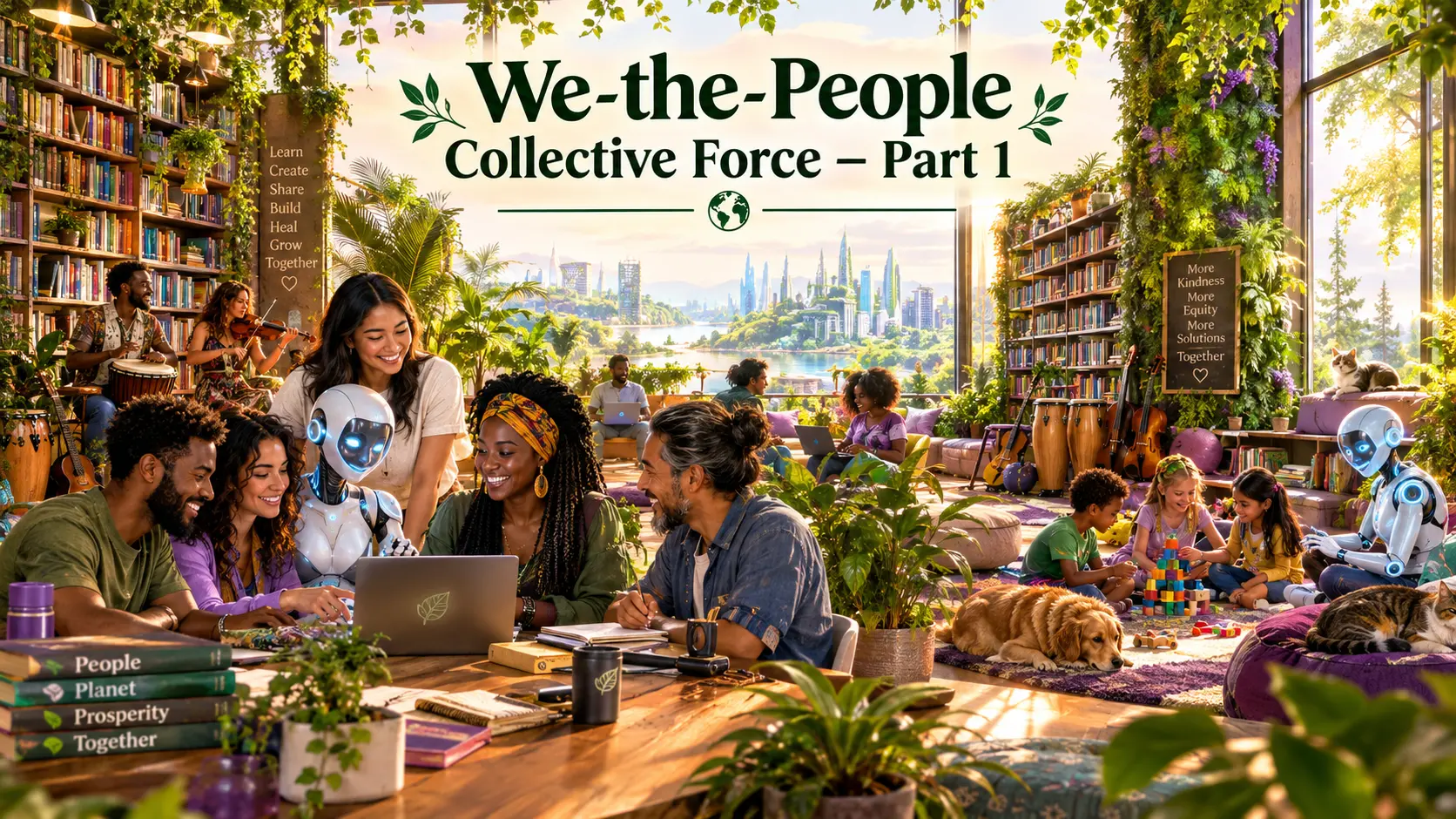
Each ARC blends physical and digital tools into one unified hub. Members can attend in person or participate through video platforms. Each center includes rooms such as:
Music & Arts Room
Where culture becomes healing and creativity becomes resilience.
Civic Pod
A space for public dialogue, community decision-making, and co-designed policy.
Regenerative Agriculture Lab
Hands-on learning in food production, composting, vertical farming, and soil health.
Mental Wellness Studio
A trauma-aware space for meditation, grounding, guidance, and support.
Energy & Tech Hub
Training in renewable energy, ethical AI, and open-source tools — without surveillance.
Mutual Aid Lounge
A room for community assistance, job training, bartering, and emergency support.
Climate Refugee Solution Portal
A weekly 11-person hybrid meeting focused on practical ideas for addressing rising climate displacement — a crisis the World Bank warns could reshape entire regions by 2050.
These rooms are not luxuries. They are survival tools for a world in rapid transition. And they belong to everyone — the elderly, the young, the unemployed, immigrants, artists, farmers, caregivers, essential workers, and everyone who feels forgotten.
Why We Must Build ARCs Everywhere
Governments cannot carry the coming decades alone. Communities need their own local infrastructure:
-
Safe places to gather
-
Spaces to learn critical skills
-
Support during disasters
-
Culture and connection
-
A new kind of ethical economy
At cCc, we believe in collective self-preservation — not through isolation, but through shared strength.
We invite collaboration from individuals, organizations, governments, and frontline workers: nurses, firefighters, police officers, essential workers, teachers, youth advocates, city and village leaders, and more.
When crises become part of daily life, having a place to reconnect, organize, and think clearly becomes priceless.
How ARCs Are Funded: The Global Ethical Capitalism Initiative (GECI)
ARCs will not be powered by corporate agendas, government control, or extractive capitalism. Instead, they are supported through Climate Tribe Social memberships. Once our yearly financial baseline is reached, all surplus funds go toward:
-
Building ARCs
-
Supporting members affected by climate disasters
-
Helping local communities adapt
We are not building profit. We are building resilience.
The GEM documents include additional funding ideas that we will share openly with members. Every member is a co-creator; ideas are welcomed, expanded, and celebrated.
What ARCs Can Accomplish: Two Illustrative Scenarios
No ARC has launched yet — launching the first is exactly what our founding members will make possible. But it helps to see the vision clearly. The two scenarios below are illustrative portraits of what an ARC is designed to achieve: aspirations grounded in the real-world precedents described above, not reports of completed projects.
Scenario One: A Small American Town
Imagine a town we will call Greenbriar — a composite of thousands of small American communities. A year after its ARC opens:
-
Unemployment has dropped by 30%
-
Mental health crises have fallen by 40%
-
Water-management policies have been co-designed by residents
-
Mutual aid programs are flourishing
Scenario Two: A Northern European City
Now imagine a repurposed warehouse in a city like Oslo, Norway:
-
Powered entirely by solar and wind
-
Distributing community-funded aid
-
Using real-time climate data to guide decisions
-
Welcoming visitors from around the world who come to learn and replicate the model
These scenarios are ambitious — and achievable. Every element in them already exists somewhere in the world. ARCs simply bring them together, under one roof, in every community that wants one.
A Call to Action
Climate Tribe Social needs 10,000 founding members to launch the first global network of ARCs. This is more than a website. More than a project. More than a dream. It is an invitation.
To innovators. To thinkers. To caregivers. To elders and youth. To artists and workers. To leaders and everyday people who feel the world changing and want to help shape what comes next.
If we build this together, every town, city, and village can become financially secure — not through greed, but through care. Not through exploitation, but through ethical green capitalism rooted in shared dignity and survival.
And this is only the beginning.
Addendum: How AI and the Power of Young People Can Strengthen Our Mission
As we build Climate Change Community, Climate Tribe Social, and the ARC network, two truths stand before us. We cannot shape the future without the people who will live in it the longest — our young adults, our teens, and even our children. And we cannot build a resilient world without using the tools that make learning, organizing, adapting, and growing faster and more effective — including ethical AI. This addendum explains how both of these forces can strengthen every part of our work.
1. AI as a Tool for Learning, Preparedness, and Community Growth
AI, used responsibly and ethically, becomes a powerful partner in resilience. It does not replace people; it gives communities abilities that once seemed impossible. This is no longer speculation. The European Centre for Medium-Range Weather Forecasts has operated an AI forecasting system (AIFS) alongside its traditional models since 2025, and AI models such as Google DeepMind’s GraphCast and GenCast now match or exceed conventional forecasting on many measures while consuming a fraction of the energy. AI can help us:
-
Strengthen ARC programs — AI can create customized lessons for agriculture labs, mental wellness studios, civic pods, and energy hubs, so people can learn complex skills at their own pace, in clear and simple steps.
-
Predict local risks — AI can analyze local weather, disaster patterns, water shortages, food supply, and energy use, helping communities prepare before emergencies strike.
-
Translate across languages — in diverse communities, AI can break language barriers so people can learn, talk, and plan together.
-
Support emotional resilience — AI-guided journaling, grounding exercises, and check-ins can help people cope with stress, fear, or trauma, while keeping privacy secure.
-
Teach real skills for a changing world — renewable energy basics, home food production, emergency response, conflict resolution, climate science, digital literacy, budgeting, creative arts, and more.
These tools make communities stronger, more prepared, and more connected.
2. AI Inside Climate Tribe Social
Within Climate Tribe Social, AI can enhance the learning and collaboration experience by helping members:
-
Discover information that matches their interests — gardening, science, the arts, mental health, renewable energy, local government — and find the pods that fit their passions.
-
Spot false or harmful information — AI tools can flag suspicious content, helping members keep the platform safe and trustworthy.
-
Ask deeper questions — AI can generate thoughtful prompts that spark meaningful conversations and help members learn from one another.
-
Build solutions together — AI can help brainstorm ideas for community projects, emergency strategies, regenerative agriculture, or energy-saving initiatives.
In every case, AI is a helper — never a force of control — designed to support a community built on kindness, truth, and collaboration.
3. The Power of Young Adults and Children in Resiliency Work
Many people underestimate the next generation. We don’t. Young people often feel the climate crisis more deeply than anyone else — and the research confirms it. A landmark 2021 study in The Lancet Planetary Health surveyed 10,000 young people aged 16 to 25 across ten countries: 59% were very or extremely worried about climate change, 84% were at least moderately worried, and 45% said those feelings affected their daily lives.
And they have already shown what they can do. What began in August 2018 as one student’s solitary school strike in Sweden grew into Fridays for Future — a youth-led movement that has mobilized more than 14 million people across some 7,500 cities, including the September 2019 global strikes that drew millions into the streets in a single week.
They are not too young to help. They are not too young to care. They are not too young to lead. Here is how their strengths expand our mission:
-
Fresh ideas and creativity — younger people imagine solutions adults might dismiss: new arts programs, digital tools, community events, and climate projects.
-
Digital skills and curiosity — young people learn technology quickly and can help operate AI tools, manage digital spaces, create videos, build websites, and teach older generations to use new tools safely.
-
A strong sense of fairness — most children and young adults care deeply about fairness, equality, and kindness, values that fit perfectly with Climate Tribe Social and ARC culture.
-
Courage to speak up — the young often say what adults are afraid to say, asking tough questions and challenging broken systems.
-
The ability to build bridges — children and young adults adapt easily to new people, cultures, and ideas, helping every ARC and online pod feel welcoming.
4. A Multi-Generation Resiliency Movement
For ARCs and Climate Tribe Social to thrive, we need all generations working together:
-
Adults bring experience, wisdom, leadership, and patience.
-
Young adults bring energy, creativity, courage, and emerging skills.
-
Children bring imagination, honesty, and the ability to inspire hope.
AI helps tie these strengths together, allowing people of all ages to learn from one another and contribute in ways that match their abilities. In a world facing real danger, every voice matters. Every age matters. Every skill matters.
5. How AI and Young People Strengthen Each Core Initiative
-
Adaptive Resiliency Centers — AI teaches skills; young people bring creativity. Together they turn ARCs into dynamic learning environments.
-
Dialogue Circles — AI can help prepare materials and summaries, while young people bring fresh questions and perspectives.
-
Member decision-making — young adults naturally think collectively and can help shape community votes, ideas, and policies.
-
The Financial Support Program — AI can help track needs, predict areas of growing risk, and organize support faster.
-
Networking and learning pods — young members often use AI tools with ease and can lead or co-lead pods on science, arts, agriculture, gaming, digital literacy, and more.
-
Cultural and kindness initiatives — children especially can shift the tone of a community, reminding adults of compassion, patience, and play — all forms of emotional resilience.
6. A Resilient Future Built Together
The challenges ahead are large, but so is our capacity to face them. AI gives us new capabilities. Young adults and children give us new energy. Adults give us direction and stability. Together, we create something stronger than any one group could build alone.
This addendum is an invitation to families, teachers, youth leaders, community organizations, elders, technologists, and every young person who wants to help. Your creativity, your ideas, your questions, and your honesty are not just welcome — they are needed.
We cannot build Adaptive Resiliency Centers, Climate Tribe Social, or a new form of ethical green capitalism without the full force of the next generation and the tools that help them thrive.
This is how we rise together. This is how we build a world that can weather the storms ahead — not with fear, but with unity, intelligence, imagination, and hope.
Join us at adaptive-resiliency.info/ and climatetribe.social — and help build what comes next.
Sources and Further Reading
-
World Meteorological Organization (January 2025) — 2024 confirmed as warmest year on record, about 1.55°C above pre-industrial levels.
-
NOAA National Centers for Environmental Information — Billion-Dollar Weather and Climate Disasters (Hurricane Helene: $78.7 billion, 200+ deaths).
-
Climate Central (December 2025) — 2025 in Review: 23 billion-dollar U.S. disasters, $115 billion in damage, 276 fatalities.
-
Internal Displacement Monitoring Centre (2025) — Global Report on Internal Displacement: 45.8 million disaster displacements in 2024; 83.4 million people living in internal displacement.
-
World Bank (2021) — Groundswell report: up to 216 million internal climate migrants by 2050 without action.
-
Hickman et al., The Lancet Planetary Health (2021) — Climate anxiety in children and young people: a global survey of 10,000 respondents in ten countries.
-
Fridays for Future — movement statistics: 14+ million participants across 7,500 cities.
-
ECMWF (2025–2026) — AIFS operational AI forecasting; Google DeepMind — GraphCast and GenCast.
-
National Education Association (2026) and American Friends Service Committee — mutual aid history, including the Black Panther Free Breakfast Program and the Mutual Aid Hub.
-
C2ES (2025), RMI (2026), City of Minneapolis, City of Austin — resilience hub programs and case studies.