The United States Has a Bad Habit That Must Change
How Unequal Accountability Becomes a Climate, Ecological, and Human Displacement Story
An opinion piece for Climate Change Community and SDL5
Let me begin with a conviction, plainly stated. The United States has a bad habit: wealth and power too often change the kind of accountability a person or corporation faces. Money can buy better lawyers, longer delays, larger lobbying operations, sophisticated public-relations campaigns, and settlements that would be unimaginable to an ordinary person. That does not mean every wealthy person is corrupt, or that every prosecution should end in prison. It means something simpler and more important: the rule of law loses legitimacy when ordinary people experience punishment as a hard wall while powerful people experience it as a negotiation.
I am not writing this because I resent success. I am writing it because a society cannot remain democratic, resilient, or ecologically sane if wealth becomes a practical shield against consequences. And if you think this is separate from the Climate and Ecological Emergency, look again. The same concentration of wealth that can weaken accountability can also shape politics, media, regulation, energy systems, and the public story we tell ourselves about what is possible.
America Has Warned Itself About This Before
Theodore Roosevelt and the “Swollen Fortune”
More than a century ago, this argument was already part of mainstream American political life. In his 1910 New Nationalism speech, former President Theodore Roosevelt warned that “the really big fortune, the swollen fortune” acquires qualities that make it different from ordinary property. He called for stronger public restraint on unfair wealth-getting and supported graduated taxes on large incomes and inheritances.
That matters because it destroys the comforting myth that serious concern about concentrated wealth is somehow foreign to American history. Roosevelt was not arguing that enterprise should disappear. He was arguing that enormous private power must remain subordinate to the public good.
Franklin Roosevelt Went Even Further
In April 1942, during a national emergency, President Franklin D. Roosevelt told Congress that “no American citizen ought to have a net income, after he has paid his taxes, of more than $25,000 a year.” The Treasury later proposed a 100 percent wartime supertax on income above that level. Congress did not adopt the full proposal, but the top marginal income-tax rate rose to 88 percent in 1942 and reached 94 percent in 1944 and 1945. Rates remained extraordinarily high by today’s standards through much of the 1950s and early 1960s.
A necessary clarification: those were marginal rates, not a 94 percent tax on every dollar a wealthy person earned. And those tax rates alone did not create the postwar middle class. Strong unions, public investment, the GI Bill, rising productivity, housing policy, industrial growth, and other forces all mattered—as did discriminatory policies that excluded many Black Americans and other communities from fully sharing in that prosperity. History is strongest when we tell all of it.
We Have Held Powerful Financial Actors Accountable Before
The Savings-and-Loan Crisis
The savings-and-loan crisis of the 1980s and early 1990s offers another useful memory. Former federal regulator William K. Black has repeatedly described more than 30,000 criminal referrals and more than 1,000 felony convictions in cases the Justice Department classified as major. Powerful figures, including Charles Keating, were prosecuted and imprisoned. The point is not that the response was perfect. The point is that regulators, investigators, and prosecutors treated elite financial misconduct as conduct that could require personal criminal accountability.
Then Came 2008
After the 2008 financial crisis, the picture looked very different. There were thousands of financial-fraud prosecutions across the country, so it would be wrong to say that nobody was prosecuted. But investigations by the Center for Public Integrity and others found a glaring absence of personal criminal cases against the top executives of the giant U.S. financial institutions most closely associated with the mortgage-securities machine that helped drive the crisis. Institutions paid enormous civil settlements. Senior leadership, in most cases, did not face the kind of criminal exposure that Americans had seen during the savings-and-loan era.
That contrast matters. When the public sees a financial institution admit wrongdoing and pay billions while the people who led it remain personally untouched, a dangerous lesson is taught: at sufficient scale, misconduct can become a corporate expense instead of a personal consequence.
Iceland Chose a Different Path
Iceland’s banking collapse was not identical to the American crisis, and its legal system is different. Still, it remains a powerful counterexample to the claim that senior financial leaders simply cannot be prosecuted after systemic collapse. Iceland created a special prosecutor’s office, pursued cases against senior bankers, and ultimately saw 36 bankers sentenced to a combined 96 years in prison. Accountability did not solve every economic problem, but it demonstrated that high office and financial status did not automatically place a person beyond criminal law.
South Korea Shows Both Accountability and Its Limits
South Korea offers a more complicated lesson. Samsung leader Lee Jae-yong was convicted and imprisoned in a bribery case, later paroled and pardoned, and then separately fought charges connected to a 2015 corporate merger. In July 2025, South Korea’s Supreme Court upheld his acquittal in that merger case. The story is not evidence of a pure system; critics have long complained about leniency and pardons for leaders of the country’s powerful family conglomerates. But it does show that even a billionaire at the center of a national corporate empire can be arrested, tried, convicted, and imprisoned.
Purdue Pharma: When a Check Is Not the Same as Accountability
The Purdue Pharma story brings the issue back home. In April 2026, a federal judge sentenced Purdue to $5.5 billion in fines and penalties connected to the company’s 2020 federal guilty plea. On May 1, 2026, a $7.4 billion nationwide settlement involving Purdue and the Sackler family became legally effective, with money intended for states, communities, and people harmed by the opioid crisis.
That money matters. Treatment matters. Prevention matters. Compensation matters. But financial recovery and personal accountability are not the same thing. Associated Press reporting on the final settlement noted that no individuals were criminally charged as part of it. After years of litigation surrounding a company whose product and marketing became central to the national opioid catastrophe, many families understandably ask whether writing a very large check is enough.
My answer is no. Not because I want cruelty, and not because prison is the only form of justice. I want symmetry. I want a legal system in which wealth does not determine whether serious wrongdoing is treated as a crime, a compliance issue, a negotiated settlement, or a regrettable line item.
The Scale of Wealth Has Entered a New Era
From Billionaires to a Trillionaire
The numbers themselves now sound fictional. Oxfam reported in January 2026 that global billionaire wealth reached a record $18.3 trillion after rising more than 16 percent in 2025, three times the average pace of the previous five years. The number of billionaires passed 3,000 for the first time. Oxfam also calculated that the world’s twelve richest billionaires held more wealth than the poorest half of humanity—more than four billion people.
Then, on June 12, 2026, SpaceX began public trading after the largest initial public offering in Wall Street history. The surge in the value of Elon Musk’s holdings briefly made him the first person estimated to be worth more than one trillion dollars. The number did not stay there: SpaceX and Tesla shares later fell, and Forbes estimates moved sharply lower before climbing again to roughly $900 billion in mid-August. That volatility is precisely why I do not want this argument to depend on one person or one day’s market price.
The larger fact remains. We have built an economy capable of concentrating wealth on a scale once associated only with national economies. Whether the richest individual is worth $700 billion, $900 billion, or more than $1 trillion on a given day, the democratic question is the same: how much private economic power can a society tolerate before that power begins to overwhelm public institutions?
Wealth Buys More Than Luxury
The concern is not simply yachts, mansions, or private jets. Wealth buys access, influence, legal endurance, campaign power, lobbying capacity, media ownership, data, and the ability to shape what millions of people see and hear. Oxfam’s 2026 report estimated that billionaires are thousands of times more likely than ordinary people to hold political office. That does not mean every wealthy officeholder is corrupt. It means extreme economic inequality can become political inequality unless democratic systems actively protect themselves.
Why This Is a Climate and Ecological Story
Carbon Inequality Is Real
The Climate Emergency is not caused equally by everyone. Oxfam and the Stockholm Environment Institute estimated that in 2019 the richest 1 percent of humanity were responsible for about 16 percent of global consumption emissions—roughly as much as the poorest two-thirds of humanity combined. In January 2026, Oxfam calculated that the richest 1 percent had exhausted their entire fair annual share of a 1.5°C-compatible carbon budget in just ten days. The richest 0.1 percent crossed that line by January 3.
This does not mean every climate problem can be reduced to individual luxury consumption. Industrial systems, electricity generation, transportation networks, land use, building codes, public policy, and corporate investment all matter. But the inequality is unmistakable: those with the greatest economic power often have the largest consumption footprints and the greatest ability to influence the systems that determine everyone else’s emissions.
The Fossil-Fuel Accountability Question
There is also a deeper history. A peer-reviewed 2023 study in Science found that Exxon’s own scientists produced remarkably accurate global-warming projections beginning in the late 1970s and early 1980s. Yet the company’s public messaging for years emphasized uncertainty about climate science. In 2024, a joint congressional staff investigation released thousands of internal industry documents and concluded that major fossil-fuel companies and trade groups had engaged in evolving forms of climate denial, disinformation, and public-relations doublespeak. The companies have disputed accusations that they deliberately deceived the public, but the underlying accountability question is unavoidable: what happens when institutions possess knowledge of large-scale harm while their public influence helps delay action?
That is where wealth, accountability, and climate policy meet. If a corporation can externalize pollution, fund political influence, shape public understanding, fight regulation for decades, and then treat penalties as another operating cost, the climate problem is not only technological. It is institutional.
And It Is a Human Displacement Story
Use the Right Words—Then Face the Reality
The language matters. People forced from their homes by climate-related hazards are not automatically “refugees” under international law. UNHCR notes that most climate-related displacement occurs within national borders and that the phrase “climate refugee” is not a formally recognized legal category. Some people who cross borders may qualify for refugee protection when climate impacts interact with persecution, conflict, or serious public disorder, but the legal situation is more complex than the popular phrase suggests.
Precision does not make the emergency smaller. It makes our case stronger. The Internal Displacement Monitoring Centre reported that 82.2 million people were living in internal displacement at the end of 2025, including 13.6 million displaced in the context of disasters. In 2024 alone, the Americas recorded a record 14.5 million internal displacements: 13.1 million were disaster-related, and the United States accounted for about 11 million disaster-related movements, largely associated with major hurricanes and evacuations.
Looking ahead, the World Bank’s Groundswell research has projected that, without strong climate and development action, as many as 216 million people across six world regions could be forced to move within their own countries by 2050 because of climate impacts. The exact future number will depend on choices we make. That is the point.
The Single Thread
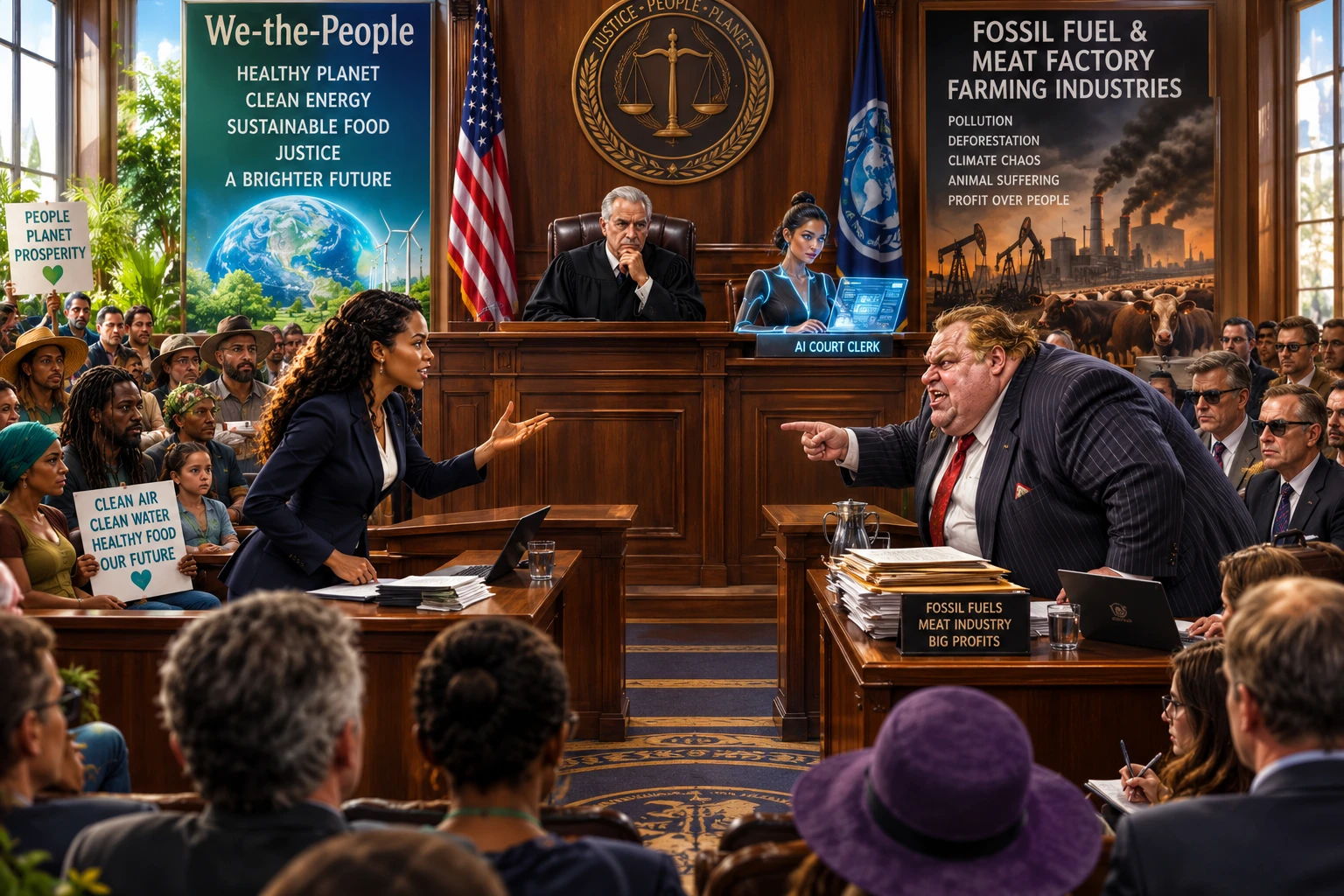
This is the thread I see running through the financial crash, the opioid catastrophe, concentrated wealth, fossil-fuel influence, carbon inequality, and displacement: power without meaningful accountability becomes a danger to everyone else.
The same institutional weakness that allows financial misconduct to end in a negotiated payment can allow environmental harm to become an externalized cost. The same political system that struggles to regulate concentrated financial power can struggle to regulate concentrated fossil-fuel power. The same inequality that gives one person extraordinary influence can leave another person with no insurance, no safe housing, no political access, and no way to recover after a flood, fire, drought, or storm.
Impunity for wealth and impunity for pollution are not identical problems. But they are connected by the same question: who is allowed to impose costs on everyone else without being required to bear a fair share of the consequences?
What Should Change?
A Ceiling Is Worth Discussing
I continue to believe that societies should be willing to discuss an upper limit on extreme private fortune. That can take different forms: a maximum-income concept, steeply progressive taxation, stronger estate and inheritance taxation, annual taxes on extreme wealth, or ratios that connect the top of the economic ladder to the floor beneath it. Political philosophers sometimes call the broader idea “limitarianism”: beyond some point, additional private accumulation can conflict with democracy, equal citizenship, and the urgent needs of society.
I do not pretend there is one simple number that solves the problem. Wealth can be difficult to value. Assets move across borders. Badly designed taxes can be avoided. Entrepreneurship, investment, and legitimate risk-taking matter. But those are design challenges, not reasons to abandon the question.
Accountability Must Be Personal as Well as Corporate
We also need stronger white-collar enforcement, adequately funded regulators, real use of criminal referrals when evidence supports them, clawbacks of executive compensation, meaningful individual liability for proven misconduct, stronger whistleblower protections, tougher anti-corruption rules, transparent political spending, and penalties large enough that breaking the law cannot be treated as a profitable business strategy.
Climate Accountability Must Follow the Same Principle
For the Climate and Ecological Emergency, that means enforcing pollution laws, ending the socialization of environmental costs, strengthening disclosure of climate risks, protecting communities from greenwashing and misinformation, making major polluters help finance adaptation and recovery, accelerating the transition away from fossil fuels, and ensuring that workers and vulnerable communities are not asked to pay the highest price for a transition they did not cause.
Clean, Green Capitalism—or Something That Deserves to Replace It
I have used the phrase clean, green capitalism because I still believe enterprise can be useful when it operates inside strong democratic and ecological boundaries. But capitalism without boundaries is not freedom for everyone. It can become freedom for the powerful to transfer costs downward—to workers, communities, future generations, and the living world.
A clean, green economy would reverse that direction. It would be strict where power is greatest and generous where opportunity is weakest. It would reward useful innovation while refusing to confuse wealth with virtue. It would make ecological limits real. It would measure success not only by how much money is created, but by whether children inherit a society and a planet in which they can safely live.
The Work for SDL5 and Climate Change Community
This is where Adaptive Resiliency becomes more than a phrase. Resilience is not simply learning to endure whatever powerful institutions hand us. Adaptive Resiliency means learning, organizing, cooperating, challenging false narratives, improving our institutions, and building the social capacity to respond before crisis becomes collapse.
For SDL5 and Climate Change Community, the work is educational and practical: understand how climate, ecology, democracy, inequality, public health, and displacement connect; learn to distinguish evidence from propaganda; make space for disagreement without surrendering facts; and build communities capable of acting together.
Accountability for extreme wealth is not about envy. Climate accountability is not about punishment for its own sake. Both are about preserving the conditions under which democracy, community, enterprise, and life itself can continue.
Break the Habit
A nation strong enough to punish the powerless is strong enough to investigate the powerful. A society wealthy enough to create fortunes measured in hundreds of billions of dollars is wealthy enough to protect people from hunger, displacement, pollution, and preventable disaster. The missing ingredient is not capacity. It is the decision to make accountability reach upward as reliably as it reaches downward.
We have made that decision before. Our own history proves it. We can make it again.
It is a critical time, and we must respond likewise.
By Mr. Alvarez | AI used to Enhance my Creativity and Thinking
Selected Sources and Fact-Check References
• Theodore Roosevelt, “New Nationalism” speech, Osawatomie, Kansas (1910), archived White House materials.
• Franklin D. Roosevelt, message to Congress on the cost of living and wartime income limits (April 27, 1942); American Presidency Project / historical public papers.
• Federal Reserve Bank of St. Louis (FRED), historical highest U.S. individual income-tax bracket data.
• Center for Public Integrity, reporting on financial-crisis prosecutions and the absence of cases against senior executives at major Wall Street institutions.
• Oxford Academic, Back from the Brink: Iceland’s Successful Economic Recovery; reporting on 36 bankers receiving a combined 96 years of prison sentences.
• Associated Press and Reuters, reporting on Samsung chairman Lee Jae-yong’s legal cases, imprisonment, pardon, and 2025 Supreme Court acquittal in the merger case.
• Reuters and state attorneys general, Purdue Pharma sentencing and the $7.4 billion Purdue/Sackler settlement that became effective May 1, 2026.
• Oxfam, Resisting the Rule of the Rich (January 2026), on billionaire wealth and political inequality.
• SpaceX investor relations, U.S. SEC filings, Nasdaq, Forbes, and Reuters on the June 2026 SpaceX IPO and subsequent changes in Elon Musk’s estimated net worth.
• Oxfam and Stockholm Environment Institute, Climate Equality: A Planet for the 99% (2023); Oxfam, Pollutocrat Day analysis (January 2026).
• Supran, Rahmstorf, and Oreskes, “Assessing ExxonMobil’s global warming projections,” Science (2023).
• U.S. House Oversight and Senate Budget Committee staff, Denial, Disinformation, and Doublespeak: Big Oil’s Evolving Efforts to Avoid Accountability for Climate Change (2024).
• Internal Displacement Monitoring Centre, Global Report on Internal Displacement 2025 and 2026.
• World Bank, Groundswell Part 2: Acting on Internal Climate Migration (2021).
• UNHCR, guidance on climate change, displacement, and the legal meaning of “refugee.”
Fact-check date: August 23, 2026. Wealth estimates, market valuations, and displacement totals can change over time.