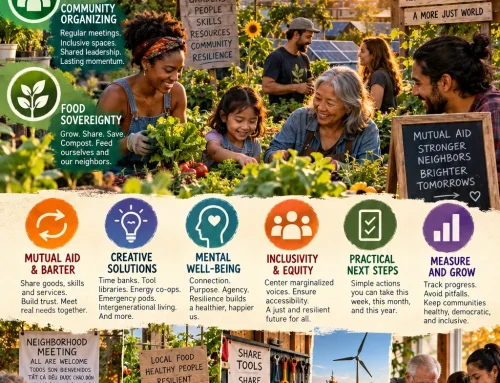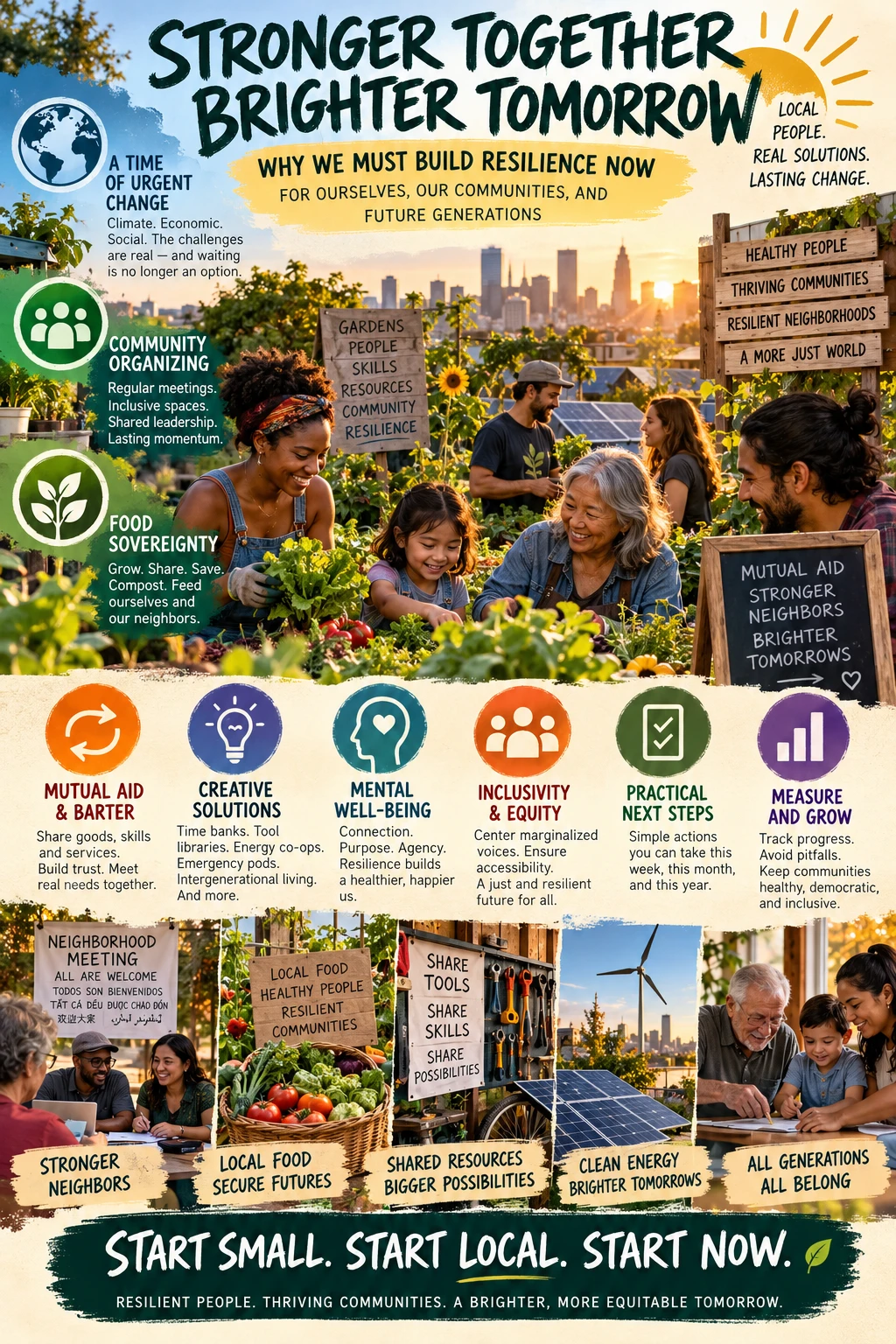
It May Be the End of Business as Usual
…see original version at climatechangecommunity.com under the same featured image. This is the draft #1 version.
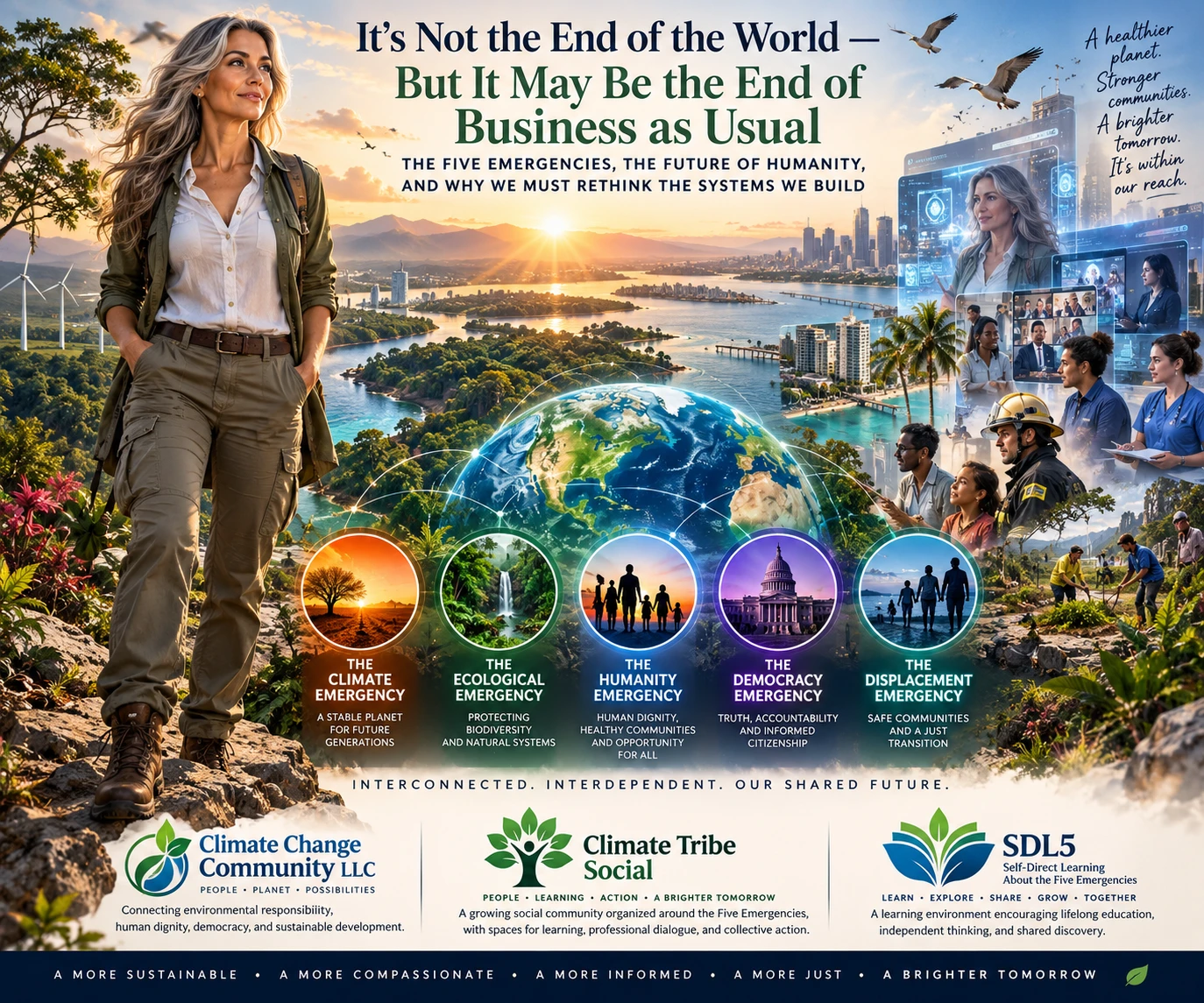
The Five Emergencies, the Future of Humanity, and Why We Must Rethink the Systems We Build
A deeper reflection on technology, environmental responsibility, human dignity, democracy, and the transformation we need.
An invitation from Climate Change Community LLC, Climate Tribe Social, and SDL5.
There is a growing contradiction at the heart of modern civilization.
We have more technology than any generation before us. We can communicate across continents in seconds, access enormous libraries of human knowledge, develop artificial intelligence, engineer extraordinary medical treatments, and build systems capable of analyzing problems that once seemed impossible to understand.
Yet, despite these extraordinary achievements, we are struggling with some fundamental questions.
Why are we becoming more technologically advanced while so many communities remain vulnerable?
Why can we connect billions of people through social media while struggling to have meaningful conversations with one another?
Why do we have increasingly sophisticated tools for gathering information, yet find ourselves surrounded by misinformation, manipulation, polarization, and distrust?
Why can we generate enormous economic wealth while ecosystems deteriorate, biodiversity disappears, and millions of people struggle to afford the necessities of life?
And why, when the consequences of our collective decisions become increasingly apparent, do we continue defending systems that may be contributing to the very problems we are trying to solve?
These are not simply political questions. They are questions about civilization, responsibility, ethics, economics, and the future we are creating for the generations who will inherit this planet.
Two videos recently brought these contradictions into sharper focus for me.
One examined Meta, Facebook, personal information, artificial intelligence, and the expanding commercial use of people’s digital lives.
The other examined an extraordinary situation unfolding around Indian Creek Island in South Florida, an exclusive residential community commonly associated with America’s wealthiest residents. Rising sea levels and groundwater changes are demonstrating that even enormous financial resources cannot completely insulate people from the physical consequences of environmental change.
At first glance, these subjects appear unrelated.
One concerns digital information. The other concerns water, geology, and climate.
But when we look more carefully, they reveal a common question:
What happens when the systems we create are designed primarily around extraction, profit, convenience, and concentrated power rather than long-term human and ecological well-being?
That question sits at the heart of what we call the Five Emergencies.
This is not an article about assigning blame to everyone who uses Facebook, owns waterfront property, develops technology, or participates in the modern economy.
It is about recognizing patterns, examining evidence, challenging assumptions, and asking whether we are capable of building something better.
I believe we are.
But doing so requires more than technological innovation. It requires personal responsibility, institutional accountability, environmental stewardship, compassion, and a willingness to transform how we live and work together.
1. Understanding the Five Emergencies: One Interconnected Crisis
At Climate Change Community, Climate Tribe Social, and SDL5, we organize our work around five interconnected emergencies.
They are useful categories for understanding the challenges before us, but they should never be mistaken for five independent problems.
They are deeply interconnected, and developments in one frequently intensify the others.
The Climate Emergency
The changing climate is affecting temperatures, precipitation, oceans, coastlines, agriculture, infrastructure, public health, and the stability of communities.
The consequences are not limited to future generations. They are increasingly visible in the decisions families, businesses, municipalities, and governments must make today.
The Ecological Emergency
Climate change is only one part of a much larger environmental crisis.
Biodiversity loss, habitat destruction, deforestation, soil degradation, freshwater pressures, ocean pollution, and unsustainable extraction threaten the interconnected systems that sustain life.
We cannot build a genuinely sustainable civilization while treating the natural world as an unlimited warehouse of resources.
The Humanity Emergency
Humanity’s challenges extend beyond material survival.
Children, young adults, families, elders, vulnerable populations, and frontline communities are experiencing the consequences of inequality, social fragmentation, violence, discrimination, loneliness, insecurity, and deteriorating public well-being.
Human dignity must remain central to any meaningful definition of progress.
The Democracy Emergency
Democracy depends on more than elections.
It requires access to trustworthy information, accountability, freedom of expression, independent journalism, informed participation, public trust, and institutions that serve the public interest.
When information becomes distorted, manipulated, or treated primarily as a commercial commodity, our ability to make informed collective decisions becomes weaker.
The Displacement Emergency
Climate-related disasters, environmental degradation, economic instability, conflict, and deteriorating living conditions can force people from their homes and livelihoods.
Displacement is not simply a matter of geography. It involves families, cultural identity, community connections, education, employment, health, and the loss of a sense of belonging.
These five emergencies reinforce one another.
A community experiencing repeated flooding may also experience declining property values, insurance difficulties, financial instability, deteriorating infrastructure, and eventually displacement.
A population exposed to misinformation may become less capable of recognizing environmental threats, evaluating public policy, or holding institutions accountable.
A society divided by hatred and mistrust will struggle to cooperate when cooperation becomes essential.
The emergencies are interconnected because life itself is interconnected.
That is why our responses must become more interconnected as well.
2. The Digital World: When Connection Becomes a Business Model
The first video that prompted this reflection concerned Meta and the increasingly complicated relationship between personal information, artificial intelligence, and commercial platforms.
The presenter, from the YouTube channel She Prepares, described her decision to leave Facebook following an account compromise and concerns about the identity-verification process.
Her experience led to a broader discussion about how personal information may be collected, processed, and used in ways that ordinary users do not necessarily anticipate.
Some of the concerns raised in the video are supported by reporting and documented company practices. Others remain allegations or matters of continuing legal dispute.
That distinction matters.
We should not confuse an allegation with an established finding, nor should we dismiss a legitimate concern simply because one part of an argument remains unproven.
The underlying questions deserve serious consideration.
Our personal information has become an economic resource
For many years, social media was presented as an extraordinary opportunity to connect people.
We could reconnect with old friends, share family photographs, communicate with relatives, participate in communities, and discover ideas from people around the world.
Much of that convenience was offered without a direct subscription fee.
But free access does not necessarily mean that a service has no economic cost.
Advertising-supported platforms can generate enormous revenue by collecting information, analyzing behavior, predicting interests, and delivering increasingly personalized advertising.
The more sophisticated these systems become, the more important the questions surrounding consent, transparency, and control become.
Consider some of the issues highlighted in the original video:
- Meta announced that conversations with its AI would become part of the information used to personalize content and advertising beginning December 16, 2025, subject to stated exclusions and regional differences.
- Facebook introduced an opt-in camera-roll cloud-processing feature that can upload photographs and videos to generate creative suggestions.
- Meta faced a $25 billion judgment in New Mexico in October 2026, which the company disputes and is expected to appeal.
- A proposed class-action lawsuit alleges that sensitive recordings from AI-enabled smart glasses were reviewed by contractors in Kenya. The allegations remain subject to legal proceedings.
- Meta has acknowledged using adults’ public posts and photographs to train AI, while privacy protections and objection procedures have differed between regions.
These developments raise an important issue that extends far beyond one company.
Who should control the information generated by our everyday lives?
A photograph may contain more than a photograph.
It may contain children, relatives, friends, home interiors, identifying information, location clues, documents, or details about someone’s private circumstances.
A conversation with an AI assistant may reveal interests, concerns, plans, professional activities, or other information that a person never intended to become part of an advertising profile.
Smart glasses introduce another dimension: the people being recorded may not even realize that they are participating in the creation of digital information.
We should be asking whether existing privacy protections are keeping pace with these technologies.
Convenience should not eliminate meaningful consent.
Innovation should not weaken human dignity.
And the ability to collect information should never automatically be treated as permission to exploit it.
The Democracy Emergency is also a digital emergency
Social media platforms have become important gateways to news, public discussion, political debate, education, and civic participation.
That gives their design and commercial incentives considerable influence over the information environment.
When engagement becomes the primary objective, emotionally charged material can receive considerable attention.
Outrage, fear, sensationalism, and conflict can travel rapidly.
This does not mean every platform deliberately promotes falsehoods or that every disagreement is the result of an algorithm.
But it does mean that the economic incentives behind digital communication deserve examination.
A healthy democracy requires more than the ability to publish something.
It requires the ability to distinguish evidence from speculation, recognize manipulation, consider opposing perspectives, and engage in meaningful disagreement without abandoning respect for other people’s humanity.
We need digital environments that reward understanding rather than simply measuring attention.
That is a very different philosophy of social media.
3. Miami’s Billionaire Bunker: When Wealth Meets the Physical Limits of Nature
The second video examined Indian Creek Island in Biscayne Bay, South Florida, an exceptionally wealthy residential enclave.
The central message was simple but powerful:
You cannot purchase immunity from the laws of nature.
South Florida sits on porous limestone formations that allow groundwater to move through the underlying geology.
As sea levels rise, coastal groundwater levels can rise as well.
This creates a challenge that conventional seawalls and coastal barriers cannot necessarily solve.
Water does not always need to arrive from the ocean’s surface. It can emerge through the ground.
The science of flooding from below
The underlying science is well established.
Miami Waterkeeper has documented how rising groundwater contributes to flooding, including situations where water appears on streets and other surfaces without significant rainfall.
The Biscayne aquifer also presents an important concern.
According to the U.S. Geological Survey, this aquifer is the primary source of drinking water for Miami-Dade County.
Because it is located near the coast and sits within permeable geological formations, it is vulnerable to saltwater intrusion.
USGS mapping published in December 2025 documented changes in the inland position of the saltwater boundary between 2018 and 2022, with movement varying across different areas.
This is not merely a concern about waterfront property.
It is a question about drinking water, infrastructure, public health, agriculture, economic security, and the long-term habitability of communities.
The October 2026 flooding reports discussed in the original video provide another reminder that high-tide flooding is not simply a distant possibility.
Miami experienced an unusually persistent period of coastal flooding, including a reported crossing of its major-flooding threshold without hurricane storm surge.
Natural tides have always existed.
What matters is the changing baseline upon which those tides operate.
As sea levels rise, events that once produced relatively manageable flooding can become increasingly disruptive.
The illusion that wealth can solve everything
Wealth can provide meaningful protection.
Homeowners with substantial resources may elevate structures, install pumps, reinforce foundations, relocate electrical equipment, improve drainage, and employ engineers to reduce their exposure.
Those measures matter.
But adaptation has physical, financial, and geographical limits.
And that brings us to a much larger question.
What happens to the people who cannot afford these measures?
- Families in modest coastal neighborhoods may not have the financial resources to elevate their homes.
- Older residents living on fixed incomes may struggle to pay for repeated repairs.
- Small businesses may find themselves facing recurring flooding and increasingly difficult insurance decisions.
- Municipalities must finance drainage systems, road improvements, pumps, and other infrastructure while balancing numerous public needs.
- Communities dependent on vulnerable freshwater resources must confront the possibility of increasing water-management challenges.
Climate adaptation cannot become something available only to people who can afford it.
If we allow that to happen, the Climate Emergency increasingly becomes a Displacement Emergency.
People may eventually leave not because they want to abandon their communities, but because remaining becomes financially or physically impossible.
This is where climate policy becomes a question of human dignity and social justice.
A society’s resilience should not be measured only by how well its wealthiest residents protect themselves. It should also be measured by whether ordinary families have a realistic opportunity to remain safe.
4. The Common Thread: An Economy That Too Often Externalizes Its Costs
The two videos point toward a common economic and ethical problem.
One concerns the extraction and commercialization of personal information.
The other concerns the extraction of fossil fuels and the environmental consequences of their use.
They are not identical activities, and we should not pretend that they are.
But they illustrate a recurring feature of economic systems that prioritize immediate returns while transferring longer-term costs to others.
Consider the pattern.
A company may profit from collecting and analyzing personal information while individuals have limited understanding of how that information will be used.
An industry may profit from extracting and selling fossil fuels while communities, ecosystems, and future generations bear substantial environmental consequences.
A business may benefit from a particular economic activity while the public eventually pays for infrastructure damage, pollution, health consequences, or environmental restoration.
Economists sometimes describe this as the problem of externalities: costs associated with an activity that are not fully reflected in the price paid by those benefiting from it.
But the problem is also ethical.
Who gets the benefits?
Who carries the risks?
Who has a meaningful voice in the decisions?
And who is expected to clean up the consequences?
These questions should apply to technology, energy, agriculture, manufacturing, transportation, finance, and virtually every major economic sector.
Profit is not the enemy. Unaccountable profit is the concern.
We should be careful not to turn this discussion into a simplistic argument that businesses, innovation, investment, or economic growth are inherently harmful.
They are not.
Businesses create employment, develop useful products, provide services, finance research, and contribute to the functioning of modern society.
Entrepreneurs and investors can be important partners in environmental progress.
The issue is whether economic success is being pursued in a way that respects the public interest and the natural systems upon which all economic activity ultimately depends.
A business model that succeeds financially while systematically transferring unacceptable costs to society should not automatically be celebrated as progress.
We need to expand our definition of success.
Financial performance matters, but so do environmental responsibility, transparency, worker dignity, community resilience, and long-term consequences.
A healthy economy should serve life rather than consume the foundations upon which life depends.
5. Technology Is Advancing. Are Our Values Advancing With It?
Artificial intelligence makes this question particularly important.
AI is already changing how we research, communicate, create, analyze information, and solve problems.
It can help researchers identify patterns, assist medical professionals, support education, improve disaster preparedness, and help communities understand complicated environmental information.
It can also be used for surveillance, manipulation, misinformation, discrimination, and increasingly sophisticated forms of commercial profiling.
The technology itself does not automatically determine which direction we take.
The decisions made by developers, businesses, governments, institutions, and users matter.
AI should expand human capability, not diminish human responsibility
I am not anti-AI.
I believe artificial intelligence can become one of humanity’s most useful tools if developed and applied responsibly.
But we must resist the temptation to confuse capability with wisdom.
An AI system may process enormous amounts of information without possessing the human experience, conscience, moral responsibility, or lived understanding that should guide important decisions.
It can help us examine arguments, explore possibilities, identify weaknesses, and understand complex subjects.
It should not become an excuse for abandoning our responsibility to think critically.
For example, AI can help:
- A nurse examine heat-related health guidance.
- A community organization understand flood-risk information.
- A local government evaluate infrastructure options.
- A student understand a complicated climate report.
- A farmer explore soil-management strategies.
- An environmental organization analyze biodiversity information.
- A citizen compare public policy proposals.
- A small business examine ways to reduce energy consumption.
These are constructive applications.
But AI also has a physical footprint.
The data centers supporting increasingly sophisticated AI systems require electricity, cooling, water, infrastructure, and materials.
Their environmental impacts depend on where and how they are built and operated.
We must therefore ask two questions simultaneously:
How can AI help us solve the Five Emergencies?
And how can we ensure that the development of AI does not intensify the environmental and social pressures we are trying to address?
This is why Green AI deserves serious attention.
We should encourage efficient models, responsible infrastructure, renewable energy where feasible, transparent environmental reporting, and locally operated AI systems where they make practical sense.
Technology must serve truth, and truth must serve life.
6. Social Media Needs a Different Purpose
Perhaps one of the most important lessons from these two videos concerns where and how we gather.
Social media has extraordinary potential.
It can bring together people who would otherwise never meet.
It can help communities exchange knowledge, support one another, organize projects, and respond to emergencies.
But much of the social media landscape has evolved around advertising, attention, and engagement.
That is not necessarily the best foundation for solving complicated long-term problems.
We need to ask a different question:
What would social media look like if its primary purpose were to help people learn, cooperate, and contribute to a better world?
That question is central to the development of Climate Tribe Social and SDL5.
There are several broad models worth considering.
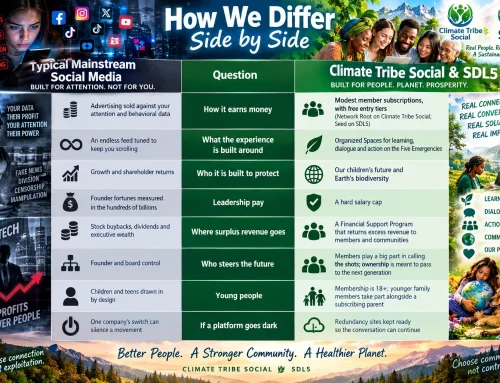
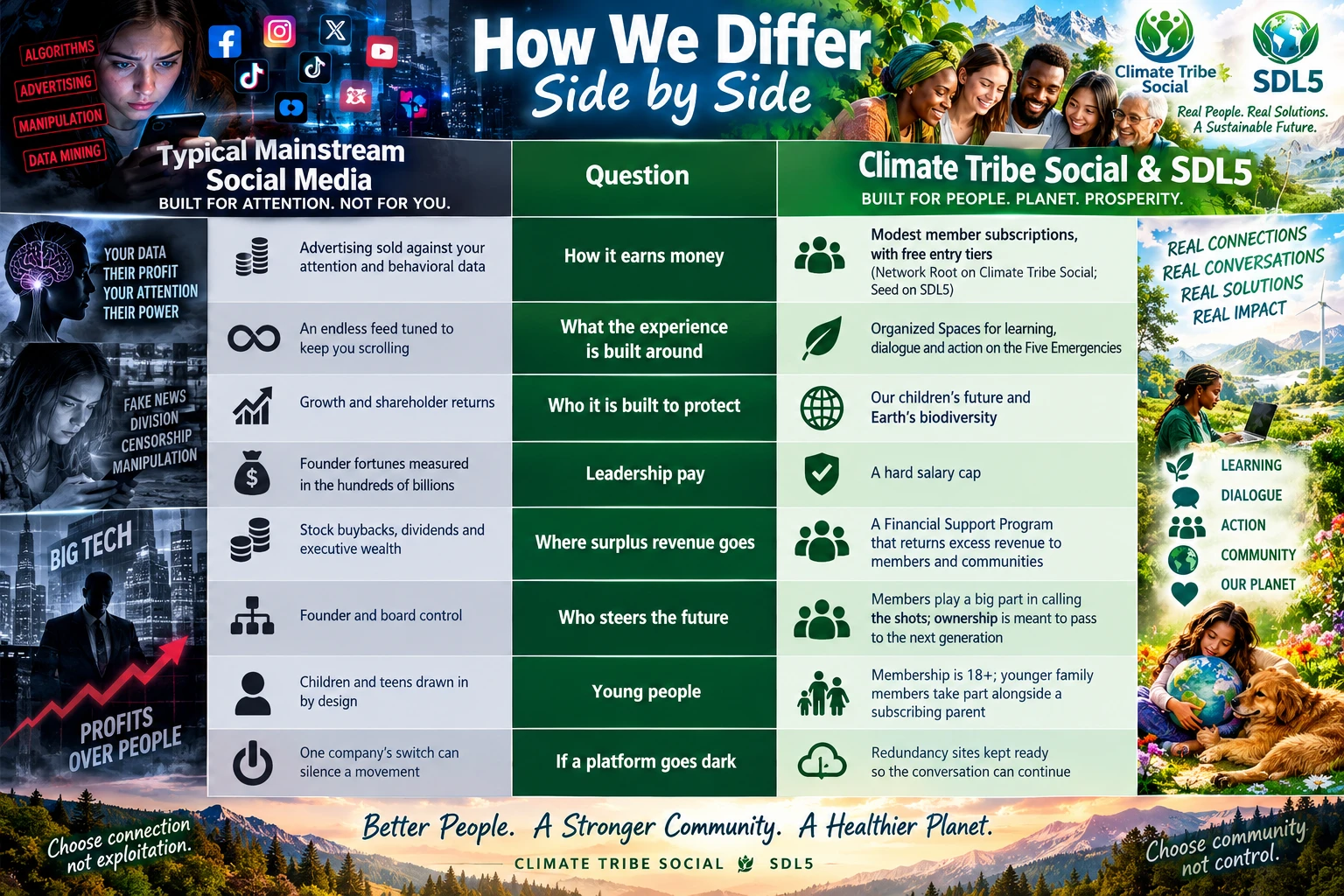
| Feature | Major advertising platforms | Open and decentralized networks | Purpose-built mission communities |
|---|---|---|---|
| Primary purpose | Broad social engagement and advertising | General conversation and community autonomy | Learning, dialogue, and collective action |
| Funding | Primarily advertising and related commercial activities | Donations, grants, subscriptions, and varied models | Membership subscriptions and free access |
| Information | Broad and varied, with platform-dependent moderation | Broad and community-dependent | Organized around defined learning and social objectives |
| Climate focus | Dependent on users and groups | Dependent on users and communities | Central to the mission |
| Privacy | Dependent on platform policies and settings | Varies by network and server | Designed around the platform’s stated membership model |
| Main limitation | Commercial incentives, noise, and privacy concerns | Fragmentation and learning curve | Smaller audience and the need to build participation |
No model is perfect.
Open and decentralized networks offer important alternatives, but they also have their own challenges.
Purpose-built communities may offer greater focus, but they must earn trust, demonstrate value, and remain accountable to their members.
Climate Tribe Social and SDL5 are still growing. We are not claiming to have solved the challenges of digital community building.
We are attempting to build something with a different purpose.
7. Climate Tribe Social: Building a Community Around the Five Emergencies
Climate Tribe Social is being developed around five major Collections, each corresponding to one of the emergencies.
Rather than expecting every important conversation to compete for attention in one enormous feed, the intention is to provide organized places where people can explore subjects, exchange knowledge, and develop relationships.
For example:
The Climate Emergency
A place for climate science, adaptation, extreme heat, energy, renewable technologies, climate policy, housing, resilience, and community preparedness.
The Ecological Emergency
A place for biodiversity, wildlife, forestry, oceans, soil, food systems, freshwater, plastics, conservation, and ecological restoration.
The Humanity Emergency
A place for children, families, youth, elders, health, accessibility, culture, music, the arts, emotional resilience, and human dignity.
The Democracy Emergency
A place for information integrity, digital rights, civic participation, accountability, democratic institutions, and responsible technology.
The Displacement Emergency
A place for climate migration, insurance challenges, managed retreat, relocation, housing, community protection, and the future of vulnerable populations.
The platform also includes specialized communities such as the Front-Line Guilds, bringing together people whose professions and daily responsibilities place them close to the challenges we are discussing.
Nurses, teachers, firefighters, infrastructure workers, agricultural workers, and other frontline professionals have knowledge that should be part of these conversations.
We also believe that meaningful dialogue requires more than online exchanges.
Our plans include 11-Person Face-to-Face Dialogue Sessions, initially targeted for the December 21, 2026 to January 1, 2027 window, contingent on participation and subscriber growth.
These sessions are intended to encourage thoughtful, respectful conversations among people with different experiences and perspectives.
We are not looking for everyone to agree.
We are looking for people willing to listen, learn, question, and work toward constructive outcomes.
A different approach to financial sustainability
Climate Tribe Social is also exploring a different approach to how a mission-driven community is funded.
The Network Root provides free entry to foundational spaces, including Home, Announcements, News, The Symposium, Climate Literacy, and The Archive.
Additional membership levels provide access to deeper participation.
Our stated principles include a hard salary cap, a Financial Support Program intended to redistribute excess revenue toward members and communities, and member participation in shaping the platform’s development.
These are commitments that must be demonstrated through transparent practices, not simply attractive language.
Trust is earned through what an organization does.
Our objective is to create a platform where financial sustainability supports the mission rather than gradually replacing it.
Climate Tribe Social is currently invitation-only, with public access planned for December 21, 2026. Membership is restricted to adults aged 18 and older.
Those interested in early approval may contact contact@climatechangecommunity.com and request a Zoom dialogue.
8. SDL5: Learning Must Become a Lifelong Practice
The companion platform, SDL5, takes a learning-first approach.
Its name reflects Self-Direct Learning about the Five Emergencies.
We believe that education should not end when someone leaves school, completes a degree, or reaches a particular stage of professional life.
The world is changing too rapidly for that.
Climate science evolves. Technologies change. New environmental challenges emerge. Political circumstances shift. Our understanding of human behavior and social systems continues to develop.
People need opportunities to keep learning.
SDL5 is being developed around that principle.
Its Learning Out Loud series encourages people to explore information, examine different perspectives, and share what they are discovering.
The platform uses three membership levels:
- Seed: Free, limited access.
- Sapling: $12 annually.
- Forest: $25 annually, with full access.
SDL5 is currently invitation-only and is developing toward a more collaborative learning environment.
Our hope is to encourage something that is increasingly important: people learning together without pretending that any one person or institution has all the answers.
Learning should be an ongoing conversation.
And the ability to change our minds when better evidence becomes available should be considered a strength, not a weakness.
9. Transformation Begins With Personal Responsibility
There is another dimension to the Five Emergencies that deserves considerably more attention.
We frequently discuss what governments, corporations, industries, and institutions must do.
Those responsibilities are real.
But transformation also requires individuals to examine their own assumptions, decisions, habits, and behavior.
We cannot reasonably demand accountability from everyone else while refusing to examine ourselves.
We cannot build a more compassionate society while continually treating people with disrespect.
We cannot expect productive dialogue while dismissing everyone who disagrees with us.
We cannot defend democracy while rejecting evidence that challenges our preferred conclusions.
And we cannot claim to care about the future of children and biodiversity while ignoring the everyday consequences of our own choices.
This is not about blaming individuals for structural problems.
An ordinary person cannot independently solve climate change, reform the global economy, or redesign the technology industry.
But individuals do have influence.
We influence our families, workplaces, communities, purchasing decisions, conversations, and the information we share.
We can become more informed.
We can reduce unnecessary consumption.
We can support responsible businesses.
We can encourage environmental protection.
We can challenge misinformation without humiliating the people who encounter it.
We can treat others with dignity even when we strongly disagree.
And we can participate in communities that encourage learning rather than hostility.
Personal transformation and institutional transformation are not competing ideas. They are complementary necessities.
The future will require both.
10. What Can We Actually Do Today?
It is easy to read about global emergencies and feel that the problems are simply too large.
But meaningful change does not require everyone to become an expert, activist, scientist, or politician.
It requires people to begin where they are.
Here are some practical starting points.
Protect your digital privacy.
Review your social media permissions, camera-roll settings, connected applications, and AI privacy controls. Think carefully before sharing sensitive personal information with digital services.
Become a more informed information consumer.
Check sources, compare reporting, distinguish allegations from verified findings, and avoid sharing emotionally charged material before establishing whether it is accurate.
Learn about your local environmental risks.
Explore flood maps, groundwater conditions, extreme heat risks, emergency plans, and local climate adaptation initiatives.
Support ecological responsibility.
Look for practical opportunities to protect biodiversity, conserve water, reduce waste, support sustainable food systems, and restore natural habitats.
Participate in your democracy.
Stay informed about public decisions, engage with representatives, support transparency, and defend the ability of citizens to participate meaningfully.
Treat human dignity as non-negotiable.
Challenge racism, cruelty, dehumanization, and discrimination. Disagreement is not permission to abandon compassion.
Use technology constructively.
Explore how AI and other technologies can help with education, research, environmental monitoring, community resilience, and problem-solving.
Find people who want to build something better.
Join conversations where learning, cooperation, and constructive action matter more than winning arguments.
These actions may appear modest individually.
But collective progress is built through millions of decisions, relationships, and commitments.
11. The Future We Should Be Working Toward
Imagine a digital environment where people are not treated primarily as advertising opportunities.
Imagine social platforms where meaningful discussion is valued, where communities can organize around important challenges, and where privacy is treated as a fundamental responsibility.
Imagine AI systems helping communities understand environmental threats, improve education, support healthcare, and prepare for emergencies.
Imagine coastal adaptation programs that protect ordinary families rather than concentrating available resources among wealthy property owners.
Imagine businesses competing not only through price and profitability but also through environmental responsibility, transparency, and the long-term value they contribute to society.
Imagine schools and learning communities teaching children how to evaluate information, respect differences, understand ecological systems, and participate constructively in democracy.
Imagine a world where technological advancement is measured partly by how much suffering it prevents, how much knowledge it makes accessible, and how effectively it protects the natural systems that sustain us.
None of this is guaranteed.
There will be disagreements, setbacks, competing interests, financial limitations, and difficult decisions.
There will also be people who benefit from existing arrangements and resist changes that challenge their position.
But that does not make transformation impossible.
It makes thoughtful preparation, cooperation, accountability, and perseverance even more important.
We should not confuse optimism with denial.
Optimism is not pretending that everything will work out.
It is recognizing that our decisions still matter and that meaningful alternatives can be built.
12. A Final Thought: We Cannot Build a Better Future With Yesterday’s Thinking
The Five Emergencies are forcing humanity to confront some uncomfortable realities.
Our environmental systems have limits.
Our economic decisions have consequences.
Our technologies reflect the priorities of the people and institutions developing them.
Our democracies depend on informed citizens.
Our communities depend on cooperation.
And our future depends on whether we can recognize the relationship between our individual well-being and the well-being of the natural world.
The Facebook discussion and the flooding around Miami may seem like two separate stories.
But both challenge us to reconsider the assumptions underlying modern life.
We should not accept that personal information must automatically become a commercial resource.
We should not accept that environmental protection is a luxury available only to those who can afford it.
We should not accept that technological advancement excuses the erosion of human dignity.
We should not accept that economic success must come at the expense of biodiversity, vulnerable communities, or future generations.
And we should not accept that division, hatred, and apathy are simply unavoidable features of human civilization.
There is another path.
It begins with acknowledging the problems honestly, learning from reliable evidence, accepting responsibility, and creating institutions and communities that reflect the values we claim to support.
This is the thinking behind Climate Change Community LLC, Climate Tribe Social, and SDL5.
We are not suggesting that a website or online community can solve the Five Emergencies.
We are suggesting that people need better places to learn, exchange ideas, build relationships, and develop practical responses.
We need spaces that encourage cooperation across professions, generations, backgrounds, and perspectives.
We need technology that strengthens human capability rather than diminishing human independence.
And we need to remember that the purpose of progress is not simply to create more powerful systems.
It is to create a world in which more people, and the natural world upon which we depend, have a genuine opportunity to flourish.
It is not the end of the world. But it must become the end of pretending that business as usual is enough.
The future is not something we simply wait for.
It is something we participate in creating.
And perhaps the most important transformation begins when we stop asking only what the world should do differently and begin asking what we are willing to do differently ourselves.
We have much to learn, much to repair, and much to build. Let’s begin doing that together.
Explore the Work and Join the Conversation
Climate Change Community LLC
Our broader initiative connecting environmental responsibility, human dignity, democracy, and sustainable development.
Climate Tribe Social — Climate Tribe City
A developing social community organized around the Five Emergencies, with spaces for learning, professional dialogue, and constructive collaboration.
SDL5 — Self-Direct Learning about the Five Emergencies
A companion learning environment encouraging lifelong education, independent thinking, and shared discovery.
Climate Tribe Social and SDL5 are currently invitation-only, with public access planned for December 21, 2026.
For early approval and a possible Zoom dialogue, contact:
contact@climatechangecommunity.com
A Note About AI
Artificial intelligence assisted in developing and refining this article. AI is being used as a tool to enhance research, creativity, organization, and critical thinking. The underlying values, editorial direction, judgment, and responsibility for the published message remain human.
Protecting our Children & Biodiversity’s future towards a more sustainable and habitable Earth!
Compiled & Mr. Alvarez’s Thoughts | Advanced AI Enhanced.
Sources & Further Reading
Digital Privacy, AI, and Accountability
- She Prepares, Facebook Just Crossed a Line… (October 27, 2026): https://www.youtube.com/watch?v=GriFRs3Us7U
- Reuters, reporting on Meta’s use of AI conversations for personalized content and advertising (October 2025).
- PetaPixel and The Verge, reporting on Facebook’s camera-roll cloud-processing feature.
- NBC News and Reuters, reporting on the New Mexico judgment against Meta (October 21, 2026).
- PBS NewsHour, reporting on the Meta judgment and its implications.
- Al Jazeera, Why has Meta been fined $25bn in New Mexico? (October 22, 2026).
- TechCrunch, Engadget, and Fortune, reporting on allegations concerning AI smart-glasses recordings and human review.
Climate, Groundwater, and Coastal Resilience
- Miami’s $500M ‘Billionaire Bunker’ Is Flooding From Below: https://youtu.be/WhP3dW7HDaI
- U.S. Geological Survey, Scientific Investigations Map 3541, saltwater intrusion in the Biscayne aquifer (published December 8, 2025).
- Yale Climate Connections, reporting on record coastal flooding in October 2026.
- Miami Waterkeeper, Managing Water from Every Direction: Compound Flooding Analysis (2026).
- Miami-Dade County, Sea Level Rise and Flooding: https://www.miamidade.gov/